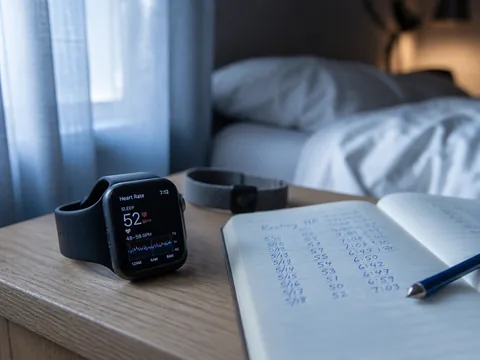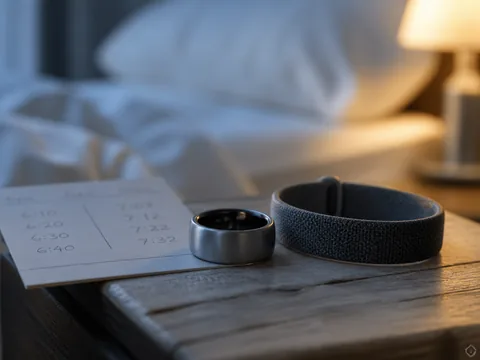
The rumor arrived the way they always do. A firmware beta, a string of model numbers nobody recognized, a screenshot on a forum, four hundred replies arguing about whether it meant a new sensor or a new watch face. Three weeks later the outgoing model was $130 off on Amazon.
Both of those things are real. Only one of them has anything to do with your sleep.
I have watched the price history on Garmin smartwatches long enough to set a calendar by it: leak season, then discount season, then launch, then the discount quietly evaporates. It is a good system if you are patient and mildly cynical. What it is not is a reason to wait — not if the thing you're waiting for is a watch that will finally explain why a late cold brew cost you an hour of deep sleep.
Here is the number that started this piece. On a night I had a double espresso at 5:40 p.m., my watch gave me a sleep score of 84 and the word Good. The next morning I felt like a rumor of myself.
What most people do when the rumors start
Two things, usually, and they contradict each other.
The first is waiting. Somebody pulls unreleased hardware IDs out of a beta firmware file — this is a real cottage industry, and sites like the5krunner have been doing it for years with a decent hit rate — and the thread fills with people saying they'll hold off until the next Fenix or the next Forerunner, because this is the generation that gets blood pressure, or cleared sleep apnea detection, or sleep staging that finally agrees with how they feel. So they wear a four-year-old tracker for another eight months, on the theory that the good data is coming.
The second is buying anyway, because the leak knocked $130 off the model that's about to be superseded, and then treating whatever the new watch says about last night as a grade. Score of 84. Deep sleep: 41 minutes. Body Battery recharged to 76. The numbers arrive with a confidence that the underlying measurement does not have, and most people — reasonably, because who has time — read them the way you'd read a thermometer.
The discount is genuinely worth having. Garmin runs a wide catalog with a long tail, so the previous generation stays on shelves, and the price floor drops when a successor is imminent and again during the late-summer and Black Friday windows. If you want a rule for the shopping half of this: the leak is the buy signal, just not for the reason the thread thinks. It's a buy signal for the old watch.
But the grading half is where it goes wrong. The rumor cycle trains you to believe the limiting factor is hardware — one more sensor, one more FDA clearance, one more algorithm update, and the black box of your own night will finally open. That belief is doing a lot of work, and it is mostly unearned.
What the evidence suggests
The eight hours after your last cup
Walk it through in the order it actually happens.
You drink the espresso at 5:40. Caffeine is absorbed almost completely from the gut — close to 99% of it — and peak plasma concentration typically lands somewhere between 30 and 120 minutes later. Call it 6:30 p.m. for a rough peak. So far this is the part everybody knows.
What it does at peak is the part worth naming precisely. Caffeine is not a stimulant in the amphetamine sense; it doesn't add anything. It is an antagonist at adenosine receptors, principally A1 and A2A. Adenosine accumulates in the brain across your waking hours as a byproduct of energy use, and its binding is one of the signals that produces sleep pressure — the heaviness that makes 11 p.m. feel different from 11 a.m. Caffeine occupies the receptors so the adenosine can't dock. It does not clear the adenosine. The pressure keeps building behind a blocked door.
Then the arithmetic. Caffeine's half-life in healthy adults runs roughly 2.5 to 6 hours, with 5 being a serviceable average, and the individual spread is wider than the average suggests. Oral contraceptives roughly double it. Smoking roughly halves it. Pregnancy stretches it dramatically — into the double digits in the third trimester. If your half-life is 5 hours and you took in about 150 mg at 5:40 p.m., you still have something like 75 mg on board at 10:40 and around 37 mg at 3:40 a.m. That second number is the interesting one, because it's circulating during the hours when your sleep is supposed to be consolidating.
And the receptor blockade doesn't announce itself. Landolt and colleagues (1995, Neuropsychopharmacology and a companion paper in Brain Research) gave a small group of young men 200 mg of caffeine in the morning — around 7 a.m. — and recorded their sleep EEG that night. Sleep efficiency dropped and low-frequency delta activity, the electrical signature of deep slow-wave sleep, was reduced. From a morning dose. A dozen or so subjects, so hold it loosely, but the direction has held up.

The study people usually reach for is Drake et al. (2013), Journal of Clinical Sleep Medicine: 12 subjects, 400 mg of caffeine — a large dose, roughly four cups of drip coffee — administered at 0, 3, and 6 hours before bedtime. Even the 6-hours-before condition significantly reduced total sleep time. The finding that matters most for anyone wearing a tracker is the secondary one: the subjects' own ratings of their sleep didn't reliably catch the disruption the recordings caught. They felt fine. The machine disagreed.
The most useful recent synthesis is Gardiner et al. (2023) in Sleep Medicine Reviews, a systematic review and meta-analysis of caffeine's effect on subsequent sleep. Its headline recommendation was a cutoff of roughly 8.8 hours before bed for a standard-ish dose around 107 mg, stretching to about 13.2 hours for a stronger 217.5 mg dose. Those precise decimals are an artifact of modeling pooled data, not a law of your particular liver, and the authors are clearer about that than the headlines were. But the shape of the answer — the honest cutoff is much earlier than the folk wisdom of "nothing after dinner" — is well supported.
What a wrist can actually see
Now the other half of the machine.
A wrist wearable infers sleep from three inputs: an accelerometer measuring movement, a photoplethysmography sensor — green and sometimes red/infrared LEDs reading blood volume changes through the skin — and the heart rate variability derived from that pulse signal. Garmin's readiness and recovery metrics, including Body Battery, descend from Firstbeat Analytics, the Finnish physiology firm Garmin acquired outright in 2020. It is a genuinely sophisticated stack of inference. It is still inference. Polysomnography, the clinical reference standard, stages sleep from brain electrical activity, eye movement, and muscle tone. Your wrist has access to none of those.
How much does that cost in accuracy? Chinoy and colleagues (2021), in the journal Sleep, put seven consumer sleep trackers against in-lab polysomnography in 34 healthy adults — one of the devices was a Garmin Vivosmart 4. The pattern that emerged is consistent across this literature: the devices are very good at knowing you're asleep, with sensitivity generally in the mid-90s, and considerably worse at knowing you're awake, with wake specificity for several devices falling below 0.5. In plain terms, a wrist tracker's default assumption is that a still body is a sleeping body. Sleep-stage classification — the deep/light/REM breakdown people screenshot and argue about — performed meaningfully worse than the simple sleep/wake call.
So, sorting honestly:
Well-established. Caffeine antagonizes adenosine receptors and suppresses slow-wave EEG activity. Late caffeine reduces total sleep time. Your subjective sense of last night is a poor instrument for detecting that. Wrist trackers estimate total sleep duration reasonably well.
Plausible but thin. That a specific number of "deep sleep minutes" from a wrist device tracks your actual slow-wave sleep closely enough to compare Tuesday against Wednesday. That genetics explain most of the person-to-person spread — the common citation is Rétey et al. (2007) in Clinical Pharmacology & Therapeutics, which linked an ADORA2A variant to caffeine-induced sleep disturbance in a small sample, and it's suggestive rather than settled.
Folk wisdom. "Caffeine doesn't affect me, I can have a coffee at 10 p.m. and sleep like a baby." You may well fall asleep. Drake's subjects fell asleep too.
Does a newer Garmin track sleep more accurately?
Probably not by much, and not in the way you're hoping. Generational updates mostly add sensor channels — more LED wavelengths, better skin-temperature sampling, cleaner signal processing — plus new metrics computed from data the previous watch was largely already collecting. The bottleneck is not the sensor. It's the inference problem: predicting what a brain is doing from a pulse waveform at the wrist. A newer watch narrows that gap incrementally. It does not close it, and no announced or rumored feature closes it, because closing it would require measuring something the wrist doesn't have access to.
The clearest evidence for this is Garmin's own behavior. If wrist-based sleep tracking were one firmware update from solved, the company would not have released the Index Sleep Monitor in 2025 — a dedicated upper-arm band, worn above the bicep where the tissue is deeper and the signal is steadier, sold specifically because the wrist is a compromised location for overnight physiology. That's not a company confident its watches have this handled. That's a company routing around a hardware limit with different hardware.
What does improve between generations is worth naming fairly, because it isn't nothing: display readability at 3 a.m., battery life long enough that you actually keep the thing on overnight instead of charging it while you sleep, and multi-band GPS if you run in cities. Compliance is a real accuracy input. A watch you wear every night gives you a more useful baseline than a better watch you charge at bedtime.

The rumor categories that recur each cycle — expanded blood pressure estimation, cleared apnea screening, refined sleep staging — are plausible product directions. Treat them as directions, not as specifications, until Garmin says otherwise. And notice that none of them would change what your last cup of coffee did to your delta power.
What I actually do
I buy the outgoing model during leak season, and I ignore most of what it tells me about sleep in favor of two numbers.
On the buying: the segmentation below is what I'd actually recommend to someone asking, with prices as the discount floors I've watched hold rather than any live quote — they move, check before you click. The last column is the one I care about here.
| Tier | Who it's for | What I'd buy on discount | What changes for your sleep data |
|---|---|---|---|
| Entry, ~$150–250 | Beginners, step-and-sleep tracking, first structured training | Vivoactive 6, Forerunner 165 | Nothing meaningful. Same inference stack. |
| Mid, ~$250–400 | Regular runners, first half or full marathon | Forerunner 265, Venu 3 | Better display and battery, so better overnight compliance. |
| Multisport, ~$400–700 | Triathlon, long trail days, backcountry | Forerunner 570/970, Instinct 3 | Battery life you won't interrupt to charge. |
| Flagship, $700+ | Expedition, dive, people who want everything | Fenix 8 | Marginal sensor gains; not a different category of sleep truth. |
And on the reading: I look at total sleep duration and resting heart rate, and I largely ignore the composite sleep score. Duration is the metric these devices estimate best. Resting heart rate — particularly the overnight low and when in the night it arrives — is derived directly from the pulse signal rather than inferred through a staging model, and it's the number that moves most legibly when I've had alcohol, a hard evening session, or caffeine too late. An overnight low that shows up at 2 a.m. instead of midnight is telling me my nervous system spent the first third of the night still working.
The deep-sleep minutes I treat as a weekly trend line and never as a nightly verdict. Night-to-night, that figure is doing more estimating than measuring.
Then there's the experiment, which costs nothing and is the only part of this that will tell you about you rather than about a pooled average. For two weeks, hold your last caffeine to at least ten hours before your intended sleep time — 9 a.m. if you're aiming for a 10 p.m. lights-out, which will feel absurd for about four days. Change nothing else: same bedtime, same alcohol, same training. Then compare the two weeks on duration and overnight resting heart rate, not on the score.1
Ten hours is deliberately conservative — it sits past Gardiner's 8.8-hour estimate for a modest dose, because most people underestimate what they actually drank and because if your personal half-life runs long you'd never find out from a shorter test.
The honest rule of thumb: count back ten hours from when you want to be asleep, make that your cutoff for one week, and judge it by your total sleep time and your overnight low heart rate — never by the score the watch puts on the screen at 7 a.m.
If two weeks of that produces nothing — same duration, same overnight low, same mornings — then you have learned something genuinely useful about your own physiology, and you can have the 4 p.m. coffee with a clear conscience. That's a better outcome than any firmware update was going to hand you.
The watch I'm wearing while I write this is two generations behind. It was $140 off the week its replacement leaked. It measures my sleep with the same fundamental uncertainty as the one being announced next month, and it has told me, over about eighteen months of paying attention, exactly one thing I didn't already suspect: my cutoff is closer to 1 p.m. than to 5 p.m., and I had been wrong about that for years.
The myth: the next generation of Garmin smartwatches will finally reveal what caffeine is doing to your sleep, so it's worth waiting.
The more accurate version: the discounted watch already on your wrist can see the effect well enough to catch it, if you stop reading the score and start moving your last cup earlier — and no sensor Garmin ships next year will change what adenosine does at 3 a.m.
-
Garmin Connect lets you log caffeine intake manually, and it's worth doing for the two weeks purely so you have honest dose-and-time records instead of a memory of "a couple of coffees." Also, be aware that some of Garmin's newer analytics live behind Connect+, the subscription tier introduced in 2025 — the core sleep duration and heart rate data do not, which is convenient, because those are the two you actually need. ↩