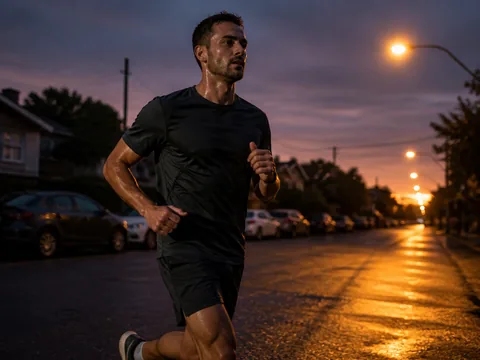
For six weeks I have been running the same flat 5 km loop at 6:45 p.m. — the hour when caffeine stops being a productivity question and becomes a sleep question. In mid-July I swapped my own running playlists for the Spotify Fitness hub, mostly out of professional curiosity about how Running Mode's tempo matching actually behaves on a real road. The first thing I noticed had nothing to do with music. On the nights I let the app drive, I fell asleep the way I do on a rest day. On the nights I had my usual pre-run espresso, I did not.
So I ran it properly. Fourteen evenings, four conditions, one watch, and a sample size I will keep apologising for throughout.
The verdict: Spotify's fitness tab is not a music feature with running paint on it — it is a stimulant product, and it bought me most of caffeine's pace benefit at none of caffeine's bedtime cost.
The myth, said out loud
The claim I wanted to test is one you have almost certainly heard, usually from someone fit and slightly evangelical: a good playlist is a pre-workout you can't overdose on. Music at the right tempo lifts output, therefore it is interchangeable with the mild stimulant you would otherwise take. Caffeine and BPM are two doses of the same thing, and the free one has no downside.
It is a smart myth, which is why it survives. The half that is true is genuinely true: the relationship between music tempo and perceived exertion has been understood for decades, it is not a wellness-blog invention, and anyone who has accidentally run a mile too fast because a song landed right has felt it. The half that is wrong is the word interchangeable. Both things raise arousal. Only one of them is a drug, and the difference between a state and a substance turns out to be worth about seventeen minutes at bedtime.
What I ran, and what I measured
Fourteen runs across twenty-four days. Same loop — 5.02 km, 31 m of elevation, two traffic lights I stopped at consistently. Start time 6:45 p.m. ±10 minutes. Air temperature between 17 and 23°C on every run; I threw out two hot evenings rather than pretend they belonged in the set.
Four conditions, rotated rather than blocked:
- Neither — my own running playlist, no caffeine after noon. Four runs.
- Caffeine only — 100 mg (one double espresso, home machine, weighed dose) at 5:45 p.m., my own playlist. Three runs.
- Hub only — Running Mode, no caffeine after noon. Four runs.
- Both — 100 mg at 5:45 p.m., Running Mode. Three runs.
Pace came off watch GPS. Rate of perceived exertion went into a voice memo within two minutes of stopping, on a 1–10 scale I have used long enough to be internally consistent even if it means nothing to you. Sleep onset latency and wake-after-sleep-onset came off a wrist wearable, with bedtime held between 10:45 and 11:15 every night, including the two nights I did not want to.
What I could not do: blind myself. There was no decaf placebo, so I always knew which arm I was in, and expectancy is a real confound in exactly the two columns I care about. The wearable estimates sleep onset from movement and heart rate; it is not a sleep lab, and it is known to be generous. Three runs per cell is not a study. Work stress, hydration, and one mild head cold went uncontrolled. Read the following as one person's field notes with timestamps, not as evidence about you.
The evidence: fourteen evenings
| Condition | Avg 5 km | RPE (1–10) | Sleep onset | Awake after onset |
|---|---|---|---|---|
| Neither | 29:14 | 6.8 | 14 min | 22 min |
| Caffeine only | 28:02 | 6.4 | 31 min | 41 min |
| Fitness hub only | 28:31 | 5.9 | 15 min | 19 min |
| Both | 27:48 | 5.6 | 34 min | 46 min |
Reading the table honestly
Start with the column that does not hold up. My run-to-run spread within a single condition was ±35 seconds, and the entire range across conditions is 86 seconds. The pace column is suggestive and nothing more. If you want to conclude from this that caffeine makes you 72 seconds faster over 5 km, you are reading noise with a confident face on.
The RPE column I trust more, not because the numbers are bigger but because they moved in the same direction every single time. Every hub run felt cheaper than every non-hub run at comparable pace, without exception, and the two conditions that included Running Mode produced the two lowest scores in the set. A nine-tenths difference on a subjective scale is not much. Fourteen out of fourteen runs agreeing on the direction is.
The sleep column is the only place where the gap dwarfs the noise. Caffeine nights roughly doubled my time to sleep and doubled the minutes I spent awake afterwards. Hub-only nights were indistinguishable from no-stimulus nights — 15 minutes against 14, which is well inside the wearable's own error. And the both row is the one that settles it: adding Running Mode to a caffeinated run did nothing to rescue the night. The cost tracks the espresso, not the effort, not the arousal, not the fact that I finished a hard run ninety minutes before getting into bed.
The hub got me most of the caffeine's benefit and none of the caffeine's bill.

The mechanism: two different kinds of up
This is where the myth's interchangeable falls apart, and the reason is boring pharmacology.
Caffeine works by sitting on adenosine receptors so the molecule that signals sleep pressure cannot dock. That blockade does not know I have stopped running. With a half-life of roughly five hours, a 100 mg dose at 5:45 p.m. leaves something in the region of 50 mg still circulating when I get into bed at 10:45 — which is not a large amount, but it is emphatically not zero, and it is the amount arriving at exactly the moment I need adenosine to be doing its job. The dose was never really "one espresso before the run." It was one espresso before the run and half an espresso at lights-out.
Music raises arousal by a completely different route. Tempo entrainment pulls cadence toward the beat — your legs negotiate with the track, usually without your permission. Attentional dissociation does the rest: attention goes outward, onto the music, and away from breathing rate, leg burn, and the interoceptive traffic that constitutes "this is hard." The work does not get easier. The accounting of the work gets cheaper. Both effects are state, not substance, and both end within one song of taking the headphones off.
Audio has no half-life. That is the entire finding, and it is also, I think, the entire product thesis.
It cuts the other way too, and the hub's boosters should be honest about it. Because the effect is attentional rather than metabolic, it cannot lift the ceiling — it can only make the ceiling feel further away. Caffeine can genuinely borrow a little capacity against tomorrow. Running Mode cannot lend you anything you do not already have in your legs that evening. On the two runs where I was actually tired, tempo matching produced a slightly faster start and a worse second half, which is the signature of a dissociation effect writing cheques the body declines.
Why a music company builds a gym
I should be clear about my footing here: I did not get a briefing, an interview, or anyone at Spotify explaining the roadmap to me. Everything in this section is read off the product surface — what shipped, what didn't, what got a partner logo — which is a weaker source than a conversation with the person who built it. Where I am guessing, I will say so.
The cheap read on the fitness push is engagement: another daypart, more minutes, a reason to open the app while your hands are busy. That is real but it is not interesting, and it does not explain the specific shape of what shipped.
The more interesting read is that Spotify has been in the arousal-management business for about a decade without naming it. Focus playlists lower distraction. Sleep and ambient catalogs lower arousal outright — it has been one of the most-streamed non-music categories on the platform for years. What the company has never had is a surface where the claim is legible. "This playlist helps you concentrate" is unfalsifiable marketing. "This feature matched my cadence to 172 BPM and my perceived effort dropped" is a demonstrable product behaviour, and Running Mode is the first thing Spotify has shipped where the arousal claim can be checked by the user in real time on the road.
Once a product can credibly say we can move your state upward on demand, the same machine runs in reverse. Down-regulation needs no hardware partner, no coaching license, no third-party integration, and no new catalog — Spotify already owns more wind-down audio than anyone. If I were writing the strategy memo, the fitness tab would be the expensive, visible half whose real job is establishing the mechanism, and the sleep half would be where the margin lives.
The Peloton tie-up fits this reading in a way I find slightly telling. It buys distribution and borrowed credibility with an audience that already believes in structured training. It also amounts to a decision not to build the human coaching layer in-house — the parts that need a person are outsourced, the parts that need a catalog stay home. That is a sane call, and it is also a ceiling. It means the fitness surface will keep getting better at audio and will stay dependent on partners for everything that resembles instruction.
Where I think the strategy is currently incomplete: the hub is all up and no down. The people most likely to use it are evening exercisers, and evening exercisers are precisely the population with a sleep problem — which my own fourteen nights, small as they are, put a number on. Right now the app raises my heart rate to 130 at 7:15 p.m. and then returns me to the same home feed I would have seen at lunchtime. The company that ships the descent — the same tempo logic pointed the other way, from finish line to lights-out — owns a daypart nobody currently owns. That one is a guess. It is the guess I would bet on.
Spotify's hub vs. Apple Fitness+ vs. the playlist you already made
Three criteria, since "which is better" is not a question: effort cost (what you have to do to get value), arousal precision (how well it hits the state you wanted), and ceiling (how good it gets once you know what you're doing).

The Fitness hub wins effort cost outright and it is not close. You open a tab, you start running, tempo tracking does the rest, and the value shows up on the first run with no setup. Arousal precision is decent and reactive. The ceiling is low, because there is no way to tell it what you want — only to let it observe what you are already doing.
Apple Fitness+, which I used for a year and still dip into, is the opposite trade. Effort cost is high: you are committing to a class, a screen, a duration, and a coach's plan for your next thirty minutes. Arousal precision is the best of the three, because a human being is deliberately shaping the curve. The ceiling is high and it belongs to the coach, not to you — which is fine until you want to run your own session.
Your own playlist has the worst effort cost by a distance. Mine took years and I still re-sequence it. But the ceiling is the highest of the three, because you know things about yourself that no tempo detector can infer — that a particular track at minute 22 will get you up the hill, that the song you love is the wrong song at kilometre one. Arousal precision is excellent and completely static; the playlist cannot adapt when the day is worse than you planned for.
That is where I sit, and I want to be honest that it makes my endorsement narrower than it might read. I build my own running playlists, I like them, and on four of five evenings I would still rather listen to mine. The hub wins on exactly one axis — and that axis happens to be the one that costs me sleep.
What the hub still gets wrong
Tempo tracking lags. On the one real climb in my loop, cadence drops immediately and the music follows roughly fifteen to twenty seconds later — which means the slow track lands as I crest and start accelerating again. It is a following algorithm applied to a domain where the useful signal is what happens next.
There is no way to set a target. I cannot say "hold me at 170 BPM for eight minutes," which is the single most useful thing tempo-matched audio could do for anyone working on cadence. The feature observes; it will not lead. For an interval session this is backwards, and it is the reason I abandoned two attempts at structured work during the test period.
The catalog skew is real. The tempo pools lean heavily on a handful of genres, and the 165–175 BPM material I actually own — a lot of it drum-and-bass and older punk — barely surfaced. Some of that is a licensing and metadata problem rather than a design one, but the user experience is the same: it plays a correct-tempo song rather than my correct-tempo song.
The data flows one way. After fourteen runs the app still had no visible idea that I am a person who runs on Tuesdays and Thursdays at a quarter to seven. Nothing about a finished workout shaped what came next, in the hub or anywhere else in the app. For a product whose entire strategic advantage is knowing what you listen to and when, that is a strange gap.
And the front door is a grid. If you already know you want tempo-matched running audio, you are three taps from happy. If you opened the tab because a friend mentioned it, you are looking at a wall of tiles with no obvious entry point, and the best feature in there is not the one with the largest tile.
Who this is for — and who it isn't
It's for you if you exercise in the evening and currently caffeinate to get out the door. That is the whole case, and for that person it is a genuinely good one: you are paying for your workout twice, and this is the cheapest available way to stop. It is also for people who have never built a running playlist and are not going to start, and for anyone who runs by feel and would like the same run to cost less subjectively.
It isn't for you if you train in the morning. The sleep argument evaporates entirely at 7 a.m., caffeine is the better ergogenic aid on every axis I measured, and you should just have the coffee. It is not for anyone doing prescribed cadence or interval work, because a feature that follows you cannot pace you. It is not for people who already own a running playlist they love — I am one of them, and on most days I go back to mine. And it is not for anyone hoping for coaching; the coaching lives with the partners, and it shows.
The honest takeaway
The myth is wrong where it counts and right where it counts, which is the most annoying kind of myth. A playlist is not a substitute for caffeine — caffeine is still better at making you fast, and no amount of tempo matching lends you capacity you do not have that day. But the myth is pointing at something true that gets lost in the argument about which one works: they do not clear the same way. One of them ends when the run ends. The other is still in your bloodstream when you turn the light off, in an amount small enough to ignore and large enough to cost you half an hour.
The Fitness hub was the only stimulant I tested that stops working the moment I want it to.
If your workout starts after 5 p.m., let the playlist do the stimulating and keep the caffeine for the morning.


