Eight thousand feet is the ceiling. That's the highest cabin pressure altitude the FAA permits a commercial airliner to hold at cruise, and at that altitude the median healthy adult's blood oxygen saturation settles around 89 percent — awake, seated, doing nothing in particular. Most guides to sleep apnea travel logistics open with packing cubes and TSA scripts. Those matter, and I'll get to them. But they sit downstream of that number, and the number is the reason any of the rest of it is worth the trouble.
Eighty-nine percent is also, in American respiratory medicine, a bureaucratically loaded figure. Medicare will pay for home oxygen at a resting saturation of 88 percent or below. A cabin at cruise puts a healthy person roughly one percentage point above the line that qualifies someone as needing supplemental oxygen at home. Nobody is harmed by this. Airlines have been flying that way for decades. But it does mean that the environment you're bringing your apnea into is not neutral.
Where 89 percent comes from
The source is Muhm et al. (2007), New England Journal of Medicine. The researchers put 502 subjects in a hypobaric chamber and held them for 20 hours at pressures equivalent to 650, 4,000, 6,000, 7,000, and 8,000 feet, with an actual in-flight arm for comparison. Oxygen saturation fell from about 97 percent at ground level to roughly 89 percent at the 7,000-to-8,000-foot exposures. Self-reported discomfort — headache, fatigue, general malaise — rose noticeably above 7,000 feet, and tended to appear three to nine hours into the exposure rather than immediately.
That study is the empirical backbone of the modern cabin-altitude standard. It is a good study. It is also, for our purposes, the wrong study, and it's worth being precise about why.
What the study did not measure
The subjects were screened healthy adults. They were seated. They were awake. And the primary outcome was how they felt, not what their airways did.
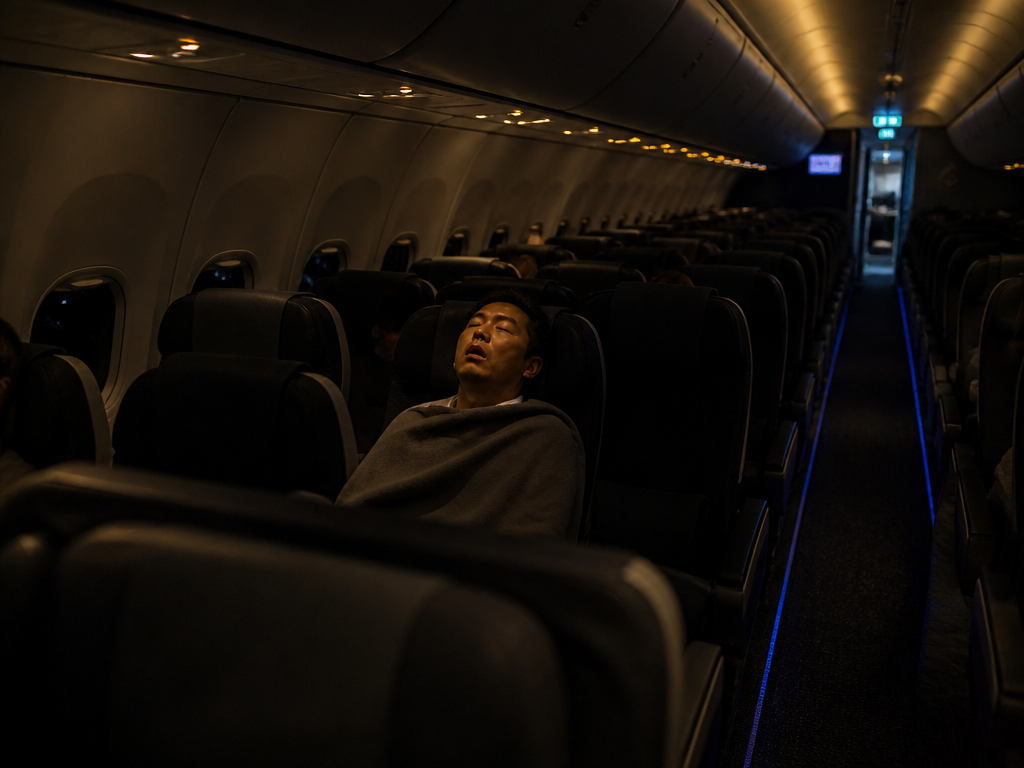
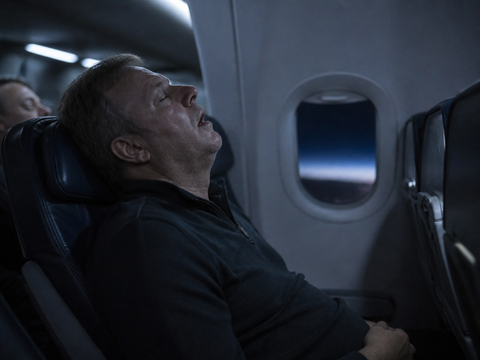
There was no polysomnography. Nobody was scored for apneas or hypopneas. Nobody with diagnosed obstructive sleep apnea was in the cohort, and nobody was asleep on their back in seat 34B with their jaw slack and their chin on their sternum. So 89 percent is not the average passenger's number. It is the floor for the easiest possible case: a healthy person, upright, conscious, breathing normally.
If you have moderate-to-severe OSA, you are not that case. You are the case that starts from a lower baseline and then does something — falling asleep — that the study deliberately excluded.
What happens in the cabin, in the order it happens
The door closes and the cabin climbs. By cruise, barometric pressure has dropped from about 760 mmHg at sea level to roughly 565 mmHg. The air mix hasn't changed; it's still 20.9 percent oxygen. What's changed is how hard that oxygen is being pressed into your lungs. The physiological equivalent is breathing about 15 percent oxygen at sea level.
Alveolar oxygen tension falls with it, from around 100 mmHg to somewhere in the low 60s. Here's where the shape of the oxyhemoglobin dissociation curve starts to matter. At sea level you sit on the flat shoulder of that curve, where a substantial drop in oxygen tension costs you almost no saturation. At cabin altitude you've slid down toward the knee — around 60 mmHg, around 90 percent — and below the knee the curve steepens hard. The same drop in tension now costs several times more saturation than it did on the ground.
Then you fall asleep. Ventilation drops on its own in NREM sleep, on the order of 10 to 15 percent. Genioglossus tone — the muscle activity holding your upper airway open — falls with it. Add a reclined seat, a flexed neck, and whatever you had to drink, and the airway narrows or closes exactly as it does at home.
But the arithmetic is different. An obstructive event that costs you eight points of saturation is a shrug at home: 96 down to 88, back up. Starting from 90, that same event lands you at 82, and it does it on the steep part of the curve, where recovery is slower and the dip is deeper.
And then the compensation arrives. Hypoxia stimulates the carotid bodies, you hyperventilate a little, CO2 falls — and if it falls below your apneic threshold, your brain simply stops sending the signal to breathe. That's a central apnea. Cycled, it becomes periodic breathing. Altitude does not just worsen obstructive apnea; it adds a second, different kind of event on top of it.
This is the part that surprises people who assume their machine covers everything. CPAP splints an airway open. It does not supply oxygen, and it does not restore your CO2 setpoint. The commonly cited work here comes from a Swiss group — Nussbaumer-Ochsner, Latshang, and colleagues took OSA patients from Zurich (about 490 meters) up to alpine villages at roughly 1,630 and 2,590 meters. Off therapy, their apnea-hypopnea indices rose sharply, and a large share of the increase was central events that had barely existed at low altitude. A companion trial published in JAMA in 2012 found that autoCPAP at altitude did what you'd expect — it controlled the obstructive events — while central events persisted.
Be careful how far you carry that. Those were multi-night stays at real altitude, and 2,590 meters is above any cabin you'll sit in. A pressurized cabin runs somewhere between about 1,800 and 2,400 meters equivalent, and newer composite-fuselage aircraft — the 787, the A350 — hold closer to 6,000 feet, which is a meaningfully gentler environment than a 40-year-old narrowbody. Extrapolating a week in Davos to a seven-hour flight is plausible, not established. The direction of the effect is well supported. The magnitude, on a plane, in a seat, for one night, is not.
Can you use a CPAP on an airplane?
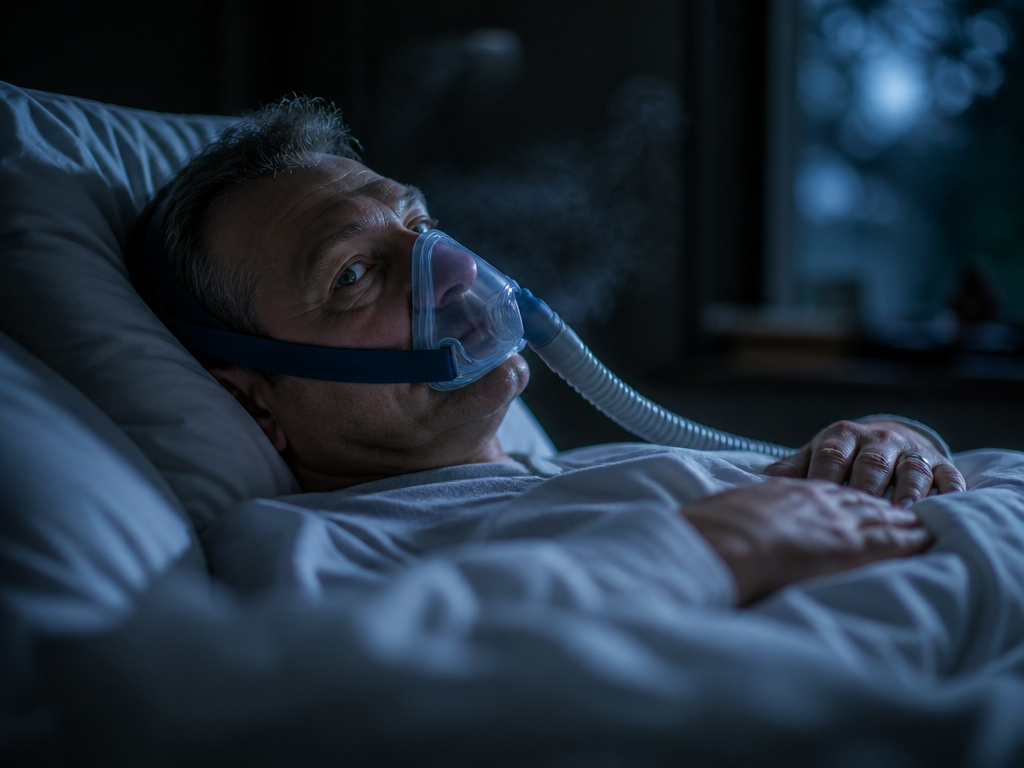
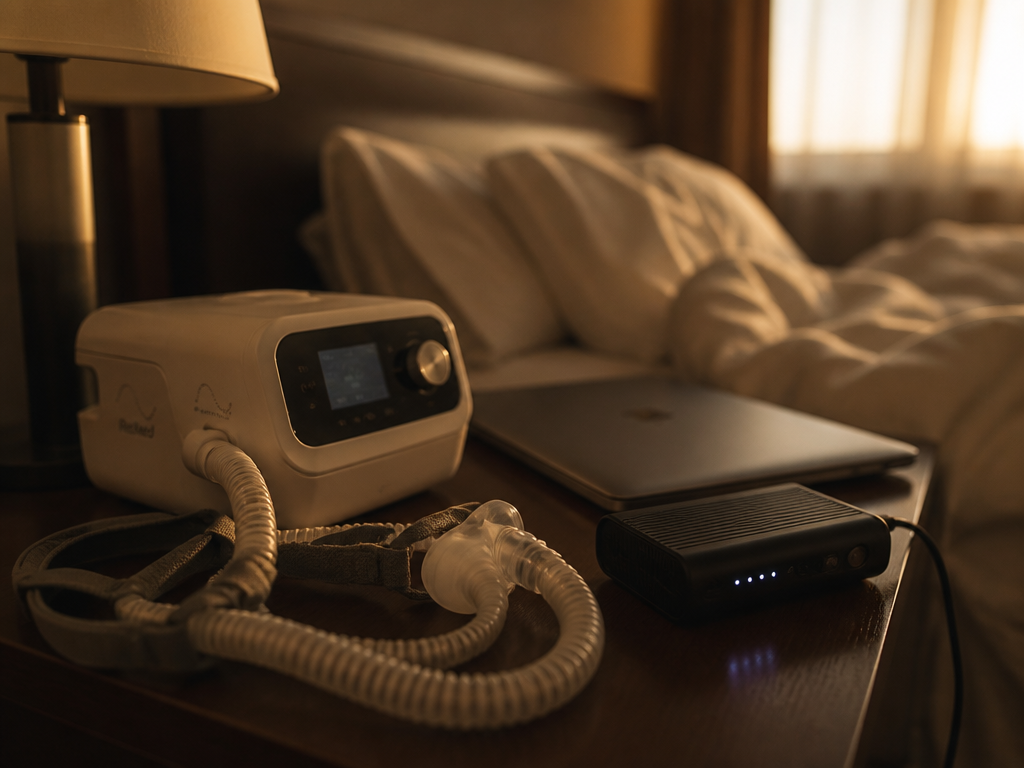
Yes. The FAA permits CPAP and BiPAP use in flight, and airlines cannot refuse a compliant device. The practical requirements are narrow: the machine must carry a manufacturer's label stating it meets RTCA/DO-160 requirements for onboard use (nearly all machines made in the last decade do), it must run on battery rather than aircraft power, and most carriers want notice — often 48 hours — plus enough battery capacity for roughly 150 percent of the scheduled flight time.
Don't worry about the paperwork side of this. A phone call to the airline's special assistance desk resolves it in about four minutes, and the note lands in your reservation.
Two practical notes the manuals bury. Run the humidifier dry — empty the chamber before you board, and don't fill it in the air, because cabin air is already arid enough that heated humidification mostly produces a puddle in the tubing and a much shorter battery life. And treat aircraft power outlets as a bonus, never a plan: they're current-limited, they cut out during certain phases of flight, and many won't carry a CPAP's draw at all.1
The screening part, which is the part people dread
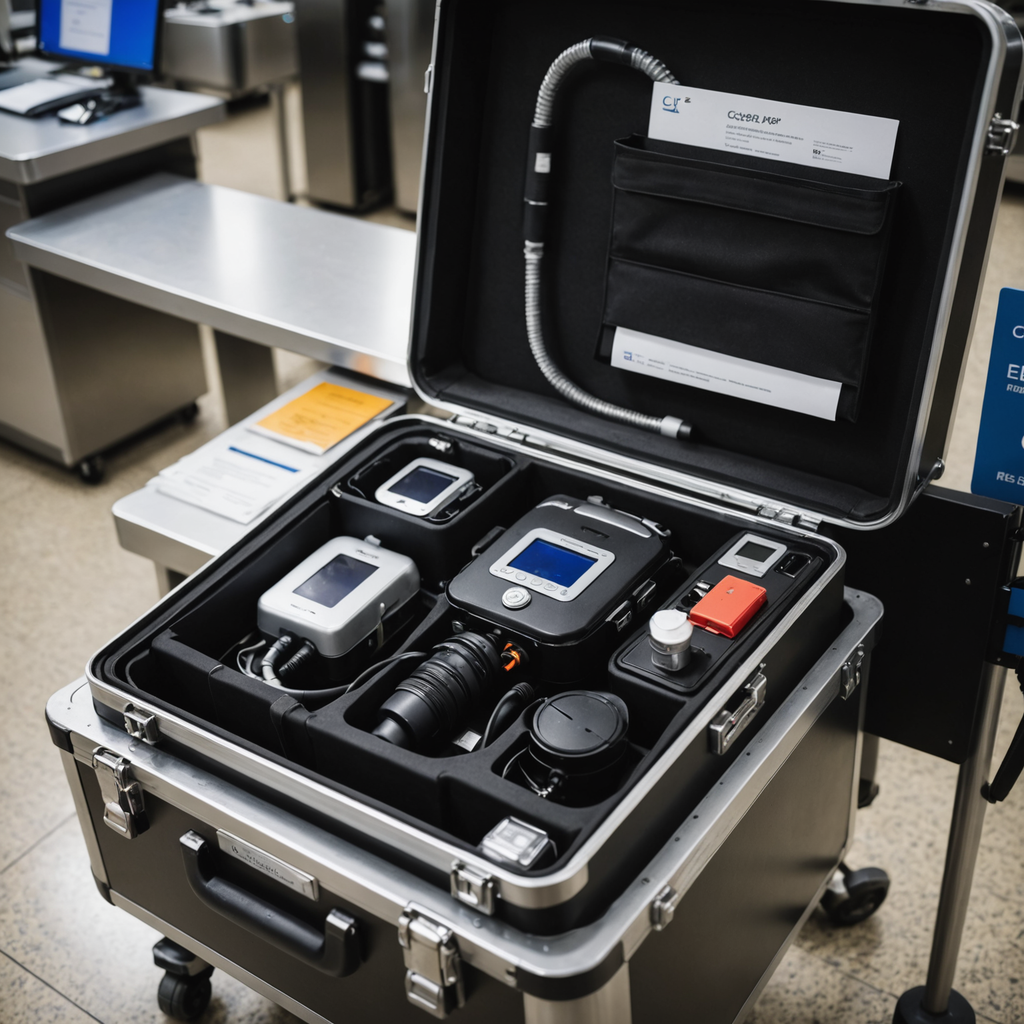
In the United States, a CPAP is a medical device and does not count against your carry-on allowance. It goes through the X-ray, usually removed from its case and placed in a bin, though you can ask for a protective liner or request a visual inspection instead. Mask and tubing can stay in the bag. Machines occasionally trigger a positive on explosive-trace swabs — glycerin and certain plastics do this — which means a few extra minutes and a supervisor, not a problem.
| Item | The rule | What it means in practice |
|---|---|---|
| The machine | Medical device; exempt from carry-on count | Never check it. Replacement abroad takes days, not hours |
| Lithium battery | Carry-on only; airline approval for >100 Wh | Confirm watt-hours before you buy, not at the gate |
| Distilled water | Subject to the 3.4 oz liquid limit | Buy it past security or at destination; tap water for one night is fine |
| Screening | X-ray or visual inspection, your choice | Say "this is a CPAP" up front and it takes 30 extra seconds |
An honest rule of thumb
If the flight is longer than six hours and you intend to sleep on it, treat it as a night: bring the battery, wear the mask, accept that you'll look like a person wearing a mask. If it's shorter than that, or if you'll be upright and awake, skip it — one nap without therapy is not the thing that will hurt you.
The thing that will hurt you is the eleven nights on the other end. The flight is a single exposure with a defined endpoint. A trip where the machine got left home, or the adapter didn't fit, or the hotel outlet was behind the bed, is the exposure that actually accumulates — untreated OSA rebounds within a night or two, and blood pressure follows it. Optimize for the destination. The plane is a rounding error by comparison.
I fly with a 97 Wh battery because it's the largest one you can bring aboard without asking permission, and I have used it exactly twice in three years. On most flights the machine stays in the bag under the seat, because most of my flights are five hours in daylight and I'm not going to sleep on them anyway. What I never do is check it. That's the whole practice: one battery I mostly don't need, and a bag that never leaves my hands.
-
If you fly a route regularly, it's worth knowing your aircraft type. A 787 or A350 holds a lower cabin altitude by design, which is not marketing — it's a couple of percentage points of saturation, and on the steep part of the curve those points are not interchangeable with the ones higher up. ↩