The number everyone quotes is 8,000 feet. That's the maximum cabin altitude the FAA permits inside a pressurized airliner — the thin-air equivalent your lungs are working against somewhere over Greenland while the cart comes through. It sounds fine. Denver sits at 5,280. People hike above 8,000 feet for fun and then eat a sandwich.
Sleep apnea travel logistics get complicated precisely because that number sounds tolerable. It is tolerable, for a person with a patent airway who is awake. It is a meaningfully different proposition for someone whose oxygen saturation already falls into the low 80s several dozen times a night at sea level. The problem isn't the altitude. It's the altitude arriving on top of a system that was already running with no margin.
So let's start with what the cabin does, because the mechanism explains most of the packing decisions that follow.
What the cabin actually does to an untreated airway
Commercial cabins are pressurized, but not to sea level. Most narrowbodies cruise with a cabin altitude somewhere between 6,000 and 8,000 feet. Newer composite-fuselage aircraft — the 787 and the A350 — hold closer to 6,000 feet, which is a real and underappreciated difference on a fourteen-hour sector.
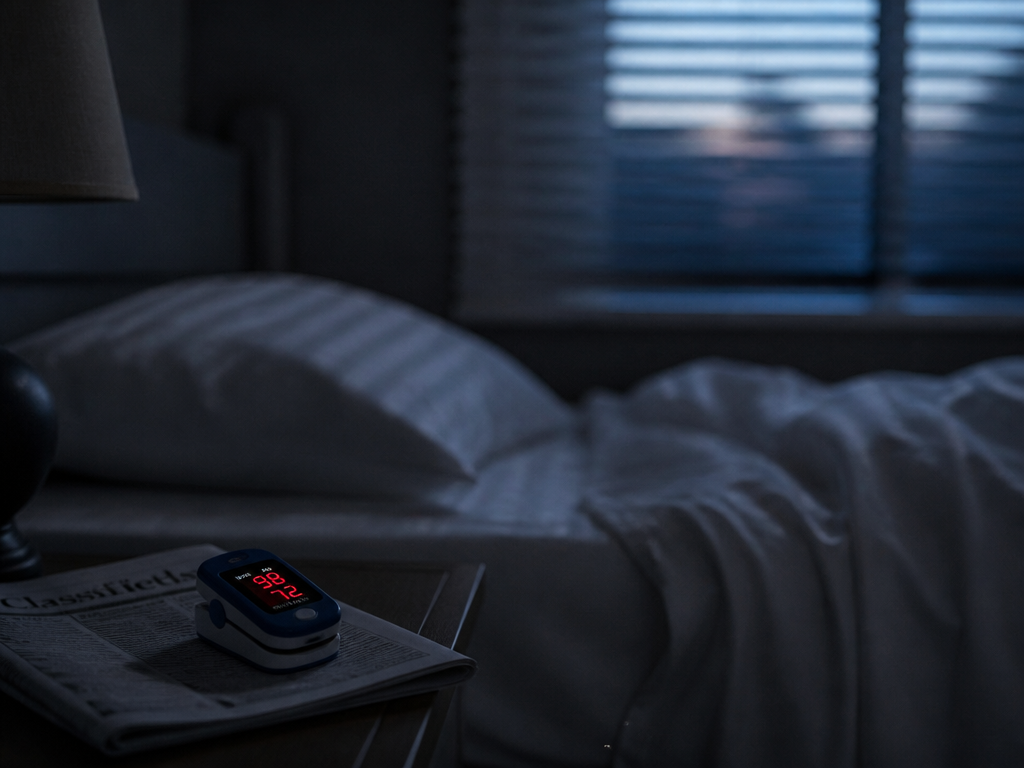
The commonly cited human measurement comes from Humphreys and colleagues (2005), in Anaesthesia, who put pulse oximeters on 84 adult passengers during ordinary commercial flights. Median saturation fell from about 97 percent on the ground to about 93 percent at cruise. Those subjects were healthy. Nobody was having an obstructive event.
The chain, in order
Here is the sequence as it actually unfolds in the body, from the door closing to the point where breathing goes strange.
The cabin climbs to its pressurization schedule. Ambient barometric pressure drops from roughly 760 mmHg to around 565. The fraction of oxygen in the air is unchanged — still about 21 percent — but the partial pressure is not. Inspired oxygen tension in the trachea falls from roughly 150 mmHg to something near 110. Functionally, you are breathing about 15 percent oxygen.
That pushes you leftward along the oxyhemoglobin dissociation curve. At 97 percent saturation you're on the flat shelf, where a big change in oxygen tension barely moves saturation at all. At 93 percent you're approaching the shoulder, where the curve turns and small further drops in tension produce large drops in saturation. This is arithmetic, not a study finding, and it's the whole story: an obstructive event that costs you 15 saturation points starting from 97 lands you at 82. The same event starting from 93 lands you in the mid-70s. The apnea didn't get worse. The starting line moved.
Then the body does something clever that makes it worse. Hypoxia stimulates the peripheral chemoreceptors in the carotid bodies, and ventilation increases. More breathing blows off carbon dioxide. Arterial CO2 falls. In wakefulness this is fine — you keep breathing because you have decided to. In NREM sleep, ventilation is under chemical control, and there is a CO2 threshold below which the drive to breathe simply switches off. That's the apneic threshold. Drop below it and you get a central apnea: no effort at all, no obstruction, just silence, until CO2 climbs back and the whole thing restarts. The pattern that emerges is periodic breathing, and it is layered on top of whatever obstructive disease you already had.
Nussbaumer-Ochsner and colleagues (2010), in Thorax, demonstrated this in the cleanest available way: they took OSA patients from Zurich at 490 meters up to intermediate altitudes near 1,600 and 2,600 meters, withheld CPAP, and re-polysomnographed them. Apnea-hypopnea index roughly doubled at the higher elevation, and a substantial share of the new events were central rather than obstructive. A follow-up trial from the same group — Latshang et al. (2012), in JAMA, randomizing 51 patients — found that autotitrating CPAP plus acetazolamide controlled breathing disturbance at altitude better than autoCPAP alone. Acetazolamide is a prescription decision and not one to make from an article, but it's worth knowing the option exists if your destination is Cusco or Lhasa rather than Lisbon.
One more piece of context, because it's the reason "I'll just skip it for a week" is a worse plan than it feels like. Kribbs and colleagues (1993) withdrew CPAP from treated patients for a single night. AHI returned to untreated baseline immediately — not gradually, not with a grace period. There is no therapeutic reservoir. Every night is settled on its own terms.
A caveat on the altitude data: those studies used mountain exposure, not aircraft, and their subjects were awake-then-asleep at altitude for hours to days. A red-eye is a shorter, shallower exposure. The direction of the effect is well established. The magnitude on any particular flight is an extrapolation.
Does a CPAP count as one of your carry-on bags?
No — not on a US carrier. Under the Air Carrier Access Act and its implementing rule, 14 CFR Part 382, assistive devices travel free of the standard carry-on allowance. Your CPAP goes in the cabin in addition to your bag and your personal item, at no charge, and airlines are required to accommodate it. You do not need to argue this at the gate, but it helps to be able to name the rule if someone tries.
Two qualifications. First, the exemption covers the device, not a suitcase you've packed around it — keep the machine, hose, mask, and power supply in a dedicated case and the exemption is unambiguous. Second, Part 382 binds US carriers and foreign carriers operating to and from the United States. On a purely intra-European or intra-Asian leg on a non-US airline, you are relying on that carrier's own policy, which is usually generous and occasionally not. Check the specific operating carrier — not the code-share marketing carrier — for any leg that never touches US airspace.
And don't check it. A CPAP in the hold is a CPAP that can arrive three days after you do, in a country where nobody stocks your mask cushion.
Three setups, four criteria
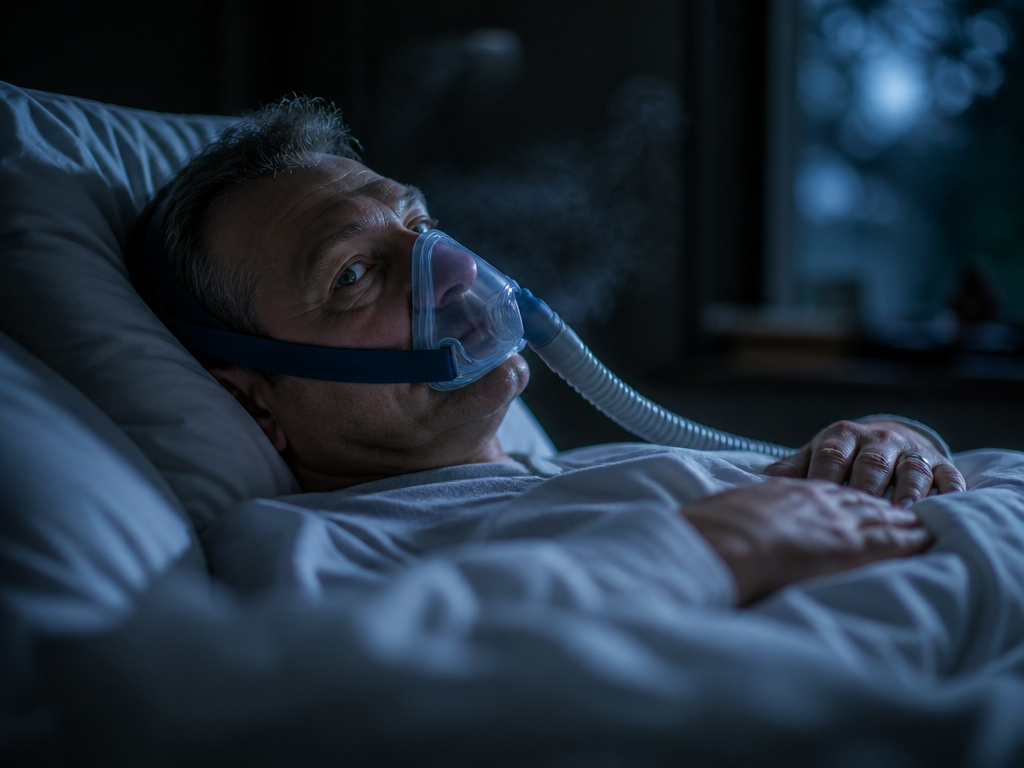
Most of the real decision-making in traveling with apnea comes down to one question asked before you pack: what, exactly, are you going to breathe through for the next twelve nights? There are three honest answers. Let's grade them against the same four criteria rather than the usual weight-and-cuteness comparison.
The criteria: therapeutic fidelity (does it deliver the pressure you were actually titrated to, with the humidification you actually tolerate); carried burden (mass, volume, and the number of separate objects that can be left in a hotel drawer); failure modes (what breaks, and how badly); and 2 a.m. recoverability (when it does break, in a foreign city, can you fix it before morning).

The home machine, hauled
Fidelity is perfect, by definition. It's the machine your titration was written for, with the humidifier setting you've spent two years dialing in and the mask that finally stopped leaking into your left eye.
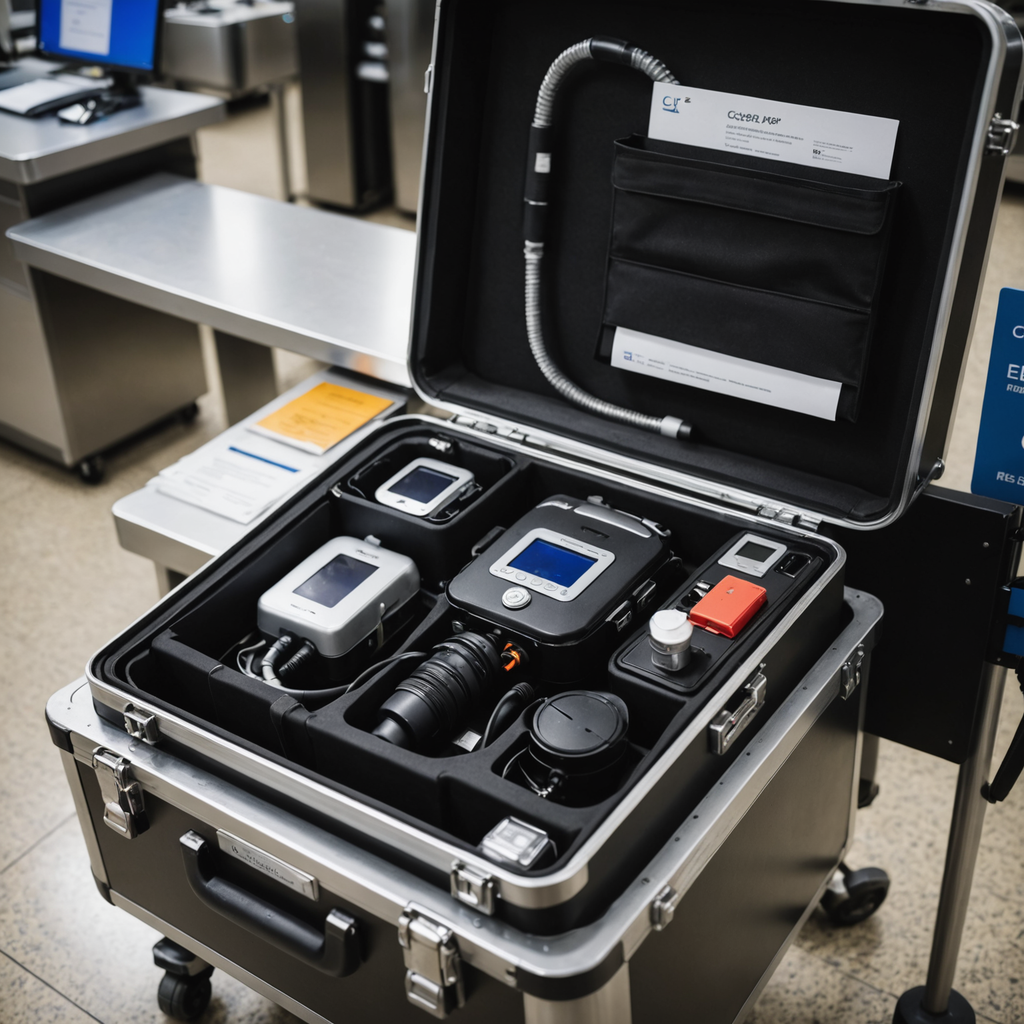
Burden is the honest cost. A full-size machine with an integrated humidifier runs roughly 3 to 4 pounds, and — this is the part people forget — the power supply brick is often the single heaviest component after the machine itself. Add hose, mask, filters, and a short extension cord, and you're carrying a small bowling ball in a bag that you must not put down.
Failure modes are boring, which is a compliment. The machine is proven. The things that go wrong are consumables and outlets: a torn cushion, a hotel nightstand with its only receptacle six feet from the bed, a humidifier chamber you have to fill with water of uncertain provenance.
Recoverability is good if you pack redundantly and poor if you don't. Nobody in Porto has your cushion size.
The dedicated travel unit
The category has gotten genuinely good. A ResMed AirMini is around 300 grams — call it two-thirds of a pound. A Transcend Micro is lighter still. A DreamStation Go sits in between with a more conventional feel.
Fidelity is where it gets interesting, and where the marketing is thinner than the confidence with which it's stated. These machines deliver real therapeutic pressure across the clinically normal range. What they generally do not deliver is heated humidification. Most use a waterless heat-and-moisture exchanger — a small hygroscopic cartridge in the circuit that captures exhaled moisture and returns it on the next breath. It works. It does not work as well as a heated chamber for people with significant nasal dryness, and if you're a 7-humidity-setting user in a dry hotel room, you will notice by night three.
Separately: several travel units use proprietary hoses and mask connectors. That is a fidelity issue disguised as a convenience feature. If your travel machine only accepts three mask models and none of them is yours, you are traveling on a mask you haven't slept in.
Burden is the obvious win. Failure modes are the obvious loss: a second machine is a second thing that can fail, and it's the one with the fewest hours on it. Recoverability is decent, because the whole unit fits in a coat pocket and the failure is usually the cartridge, which you can carry six of.
The device-free week
The third option is the one people take by accident and rarely plan for: no positive airway pressure at all, substituting a mandibular advancement device and deliberate positional therapy.
On fidelity it loses, and it isn't close. Custom oral appliances reduce AHI meaningfully — the working consensus from review literature, including Sutherland and colleagues' summaries, is roughly a 50 percent reduction on average, with full control in a minority of patients and a strong inverse relationship to baseline severity. If you started at an AHI of 60, halving it leaves you at 30, which is still severe.
But the comparison isn't as lopsided as fidelity alone implies, and this is the finding people underuse. Phillips and colleagues (2013), in the American Journal of Respiratory and Critical Care Medicine, ran a randomized crossover of CPAP against a mandibular advancement device in 126 patients. CPAP was clearly superior at suppressing AHI. Yet several downstream health measures — 24-hour blood pressure, daytime sleepiness scores — came out broadly similar, and the authors attributed it to adherence: people used the appliance more hours per night than they used the mask. Efficacy times hours-actually-used is the quantity that matters, and CPAP only wins that product when the mask is on.
Add positional therapy on top. A large fraction of OSA is supine-predominant — events cluster when you're on your back, because gravity, tongue, and soft palate cooperate against you. A tennis ball in a shirt pocket is folk wisdom with better-than-folk results in the positional subgroup, and a wedge that raises the torso 30 to 45 degrees is a cheap addition to a hotel room with too many pillows.
Burden: near zero. Failure modes: near zero. Recoverability: total, because there's nothing to recover.
| Home machine | Travel unit | Oral appliance + position | |
|---|---|---|---|
| Therapeutic fidelity | Exact, humidification included | Pressure yes, humidification approximated, mask options narrowed | ~50% AHI reduction on average; severity-dependent |
| Carried burden | ~3–4 lb plus brick, hose, mask, cord | ~0.5–2 lb, pocketable | Fits in a shirt pocket |
| Failure modes | Consumables, outlets, water quality | Second machine, fewest hours, proprietary parts | Jaw soreness, bite changes over months |
| 2 a.m. recoverability | Good with spares, poor without | Good — carry spare cartridges | Nothing to fix |
| Best for | Trips over ~10 days, reliable power, severe disease | Multi-leg trips, tight bags, moderate disease | The lost-luggage night, the flight itself, the backup you never unpack |
The verdict, such as it is
If your AHI is in severe territory and the trip is longer than about ten days, take the home machine. The burden argument loses to the fidelity argument once the number of nights gets large, and the machine you know is the machine that won't surprise you on night eight in a city where the pharmacy closes at six.
If the trip is short, or involves four segments and a bag you have to run with, the travel unit earns its place — provided you have slept on it at home for at least a week first, on a mask you own two of. A travel CPAP is a second machine, not a lighter version of your machine, and it deserves a domestic shakedown before it gets an international one.
The oral appliance is not a substitute and shouldn't be sold as one. It is, however, the single best thing you can put in your carry-on, because it covers the two situations neither machine covers: the flight itself, and the night your equipment doesn't arrive. Get one fitted by a dentist with sleep medicine training, not from a boil-and-bite kit. Then don't worry about it again until the night you need it.
What actually happens at the TSA belt
Short version, because this is where most of the anticipatory dread lives and it deserves about ninety seconds of your attention.

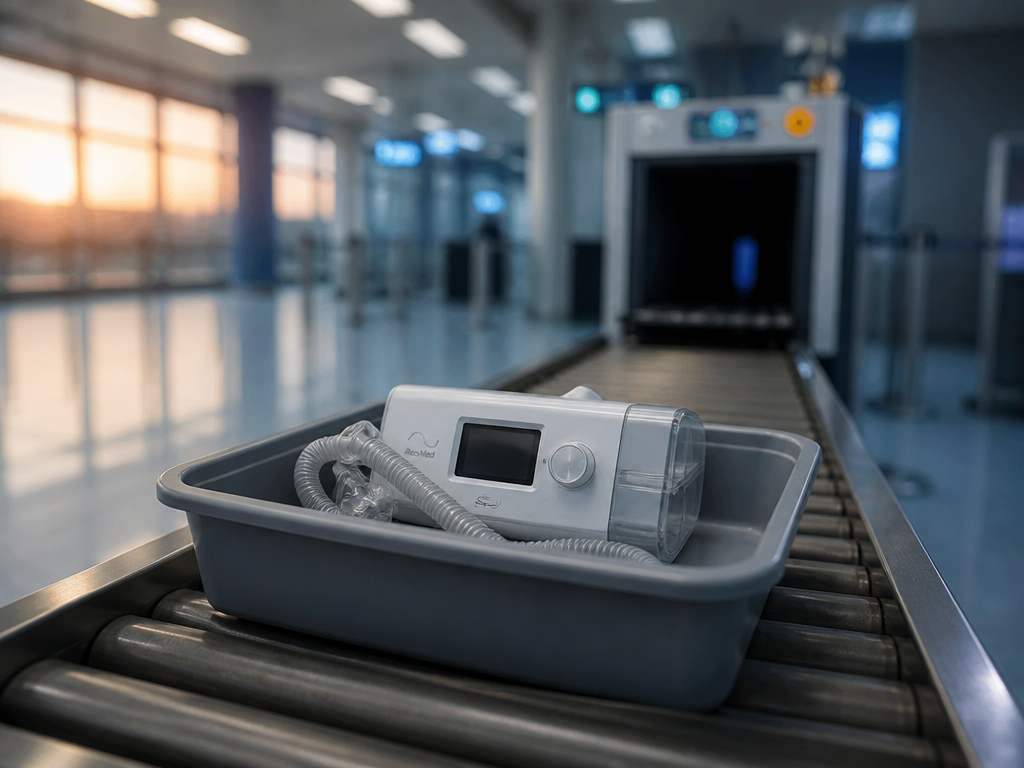
Take the machine out of its bag. It goes in a bin by itself, the way a laptop does — the dense motor and blower housing render as an opaque block otherwise. Mask and tubing can stay in the case. You may ask for a clean bin liner or bring your own gallon zip bag; officers are used to this request and it is not an imposition.
Expect an explosive trace detection swab. It's routine for medical devices, it takes fifteen seconds, and it means nothing about you.
Distilled water is a medically necessary liquid and is exempt from the 3.4-ounce rule in reasonable quantities. Declare it at the start of screening rather than letting it be discovered. Empty the humidifier chamber before you leave for the airport — a full chamber is both a liquid and a sloshing hazard in a bag that will be tipped sideways.
And bring the machine's prescription or a printed physician letter. You will almost never be asked. The exception is customs in a handful of countries where a bag search turns up an unfamiliar medical device, and the letter converts a twenty-minute conversation into a two-minute one.
The overnight flight is a different problem
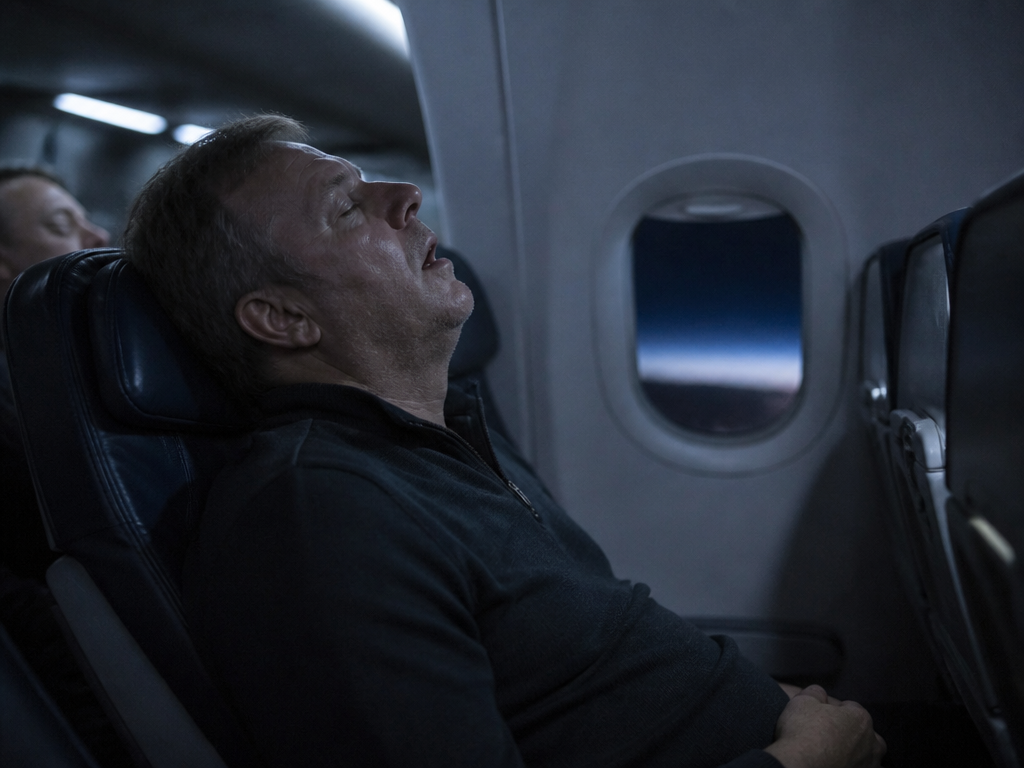
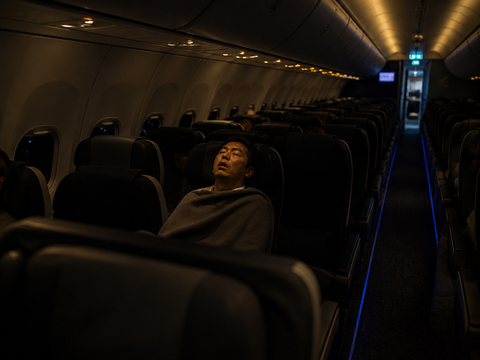
Using CPAP in seat 34B is legal and rarely worth it.
Legal, because the FAA permits CPAP use in flight for devices bearing the manufacturer's statement of compliance with RTCA DO-160 emissions standards — the label is usually on the underside of the machine. Most current ResMed and Philips units carry it. Airlines typically want 48 hours' advance notice, and some want a physician letter on file.
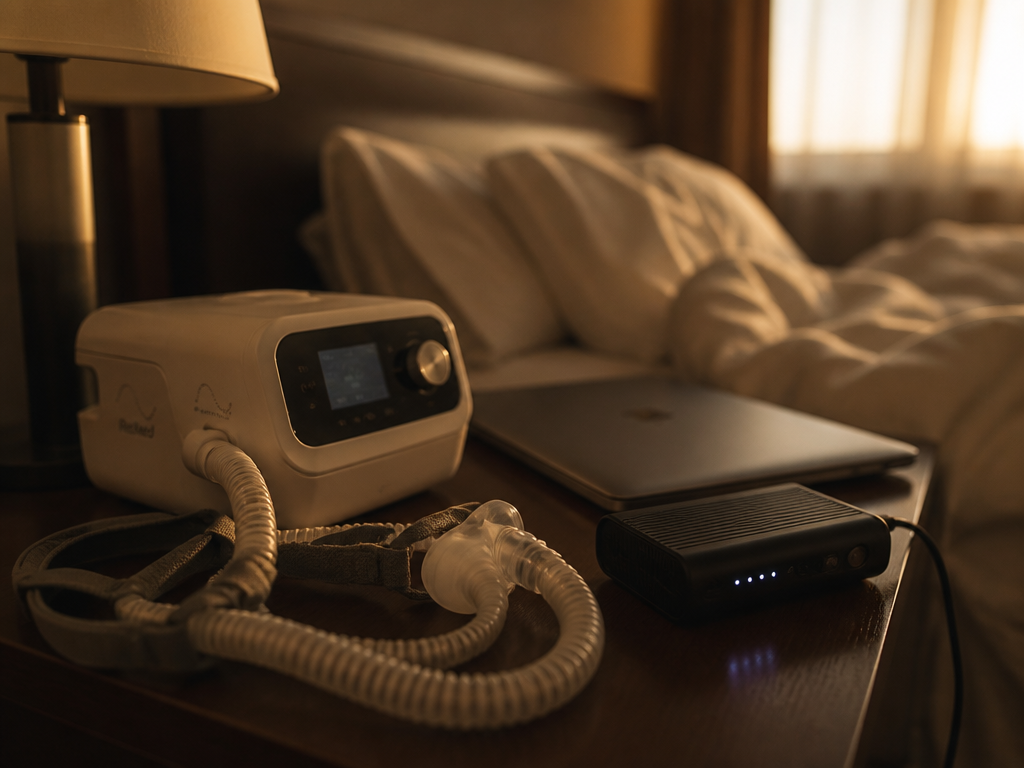
Rarely worth it, because of watt-hours. Aircraft seat power is not a permitted primary source for a medical device; you must be able to run the whole night on battery. Lithium-ion spares are carry-on only, freely permitted up to 100 watt-hours, and require airline approval between 101 and 160. Above 160 they are simply forbidden. The dedicated CPAP batteries sold for this purpose — the Medistrom Pilot-24 line, ResMed's Power Station II — are engineered to sit just under the 100 Wh line, which gives you roughly one night at moderate pressure with humidification off. On a seven-hour red-eye where you'll actually sleep for three, in a seat that keeps you semi-upright, the arithmetic frequently favors the oral appliance, an eye mask, and no alcohol.
That last item is not moralizing. Alcohol depresses genioglossus muscle activity — the tongue's protrusor — which is the specific muscle keeping your upper airway open in sleep. The observation goes back to Issa and Sullivan (1982): alcohol increases both the frequency and duration of obstructive events in people who have them. Two glasses of red at 35,000 feet is a pharmacological decision about your airway, taken at the moment your airway has the least margin.
Jet lag is a second machine breaking
Circadian realignment runs at roughly one hour per day traveling east and about an hour and a half per day traveling west. Six time zones east is therefore most of a week. During that week you are sleeping at biologically wrong times, which fragments sleep architecture, which increases the proportion of the night spent in the lighter stages where arousal thresholds are lowest — and untreated apnea is, mechanically, a disorder of arousal.
The practical lever is light, and the direction matters more than the dose. Traveling east, you want morning light at the destination and to avoid bright light in your local late evening. Traveling west, invert it: evening light, dark mornings. Low-dose melatonin — the 0.5 mg range, taken for phase-shifting rather than the 10 mg doses sold as sedatives — has reasonable support as an adjunct. Sedative-hypnotics are a genuinely unsettled area in this population; the data on whether z-drugs meaningfully worsen AHI in mild-to-moderate OSA is mixed, and it's a conversation for your prescriber, not a travel blog.
An honest rule of thumb for tonight
Pack the machine you were titrated on, and pack the oral appliance as the backup that never gets unpacked.
Before the trip, in this order:
- Confirm your power supply reads 100–240V, 50/60Hz on the label. If it does — and nearly all modern ones do — you need a plug adapter, not a voltage converter. Converters are heavy and can damage the machine.
- Pack two mask cushions and one spare filter. These are the parts that fail, and they weigh nothing.
- Throw in a six-foot extension cord. Hotel outlets are behind the headboard roughly half the time.
- Photograph your prescription and your machine's serial number and settings screen. Store both offline on your phone.
- Empty the humidifier chamber before leaving for the airport, and plan to use bottled water rather than tap where tap is questionable.
Don't worry about the checkpoint. Worry about the outlet.
What this piece didn't answer
Three things, honestly.
It didn't answer whether a week on an oral appliance instead of CPAP produces measurable harm. The physiology says your AHI goes up. The Phillips crossover suggests some downstream markers may not care as much as the AHI number implies. What nobody has cleanly studied is the specific case in question — a well-controlled patient, seven to fourteen days of partial therapy, then back to normal. That trial doesn't exist, and anyone who tells you the answer with confidence is extrapolating.
It didn't give you a personal altitude threshold. The Zurich work establishes that intermediate altitude degrades breathing in OSA patients as a group. It cannot tell you whether your airway starts generating central events at 6,000 feet or 9,000, because that depends on your individual chemoreflex gain — how sharply your ventilation responds to CO2 — which is not something a sleep study routinely reports.
And it didn't address mask fit under travel conditions. Long-haul flights and high-sodium travel eating produce real facial edema, and a mask fitted to your unswollen face at 9 a.m. in a clinic behaves differently on a puffy one at midnight. There is almost no literature on this. There is a great deal of anecdote.
Where to look next is your own data. Every modern machine writes nightly AHI, leak rate, and usage hours to an SD card or the manufacturer's app. Pull the numbers for the two weeks before a trip, during it, and the two weeks after. That is the only n-of-1 evidence that applies to your airway, and it costs nothing but the discipline of looking. Bring the export to your next appointment; a good sleep physician or a competent DME technician will read more out of a leak-rate graph than any article can tell you.
You are not fragile for needing a machine to breathe at night. You are someone with a treatable mechanical problem and a well-understood piece of equipment that fixes it — and equipment, unlike anxiety, fits in a bag.