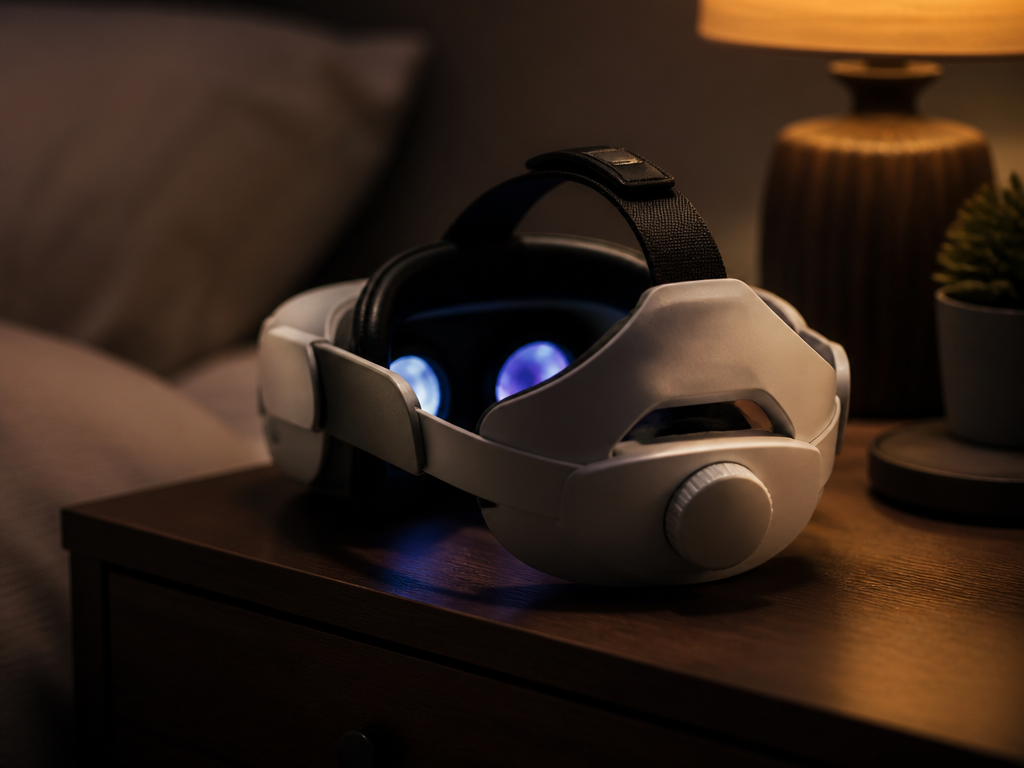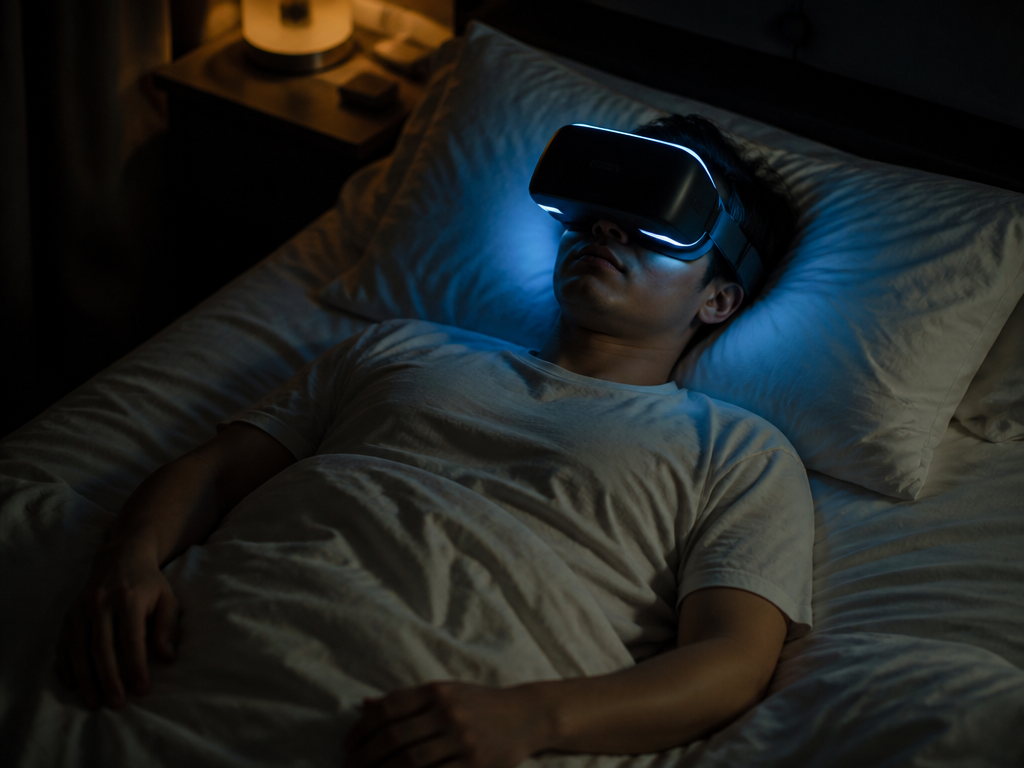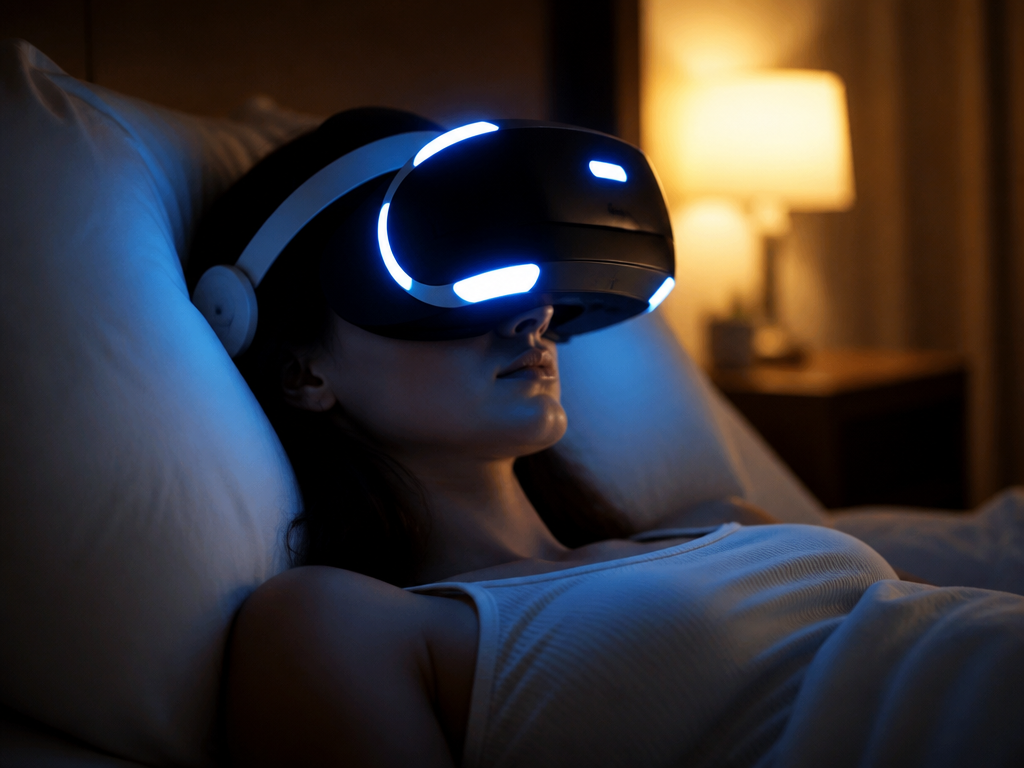
The most useful thing you can buy for a Meta Quest 3 is not a better controller or a louder pair of strap-mounted speakers. It is whatever lowers the temperature against your face and moves the weight off your cheekbones. That is a strange thing to say in a magazine about sleep, so the rest of this piece is going to earn it.
Here is the connection most VR accessories reviews skip: a head-mounted display is a small, warm, light-emitting object strapped to the exact part of your body that your nervous system uses to decide whether it is time to sleep. The face, the eyes, and core temperature are not incidental to rest. They are the control panel. So when you choose VR accessories — and especially when you play at night, which is when most people play — you are quietly making decisions about your sleep physiology, whether the box mentions it or not.
Does playing VR before bed hurt your sleep?
Probably a little, and the mechanism is light, not adrenaline. The strongest, best-established effect is that bright, close, blue-rich light suppresses melatonin and pushes your circadian clock later. A VR headset puts two displays a few centimeters from your retinas and fills your entire visual field with them, which is about as direct a dose of evening light as consumer hardware delivers. The arousal from an intense game matters too, but it fades faster. The light is the part that lingers, because melatonin suppression and phase delay can outlast the play session by an hour or more.
That is the honest version. Not "VR will wreck your sleep" — that is fearmongering. But "the screen against your eyes is doing what evening screens do, only more so" is well-supported.
The accessory you don't notice is the one working
Comfort in VR is usually sold as a feeling. The better way to think about it is as load management. The Quest 3 weighs about 515 grams with its default strap. That is not a lot in your hand. It is a great deal hanging off the front of your skull, because the headset is a lever, and the pivot is somewhere around your cheekbones and the bridge of your nose.
The stock soft strap solves this badly. It distributes that 515 grams across a thin band of fabric and lets the device rock forward. The result is pressure on the maxillary and infraorbital regions — the cheeks and the soft tissue just under the eyes — both of which are richly served by the trigeminal nerve. The trigeminal system is sensitive, fast to complain, and slow to forgive. This is why people report a red pressure-line on their face after forty minutes, and why "I just got used to it" usually means "I stopped noticing the signal, not the load."
A rigid head strap with a back cradle — the category Meta and third parties both sell — changes the physics. It moves the bearing surface to the occipital bone at the back of the skull, which is hard, flat, and indifferent to pressure in a way your cheeks are not. Add a counterweight at the rear (often a battery, conveniently) and you shift the center of mass back toward the crown, so the device stops trying to slide down your face. None of this is comfort in the spa sense. It is leverage and contact area. Those are the variables that actually move.
What heat does to your face, in order
Here is the sequence, because the order is the point.
You put the headset on. Within a few minutes the facial interface — the foam or rubber gasket that seals the optics against your face — traps a pocket of air. Your skin keeps doing what skin does, radiating heat and emitting water vapor, but now that vapor has nowhere to go. The trapped air warms and saturates. Within ten to fifteen minutes of an active session you have a small, humid, body-temperature microclimate sitting against your forehead, eye sockets, and cheeks.
Two things follow. The first is fogging: warm humid air hits the cooler lenses and condenses, which is annoying but harmless. The second is the one that matters for sleep. The face is one of the body's primary heat-dumping surfaces. When you want to fall asleep, your core temperature has to drop by roughly half a degree Celsius, and the body achieves that largely by shedding heat through the skin of the face, hands, and feet. A sealed foam gasket pressed against your forehead does the opposite of what the pre-sleep body is trying to do. It insulates the radiator.

This is why the facial interface — the cheapest, least glamorous accessory in the catalog — is arguably the most physiologically relevant one you can change. A swappable interface with an open or vented design, or a thin silicone gasket instead of dense foam, lets that microclimate breathe. Some aftermarket interfaces add a small gap at the nose or cheek specifically for airflow. The marketing calls this "breathability." The mechanism is convective heat loss, and it is real.
What the research actually measured
This is the part where most articles would cite a study proving VR ruins your sleep. I am not going to, because the study with that headline and a clean design does not really exist yet, and pretending otherwise would be exactly the kind of credential-stacking this magazine was built to avoid.
What we do have is solid on the components and thin on the combination.
The light-and-melatonin link is well-established and decades deep. The standard reference points are Lockley et al. (2003) in the Journal of Clinical Endocrinology & Metabolism, which showed that 460 nm blue light suppressed melatonin and shifted circadian phase more than longer-wavelength light at the same intensity, and Chang et al. (2015) in PNAS, which had subjects read on a light-emitting e-reader versus a print book before bed — twelve participants, a crossover design — and found the e-reader group took longer to fall asleep, had suppressed melatonin, and felt less alert the next morning. A VR display is a brighter, closer, full-field version of that e-reader. Extrapolating is fair, but it is extrapolation, and you should know that it is.
The thermal side is plausible but thinner. The role of distal skin temperature and core-temperature decline in sleep onset is well-supported — Kräuchi et al. (1999) in Nature is the durable citation, showing that the degree of distal warming (and consequent core heat loss) predicted how fast healthy young subjects fell asleep. But nobody has run a clean trial measuring whether a vented VR facial interface improves sleep latency after night gaming. That experiment would be easy and someone should do it. Until they do, the chain of reasoning — sealed foam traps facial heat, facial heat loss drives sleep onset, therefore venting helps — is mechanistically sound and empirically unproven at the last link. I would rather tell you that than dress it up.
And the claim you'll see on forums that VR is uniquely "stimulating" to the nervous system and therefore worse than a monitor? That is mostly folk wisdom. Immersion is real and a frightening game will spike your heart rate, but arousal of that kind subsides relatively quickly once the headset comes off. The light exposure is the part with a long tail.
Choosing by mechanism, not by award
If you walk into the accessory aisle thinking about comfort, you will buy the thing that feels plush in the store. If you walk in thinking about load and heat, you will buy differently. Here is what each category is actually doing.
A rigid head strap with a rear cradle is the highest-leverage purchase, in both senses. It is the difference between hanging the headset off your face and balancing it on your skull. If you only change one thing, change this. The trade-off is bulk and a slightly more involved fit adjustment; the stock soft strap is faster to throw on for a five-minute session.
A counterweight — usually marketed as a strap-mounted battery — does double duty: it extends your play time and it pulls the center of mass backward, reducing forward pitch. The honest caveat is that it adds total mass. You are trading a worse weight distribution for a heavier but better-balanced headset, and for most necks that is a good trade. For a long session it is clearly worth it.
A replacement facial interface is the cheap, high-impact, under-discussed one. Thinner silicone or a vented design improves both heat dissipation and hygiene (the stock foam absorbs sweat and is a pain to clean). The cost is light leakage — a more open interface lets ambient light seep in at the edges, which immersion purists hate. For night use that light leak is arguably a feature, because total visual immersion is part of what makes the melatonin hit so complete.
A light blocker, by contrast, does the opposite, sealing out ambient light for a darker image. Good for daytime play in a bright room. Counterproductive at 11 p.m., when sealing yourself more completely inside a glowing box is not the goal.

| Accessory | What it actually changes | Best for | Honest trade-off |
|---|---|---|---|
| Rigid head strap + rear cradle | Moves load from cheeks to occipital bone | Anyone past 20-min sessions | Bulkier, slower to fit |
| Strap-mounted counterweight battery | Shifts center of mass back; extends runtime | Long sessions | Adds total weight |
| Vented / silicone facial interface | Improves facial heat loss and hygiene | Warm rooms, night play | Edge light leakage |
| Light blocker gasket | Seals out ambient light | Bright-room daytime play | Wrong move late at night |
Notice what is not on this list: speakers, prescription lens inserts, fancy controller grips. They are fine. They are not load or heat or light, so they are not in the conversation this magazine is having.
The "Made for Meta" trap
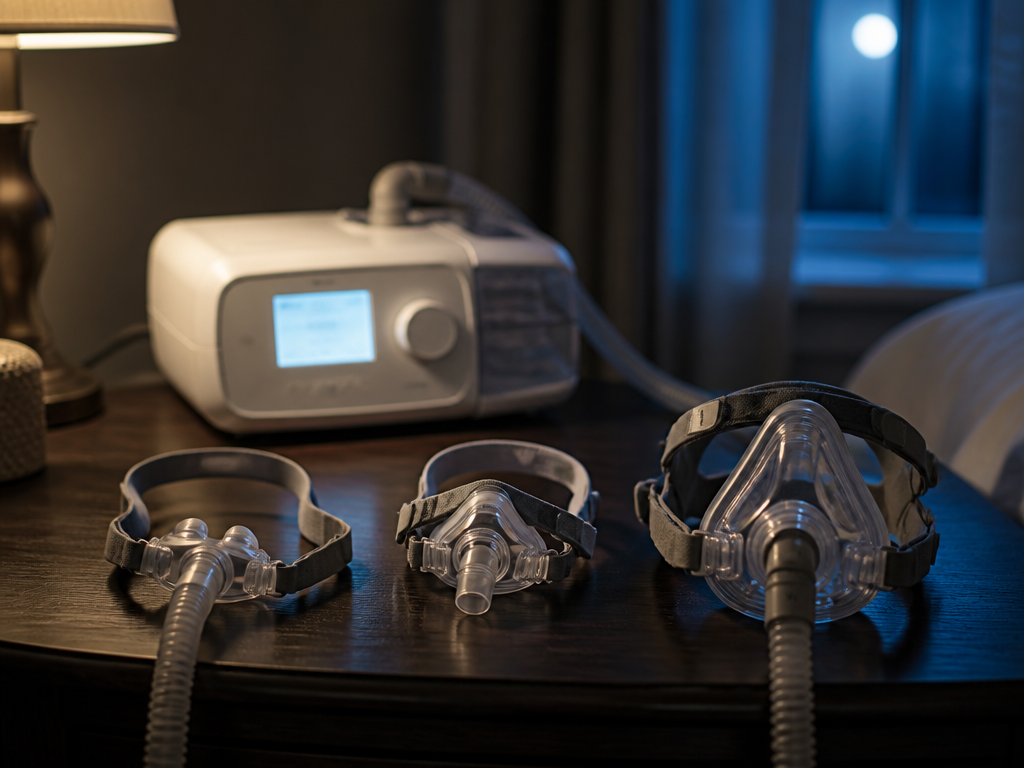
There is a genre of VR accessory announcement that runs almost entirely on credentials. It tells you the partner is a world-leading brand, that the product won a design award, that it carries an official compatibility certification. ResMed-adjacent and Razer-adjacent launches lean this way; so do plenty of others. The certifications are not lying. They are simply answering a different question than the one you are asking.
An official "Made for Meta" badge tells you the dimensional tolerances are right — the strap will clip into the correct slots, the interface will seat against the correct frame, the magnets are where Meta said they would be. That is genuinely useful. A poorly fitted third-party strap that lets the headset wobble defeats the entire point of buying it. So certification is a floor.
What it does not tell you is the thing you actually care about: how the load is distributed, how the gasket handles heat and moisture over forty minutes, whether the cradle's contact patch suits the back of your particular skull. A design award is a judgment about an object, usually made by people who did not wear it for two hours after dinner. Award pedigree is a proxy for quality, and proxies are what you reach for when you don't have the measurement. You can have the measurement. It is your own face, after twenty minutes, telling you exactly where the pressure is and how warm it has gotten. Trust that over the badge.
Heritage in adjacent fields is worth a sideways glance, too. A company with real history in respiratory masks or sleep hardware genuinely does understand sealing surfaces, facial pressure mapping, and breathable materials — that is the actual transferable expertise, far more than any award. But the expertise has to show up in the gasket geometry and the strap mechanics, not in the press release. Read the object, not the lineage.1
The simplest test that beats every spec sheet
You do not need a lab. Play for twenty-five minutes at your normal evening intensity, then take the headset off and look in a mirror. A red pressure line across your cheeks or the bridge of your nose means the load is in the wrong place — fix the strap and the balance. Skin that is flushed and damp where the gasket sat means the microclimate is running hot — that is your facial interface, and venting it is the cheapest upgrade you can make. If your eyes feel slow and you are wider awake than the hour warrants, that is the light doing its well-documented job, and no accessory fixes it. Only the clock does.
That last one is worth sitting with, because it is the limit of what any VR accessory can buy you. You can move the weight off your cheekbones and let your face shed heat and make the whole rig feel like nothing at all. You still cannot make a full-field, blue-rich display at arm's length read as darkness to a system that evolved to treat bright light as a reason to stay awake. Hardware solves the mechanical problems. The light problem is a scheduling problem.
Honest rule of thumb for tonight
If you're going to game in VR within two hours of sleep, vent the facial interface for heat, balance the headset on your skull rather than your face for pressure — and accept that the only fix for the light is to stop earlier than you want to.
-
This is the inverse of the more famous problem, where a respiratory or sleep-medicine brand attaches its name to a gaming product and lets you assume the clinical rigor came along for the ride. Sometimes it did. The gasket will tell you. ↩