The number is two hours.
In 1992, the psychiatrist Thomas Wehr ran an experiment that still anchors almost every serious conversation about biphasic sleep. He took a small group of healthy men and did something the modern world almost never does to anyone: he gave them long nights. Fourteen hours of enforced darkness, night after night, for a month. Within a few weeks their sleep came apart into two pieces — an early block and a pre-dawn block — separated by about two hours of calm, unforced wakefulness in the middle.
That gap is the whole story. It is also the whole problem.
The short version: Wehr's study is good evidence that the human body can settle into a two-part night when the nights get long enough. It is not evidence that you should sleep in two shifts, that doing so fixes insomnia, or that a divided night is healthier than an unbroken one. The two hours measure a capacity, not a cure.
What the two hours actually were
Strip away the folklore and the finding is narrow and specific. Put people in darkness for fourteen hours — roughly the winter night at high latitudes before electric light — and remove the option of doing anything else, and their sleep tends to reorganize. Not for everyone, not on the first night, but as a trend across the group and across weeks.
Three details matter more than the headline.
First, the gap was not insomnia. The men were not lying there frustrated. Wehr described the wakeful interval as quiet, even pleasant — closer to meditation than to the 3 a.m. dread most modern people know. Their prolactin, a hormone associated with calm, restful states, stayed elevated through the gap, as if the body had not fully clocked out.
Second, the darkness did other things too. Under long nights the volunteers secreted melatonin for a longer stretch — on the order of ten hours rather than the compressed window a short, summer-style night produces. The two-block pattern rode on top of a broader hormonal shift, not a simple decision to nap twice.
Third, it took time. The split did not appear on night one. It emerged over weeks, which tells you it is something the body settles into under sustained conditions, not a switch you flip on a Tuesday because you read about it.
It's worth being precise about the vocabulary, too, because the field is sloppy with it. A two-part pattern in the strict sense means one main sleep plus a second distinct bout — the segmented night Wehr produced, or a long night plus a siesta. That is a different animal from the polyphasic schemes that chop rest into four or six short naps across a day; those have no support in this study and little anywhere else. When people cite Wehr to defend a nap-every-four-hours regimen, they are quoting a result that does not exist.
If you want one sentence to screenshot: the experiment showed that long nights can produce a segmented night — the two-hour gap is real, reproducible, and hormonally distinct from insomnia.
What the two hours don't measure
Here is where most retellings overreach.
The sample was tiny. This was a small group of healthy young men in a lab, not a population. You cannot generalize a rhythm for eight billion people — women, shift workers, the elderly, the already-sleepless — from a study you could seat at two dinner tables. Wehr himself was careful about this; the popularizers who followed often were not.
The conditions were artificial in the other direction, too. Fourteen hours of darkness is not "natural" so much as it is pre-industrial winter. Nobody in the study chose to be awake at 1 a.m.; they were awake because they had been in the dark since evening with nothing to do. That the body fills unavoidable dark time with a wakeful interval is interesting. It does not follow that the interval is a suppressed need clawing to get out during your normal, well-lit, seven-hour night.
The study also measured almost nothing about outcomes. It did not track whether the men were sharper, happier, longer-lived, or better at their jobs on the split schedule. It measured what the body does under long nights, not whether that's good for you. Every claim that segmented sleep boosts creativity, mood, or productivity is being smuggled in from somewhere else — usually from historian A. Roger Ekirch's separate work showing that pre-industrial Europeans routinely described a "first sleep" and "second sleep" with a waking hour between them.

Ekirch's archive is genuinely rich, and it rhymes with Wehr's number in a way that's hard to ignore: two independent lines of evidence, one from hormones and one from diaries, pointing at the same divided night. But rhyme is not proof. That people once slept in two parts, and that a modern body will do the same in a dark lab, still doesn't tell us whether the pattern is better — only that it is available.
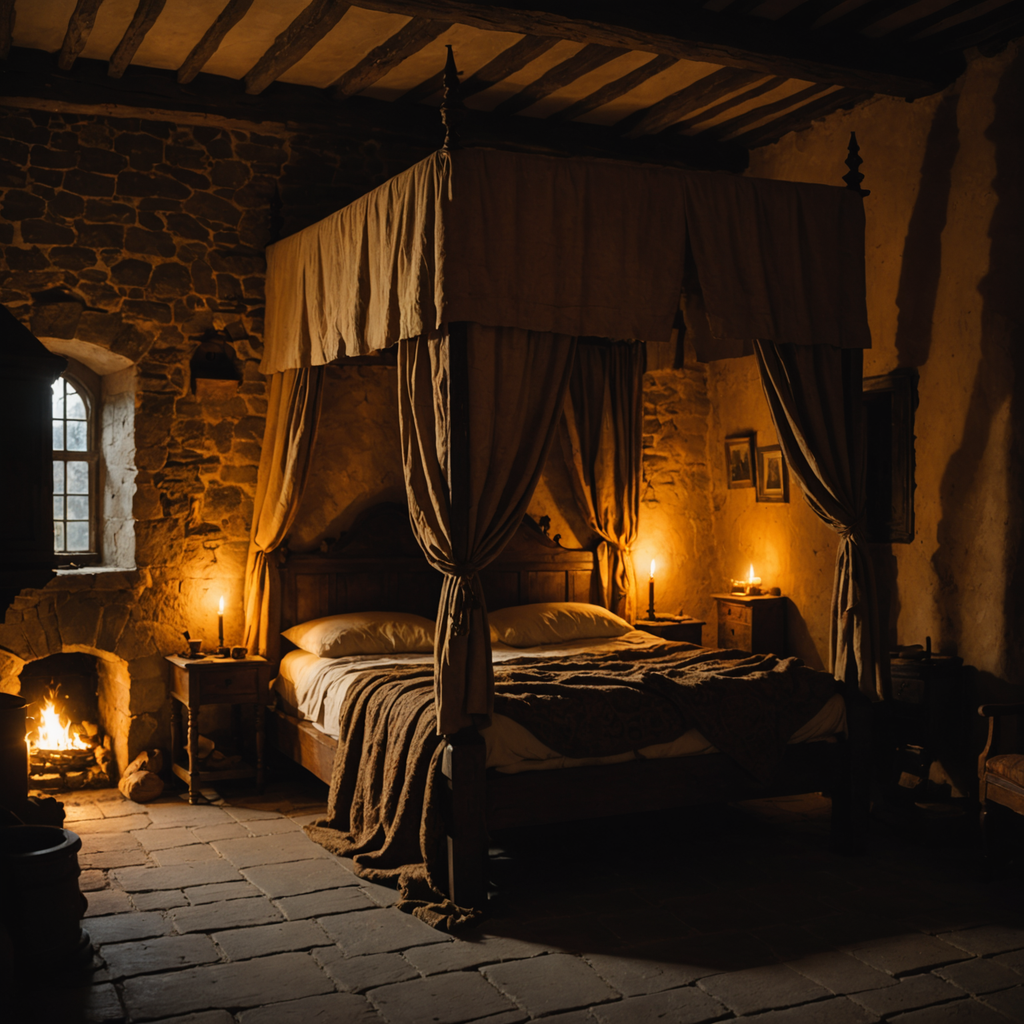
The gap in Ekirch's records is also more social than Wehr's. People used the waking hour to pray, tend the fire, talk quietly, have sex, or visit neighbors — it was a room in the night, furnished by a culture that expected it. Wehr's volunteers had an empty version of the same room: the physiology without the world built around it. Which of those is the "real" biphasic night is not a question a sleep lab can answer.
Three versions of the split night
It helps to keep separate three things that get blurred together.
| Wehr's lab night | A pre-industrial night | A modern "split sleep" hack | |
|---|---|---|---|
| What triggers it | 14 hrs enforced darkness | Long winter nights, no cheap light | A choice, on a normal-length night |
| The middle gap | ~2 hrs, calm, hormonally distinct | An hour or so, used for prayer, talk, sex | Often anxious clock-watching |
| Evidence quality | Controlled but tiny sample | Rich historical record, no measurements | Anecdote, mostly |
| What it proves | Capacity under long nights | The pattern was once normal | Very little on its own |
The trouble with the third column is that it borrows authority from the first two while sharing conditions with neither. Choosing to wake at 2 a.m. inside a short, artificially lit night is not the experiment Wehr ran, and it is not the life Ekirch's diarists led.
Who this is actually for
If you are a shift worker or a new parent whose sleep is already broken into pieces, the study offers something real: a reason to believe that a divided night need not be a damaged one, and that the wakeful gap can be calm rather than catastrophic. Reframing 3 a.m. wakefulness as a known pattern rather than a personal failure is, for some insomniacs, genuinely useful — not because it adds sleep, but because it subtracts panic, and panic is half of what keeps you up.
For the chronically sleep-deprived, then, the practical takeaway isn't the schedule at all — it's the permission. A night that arrives in two pieces has a long human pedigree and a plausible physiology behind it. That won't hand back an hour of rest. It might lower the stakes of the hour you're missing.
If you sleep soundly in one block, this is not an upgrade waiting for you. There is no measured benefit here to chase, and deliberately fragmenting a good night to imitate a lab result is the kind of move that reliably makes people more tired, not less. The people the number does not serve are the ones currently sleeping fine and looking to optimize.
And if you are hoping the two hours are a lost natural rhythm that modern life stole from you — the honest answer is that the science does not yet license that story, however much you may want it to.
The question the number leaves open
I keep returning to the prolactin. The men in the dark were not just awake; they were awake in a specific, calm, faintly sedated state that the body seems to hold on purpose. That is the detail that makes the whole thing feel like more than an artifact.
But it can be read two ways, and the study cannot choose between them. Either the two-hour gap is a latent rhythm — something our physiology is built to do and electric light has been quietly overriding for a century and a half — or it is simply what any mammal does when it is pinned in darkness with nothing to occupy it: a hormonally polished form of boredom that means nothing for how you should sleep on a normal night.
Wehr's number tells us the divided night exists and can be pleasant. It does not tell us which of those two stories is true. Until an experiment measures what the split night does to people over years — and not just what long darkness does to their hormones over a month — that is the part still genuinely up for grabs.