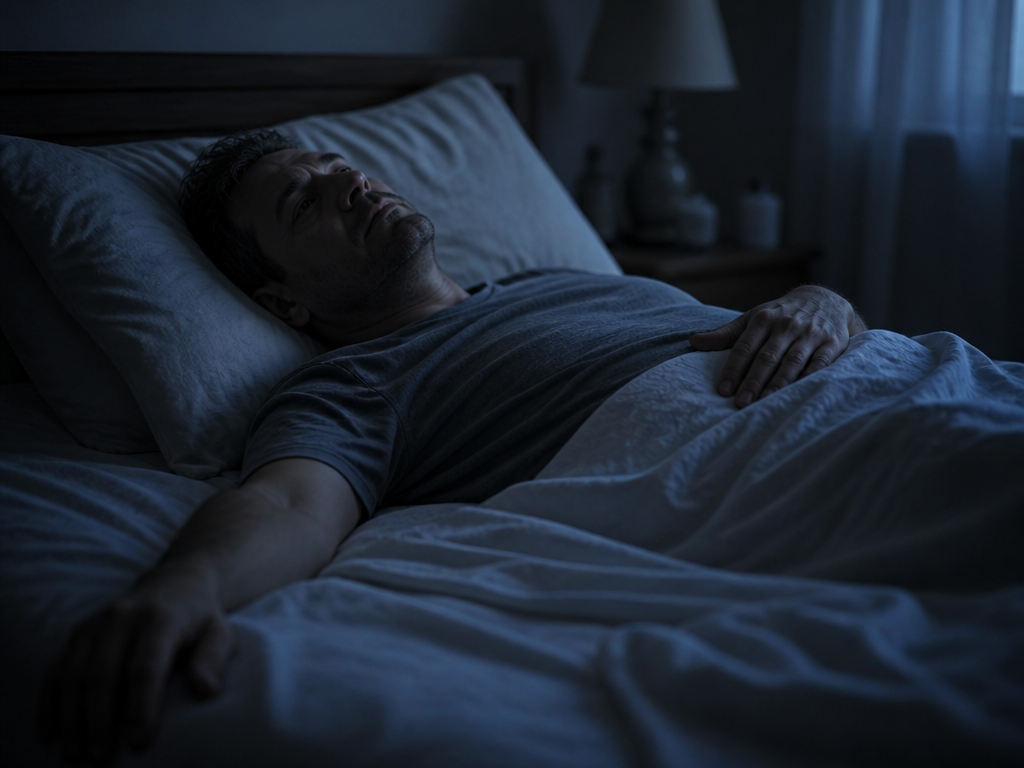
Lose enough sleep and your body will hurt more the next day — not because you're tired, and not because something has broken, but because your nervous system has quietly recalibrated how much pain a given stimulus is allowed to produce. The same pinprick, the same sore knee, the same headache: dialed up. This happens fast, it happens in healthy people, and it shows up long before any of the diseases we usually associate with bad sleep.
That claim is worth slowing down for, because it reframes what poor sleep quality costs you. Most of us file sleep under energy, mood, and the long-run risks — heart, metabolism, memory. All real. But pain belongs on the list as a mechanism in its own right, not a side effect of feeling rough. The rest of this piece is an attempt to earn the sentence I just wrote.
What we usually mean when we say sleep affects health
When a doctor tells you to sleep more, the implied syllabus is familiar. Short sleep tracks with higher blood pressure and cardiovascular events over years. It worsens glucose handling — even a few nights of restriction nudge insulin sensitivity in the wrong direction. It frays attention and mood within a single day. None of this is controversial anymore, and you've probably internalized it.
Pain is different. It isn't a slow-accumulating risk you'll meet in your sixties, and it isn't simply the irritability of a bad night bleeding into how you describe your aches. It's a measurable shift in the input-output curve of your pain system, observable in a lab the morning after. That distinction — pain as a direct readout of sleep, not a mood-colored impression of it — is the part most people haven't been told.
What the research actually measured
Short answer: yes, losing sleep makes you more sensitive to pain, and this has been measured directly rather than inferred from how cranky people feel. Researchers apply a controlled, escalating stimulus — heat, pressure, or cold — and record the threshold at which a person first calls it painful and the point at which they want it to stop. After sleep loss, both thresholds drop. Less stimulus, more pain.
The cleanest mechanistic look comes from Krause et al. (2019), published in The Journal of Neuroscience. They kept young, healthy adults awake for a night and then delivered increasing heat to the leg inside an fMRI scanner. Pain sensitivity rose, and the imaging showed why it might: heightened response in the somatosensory cortex (the region that maps where and how much something hurts) alongside blunted activity in striatal and insular regions that normally help calibrate and contextualize a painful signal. The brain was both amplifying the alarm and softening its own volume knob. The sample was small — around two dozen subjects across the experimental arms — so read it as a strong mechanistic hint, not a population-level law.
For the threshold effect itself, the older and more direct citation is Schuh-Hofer et al. (2013) in PAIN: 14 healthy volunteers underwent one night of total sleep deprivation, and the next day showed lowered pain thresholds across several modalities plus increased spontaneous pain. Fourteen people is not many. But the result has held up across a now-substantial literature.
That literature was pulled together by Finan, Goodin, and Smith in a 2013 review in The Journal of Pain, and revisited in work by Krause and colleagues since. The consensus they describe is the rare kind that's genuinely well-established: the relationship between sleep and pain is bidirectional, and — this is the surprising direction — sleep disturbance predicts the onset and worsening of pain at least as strongly as pain predicts bad sleep. For years clinicians assumed the arrow ran one way: pain keeps you up. It does. But the reverse arrow turns out to be the heavier one.
So, sorting the evidence honestly:
- Well-established: a night or several nights of restricted sleep lowers experimental pain thresholds in healthy people. Multiple labs, multiple stimulus types, consistent direction.
- Plausible but still thin: the specific brain-region story from imaging. The findings are compelling and they replicate in broad strokes, but the samples are small and fMRI interpretation is famously slippery.
- Folk wisdom dressed as fact: that "8 hours" is the universal threshold below which pain sensitivity climbs. The dose-response curve is real but individual, and the round number is convenience, not biology.

The mechanism, in the order it happens in the body
It helps to walk through this the way it actually unfolds overnight and into the morning, because each step does a distinct job.
Step one: the adenosine ledger doesn't get cleared
While you're awake, the byproducts of neural metabolism — chiefly adenosine — accumulate in the brain and build what researchers call sleep pressure. Deep sleep is when that ledger gets cleared. Skip or shorten it and you wake with the debt still on the books. This is the same molecule caffeine works on: caffeine blocks adenosine receptors, which is why a cup masks the feeling of the debt without paying it down. The unpaid debt is the upstream condition for everything that follows. You don't feel pain differently because of adenosine itself; you feel it differently because the restorative processes that adenosine clearance enables never fully ran.
Step two: your built-in pain brakes go quiet
You have a descending pain-modulation system — a top-down circuit running from the brainstem, through the periaqueductal gray, that releases your own endogenous opioids to dampen incoming pain signals before they reach full consciousness. Think of it as a set of brakes the body applies automatically. Sleep loss appears to weaken these brakes. In experimental terms, "conditioned pain modulation" — the normal effect where one painful stimulus suppresses your response to a second one — is measurably reduced after sleep disruption. The internal analgesia you'd normally apply for free is partly offline.
Step three: the threat-and-reward circuits recalibrate
This is where the Krause findings fit. With the brakes weakened, the signal arriving at the cortex is already less filtered. On top of that, sleep-deprived brains show altered activity in the striatum and related regions that assign salience and reward. Crudely: a tired brain is worse at deciding that a sensation is tolerable, mildly annoying, "fine," background. More incoming signals get flagged as worth caring about. The somatosensory cortex lights up harder for the same physical input. Amplifier up, filter down — at the same time.
Step four: the slower inflammatory pathway
Running on a longer clock is inflammation. Even modest sleep restriction raises circulating inflammatory markers — interleukin-6 and C-reactive protein among them. The frequently cited work here comes from Irwin and colleagues, who have shown that partial sleep loss activates inflammatory signaling and that recovery sleep helps normalize it. Inflammatory cytokines are themselves pro-nociceptive: they sensitize peripheral pain neurons, lowering the bar for firing. This pathway won't explain why you ache the morning after one bad night — it's too slow — but it's a strong candidate for why chronic poor sleep keeps pain elevated over weeks and months.1
Put the four together and you get a coherent picture. The brakes are weaker, the amplifier is louder, the filtering is worse, and over time a low simmer of inflammation lowers the threshold at the periphery too. None of these requires you to be sick. They're features of a tired, otherwise healthy nervous system.
Acute versus chronic: the loop that closes on itself
A single bad night produces the acute version: lower thresholds the next day, mostly reversible once you sleep normally again. Annoying, not dangerous. The concerning case is when the disruption persists, because pain and sleep form a feedback loop, and the loop is self-reinforcing.
Here's the shape of it. Poor sleep lowers your pain threshold. Higher pain makes it harder to sleep — pain fragments sleep architecture, particularly deep slow-wave sleep, which is the stage most associated with restorative effects. Fragmented sleep then lowers your threshold further. Each turn of the loop tightens it.
The epidemiology backs the worrying direction. Large prospective cohorts — the often-cited example is the Norwegian HUNT study, following tens of thousands of people over years — find that individuals reporting insomnia symptoms at baseline, and who were pain-free at the start, have a markedly higher risk of developing chronic musculoskeletal pain, including fibromyalgia, later on. The effect is dose-dependent: more insomnia, more risk. Cohort data can't prove causation by itself, and people with disturbed sleep differ in other ways too. But the temporal order — sleep problem first, pain second, in people who started without pain — is exactly what you'd predict from the lab mechanisms, and that convergence is what makes the case strong rather than merely suggestive.
Why this matters before you're a patient

The usual sleep-health warnings ask you to imagine a future self with a cardiac event or a metabolic diagnosis. The pain effect is different because it's happening to you now, subclinically, in a form you've probably misattributed.
Think about the mornings your lower back is worse, the weeks a nagging shoulder won't settle, the headache that seems to have no trigger. Some fraction of that variance isn't tissue damage fluctuating. It's your pain threshold fluctuating with how you slept. The injury didn't get worse overnight; your reporting of it did, because the system that decides how loud the signal gets was running with worse settings. This isn't a reason to dismiss pain as "just in your head" — the amplification is physical and real. It's a reason to treat sleep as part of the pain itself rather than an unrelated lifestyle footnote.
An honest rule of thumb
For people managing pain — or just noticing it more than they'd like — here's what the evidence supports and what's been oversold.
| What you've heard | How solid it is |
|---|---|
| Bad sleep makes pain feel worse the next day | Solid. Replicated experimental finding. |
| Fixing sleep can reduce chronic pain | Plausible and supported by trials of CBT-for-insomnia in pain patients, though effect sizes are moderate, not miraculous |
| A specific number of hours protects everyone | Oversold. The threshold is individual; consistency matters as much as duration |
| Catching up on weekends fully resets the pain effect | Thin. Recovery sleep helps, but irregular schedules carry their own cost |
| Painkillers fix the underlying problem | No. They treat the signal, not the lowered threshold that sleep loss created |
The directive for tonight: if you're in a pain flare, protect deep sleep before you do anything else — keep a fixed wake time, stop caffeine by early afternoon (its half-life is roughly five to six hours, so a 3 p.m. cup still has a quarter of its dose working at bedtime), and treat the night as part of your treatment, not the time off from it.
What's still unsettled
I want to be precise about the edges, because they're where the writing usually gets sloppy.
First, individual variability is large. Some people's pain thresholds barely move after sleep loss; others swing dramatically. We don't yet have a reliable way to predict who's who, though genetics and baseline anxiety seem to matter.
Second, the relative importance of duration versus architecture is unresolved. Is it total hours that protect you, or specifically slow-wave and REM sleep? The slow-wave findings are intriguing — selectively disrupting deep sleep, without shortening total sleep, has lowered pain thresholds in some studies — but the experiments are hard and the samples small. Quality and quantity are tangled together in ways the research is still pulling apart.
Third, caffeine occupies an honestly contradictory position. Acutely, caffeine is mildly analgesic — it's a common adjuvant in over-the-counter painkillers, which is why your headache tablet may contain it. But by blocking adenosine and pushing back sleep, chronic late-day caffeine can degrade the very sleep that keeps your pain threshold high. It can help with the pain in front of you and quietly worsen the system behind it. We don't have a clean accounting of where that trade-off nets out for a regular user, and anyone who tells you otherwise is ahead of the data.
What isn't unsettled is the core direction. The evidence that sleep loss sensitizes the pain system is among the more robust findings in this field — more robust, frankly, than the confidence with which the cardiovascular numbers are sometimes thrown around.
So here is the contrast the whole piece has been building toward.
The myth: poor sleep makes you tired, and tiredness makes you complain more about aches you'd otherwise shrug off.
The more accurate version: poor sleep measurably lowers the threshold at which your nervous system reports pain — weakening your built-in analgesia, amplifying the signal, and, over time, stoking the inflammation that keeps it elevated — so the pain isn't exaggerated, it's manufactured by the same night you lost.
-
The inflammation pathway is also the leading mechanistic candidate linking poor sleep to the cardiovascular and metabolic risks mentioned earlier — which means a single upstream process may fan out into several of sleep's downstream harms at once. ↩