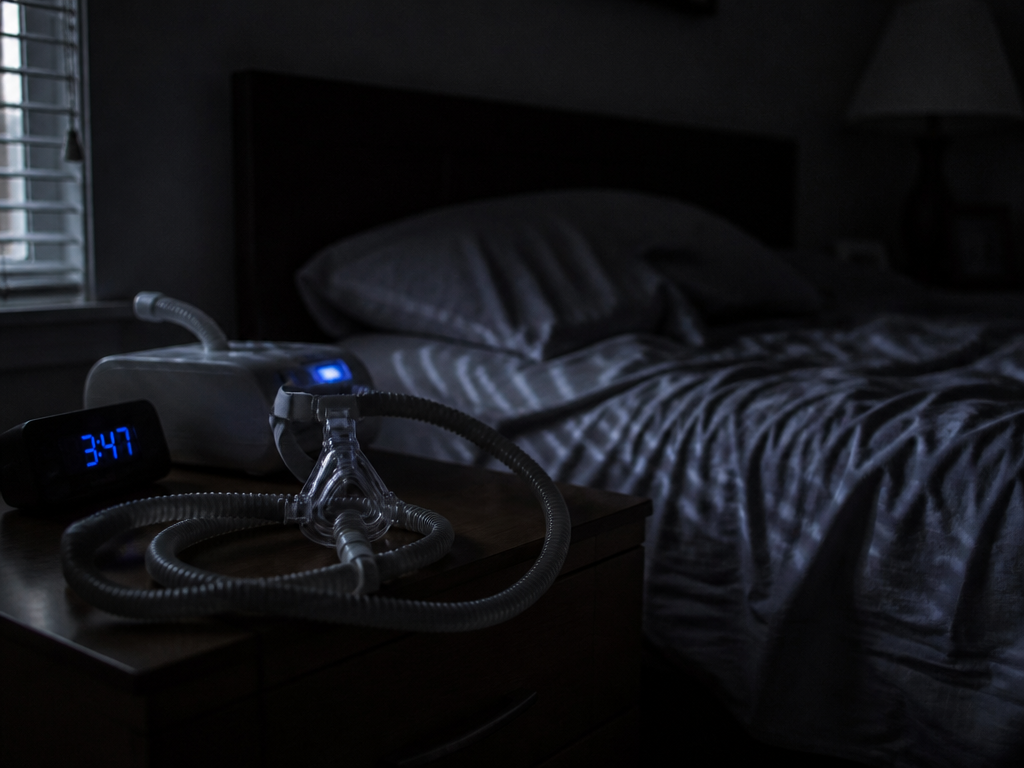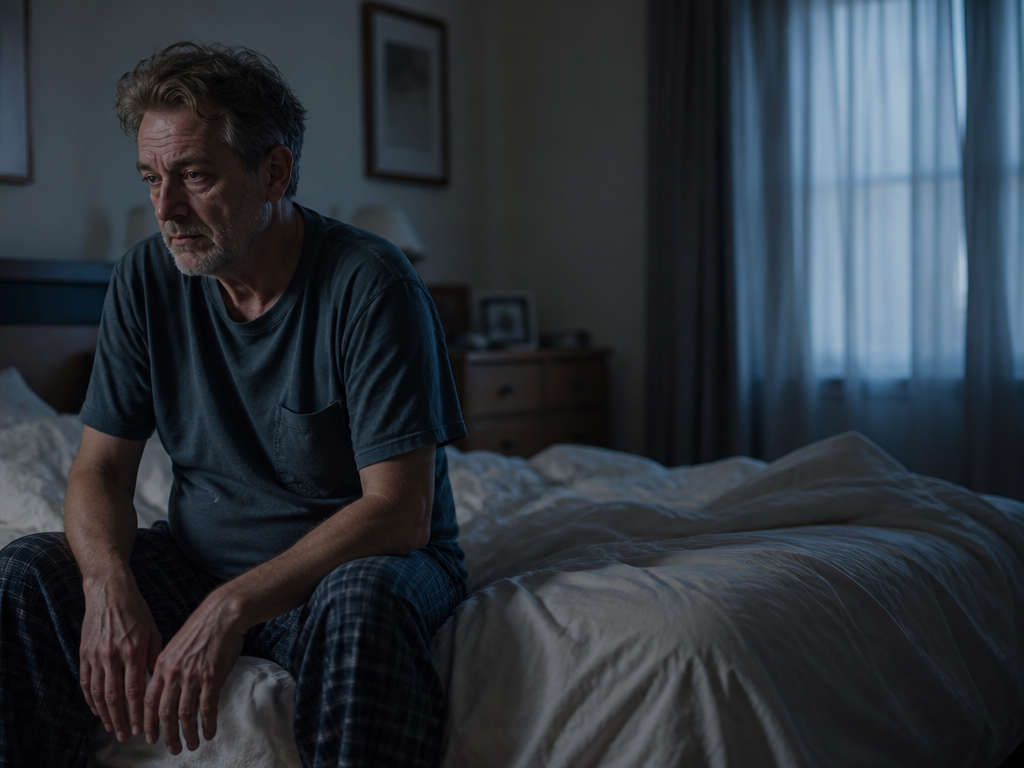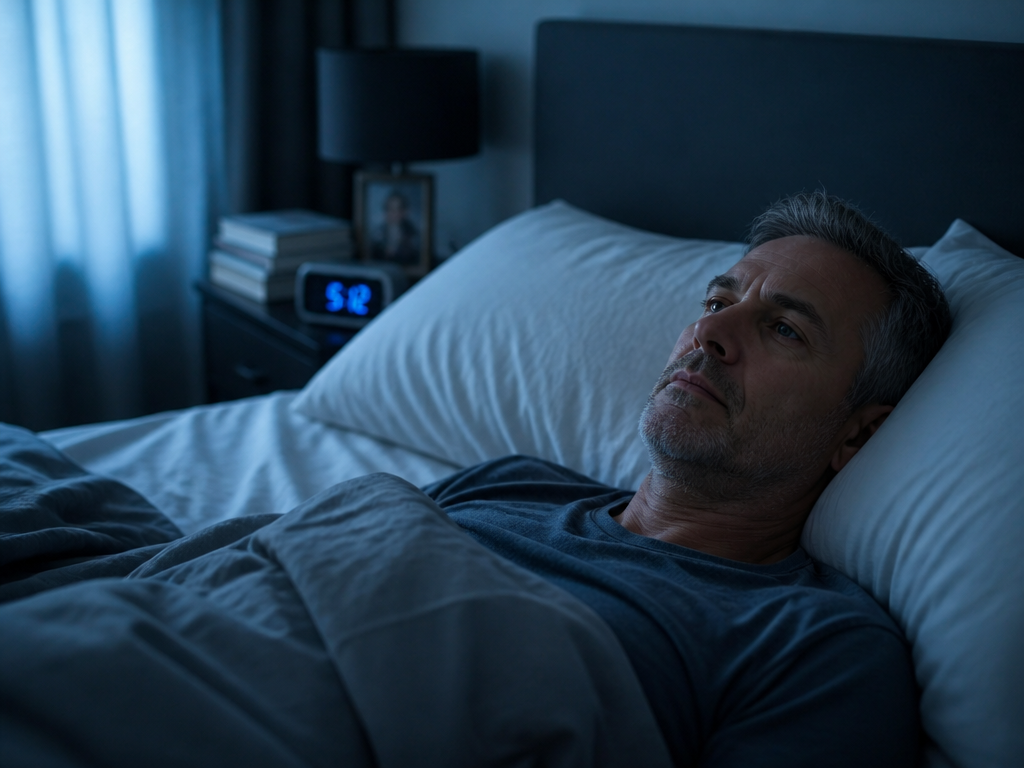
There is a particular kind of elbow that arrives in the dark. It lands between the shoulder blades, and it means: you stopped breathing again. Most people who have sleep apnea learn about it this way — not from a doctor, not from a chart, but from the person trying to sleep next to them. This is the central problem with sleep apnea symptoms: the person best positioned to notice them is unconscious for all of them.
So we rely on proxies. Daytime fog. A dry mouth at 6 a.m. A partner's testimony. And we rely on a mental picture of what a person with apnea looks like — a picture that turns out to be roughly seventy years old and assembled, in part, from a Charles Dickens character. The belief is older and stranger than the biology, and it has quietly steered a lot of people away from a diagnosis they needed.
The fat boy in the novel
The clinical story starts in 1956, when C. Sidney Burwell and colleagues published a case report in The American Journal of Medicine describing an obese patient with daytime sleepiness, low blood oxygen, and heart strain. Burwell named the cluster Pickwickian syndrome, after Joe, the perpetually-dozing fat boy in Dickens's The Pickwick Papers (1837). Joe falls asleep mid-sentence, mid-task, mid-knock-on-the-door. He is fat, red-faced, and somnolent. Dickens drew him for comedy. A hundred and twenty years later, a Harvard physician used him as a diagnostic archetype.
The label stuck because it was vivid, and vividness is sticky. For decades, the prototype of a person with a serious breathing-during-sleep problem was the heavyset, loudly-snoring, visibly-sleepy man. That image is not wrong, exactly. Obesity is the strongest single risk factor for obstructive sleep apnea; loud snoring is the most common symptom; men are diagnosed more often than women. But a prototype is not a definition, and treating it like one leaves a lot of people outside the frame.
Here is the thing the picture obscures: what Burwell actually described — obesity hypoventilation syndrome — is not the same as obstructive sleep apnea, the condition most people with the elbow-in-the-back actually have. The most famous early portrait of "sleep breathing disorder" was, technically, of a different disorder. The folk model and the clinical reality were already drifting apart in 1956, and the folk model won.
It took until the late 1960s and early 1970s for European researchers — Gastaut, Tassinari, and Duron in France; Jung and Kuhlo in Germany — to record what was happening in the airway itself: the throat collapsing, breathing stopping, the sleeper jolting half-awake to reopen it, over and over, hundreds of times a night. That is obstructive sleep apnea. It can happen to people who are not fat. It can happen to people who do not, by their own account, snore. The science arrived a decade and a half after the cartoon, and the cartoon had a head start.
What the research actually measured
When a sleep physician tells you that you have "moderate" apnea, they are reporting a single number: the apnea-hypopnea index, or AHI. It is the average number of times per hour that your breathing either stops completely (an apnea) or drops significantly (a hypopnea) during sleep. The standard thresholds, set largely by the American Academy of Sleep Medicine, are clean and memorable: 5 to 15 events per hour is mild, 15 to 30 is moderate, above 30 is severe.
Those numbers feel precise. They are less precise than they feel.
Consider how the cutoffs were chosen. The line at 5 events per hour — the boundary between "no apnea" and "apnea" — was not handed down by the body. It emerged from clinical convention and a handful of studies in the 1980s and 1990s correlating event frequency with daytime symptoms and outcomes. Different labs have, at different times, used different definitions of what even counts as a hypopnea: some require a 4% drop in blood oxygen, some accept 3%, some count an arousal from sleep instead. Punsawad and others have shown that scoring the same night of data under different rules can shift a person's AHI by enough to change their diagnostic category. A patient can be "mild" in one lab and "moderate" in another without their throat doing anything differently.
This matters because the AHI is treated as the disease, when it is really a tally of one feature of the disease. It says nothing about how long each pause lasts, how far the oxygen falls, or how violently the body fights its way back. Two people with an AHI of 20 can have wildly different nights. The number is useful. It is not the territory.
I am laying this out not to make you distrust the diagnosis but to make you distrust the threshold — the idea that there is a bright line below which your symptoms don't count. Plenty of people who feel terrible sit just under the cutoff. Plenty who feel fine sit above it.
What happens in your throat during one event

It's worth walking through a single apnea in the order your body experiences it, because the symptoms make more sense once you see the mechanism.
You fall asleep. The muscles that hold your upper airway open — the tongue, the soft palate, the walls of the throat — relax along with the rest of you. In most people, the airway stays open anyway. In obstructive sleep apnea, it narrows past the point of holding, and on an inhale, the soft tissue gets sucked inward and seals shut. Air stops moving. Your chest and diaphragm keep heaving against the closed door; nothing comes in.
Oxygen in your blood begins to fall. Carbon dioxide climbs. Chemoreceptors in your carotid arteries and brainstem register the shift and sound an alarm. Your sympathetic nervous system floods the body with adrenaline and noradrenaline. Your heart rate and blood pressure surge. The brain, sensing suffocation, kicks you up out of deep sleep toward the surface — not always to full waking, often just enough — and that partial arousal restores muscle tone to the airway. The throat snaps open. You gasp, snort, or take a deep ragged breath. The bed partner hears it. You usually don't.
Then you sink back down, the muscles relax, and it begins again. In severe cases this loop runs more than thirty times an hour, all night. You are not choking to death — the system rescues you every time — but you are also never resting. The repeated adrenaline surges are why apnea tracks so closely with high blood pressure and cardiovascular strain, and the repeated arousals are why you can spend nine hours in bed and wake up feeling like you spent ninety minutes. The fragmentation is invisible on the inside. That's the cruelty of it.
What are the warning signs of sleep apnea?
The most reliable signs are the ones you can't observe yourself, which is why a bed partner's report carries more weight than your own. The classic trio is loud, chronic snoring; witnessed pauses in breathing followed by a gasp or snort; and daytime sleepiness that sleep doesn't fix. Beyond those, the common quieter signals are waking with a dry mouth or sore throat, morning headaches, waking suddenly with a sense of choking, needing to urinate multiple times a night, difficulty concentrating, and irritability or low mood that has no obvious cause. You do not need all of these. The combination that should prompt a real conversation with a doctor is snoring plus either a witnessed pause or sleepiness that good sleep hygiene doesn't touch.
The reason these signs scatter so widely is that apnea is not one symptom but the downstream wash of two underlying problems: low oxygen and broken sleep. The dry mouth comes from mouth-breathing around an obstruction. The night urination comes partly from a hormone called atrial natriuretic peptide, released when the heart strains against a closed airway. The morning headache comes from elevated overnight carbon dioxide. The mood and concentration problems come from never reaching, or never staying in, restorative sleep. Different bodies route the same root cause into different complaints, which is exactly why a checklist alone never settles it.
Why your daytime story is an unreliable narrator
Here is something the textbooks underplay: people are bad at rating their own sleepiness.
The standard tool, the Epworth Sleepiness Scale (Johns, 1991), asks how likely you are to doze off in eight everyday situations — reading, watching TV, sitting in traffic. It is genuinely useful and genuinely flawed. It measures your perception of sleepiness, and chronic sleep debt blunts perception. If you've been tired for fifteen years, "normal" recalibrates. You stop noticing that sitting still in a warm room knocks you out, because it has always knocked you out. People with severe, objectively-measured apnea routinely score themselves as only mildly sleepy. They have forgotten what alert feels like.
This is why the partner is the better witness, and not only for the gasping. A partner notices that you fall asleep on the couch at 8:40 every night. A partner notices the silence — the unsettling stretch where the snoring stops and nothing replaces it — followed by the gasp. The pauses are, clinically, more telling than the snore itself, and they are precisely the thing you will never hear.
If you sleep alone, you are not out of options, but you are working with less. A phone left recording overnight will pick up snoring and sometimes the gasps. It will not catch the silent pauses well, and it will not measure oxygen. Treat the recording as a reason to ask, not as an answer.
The people the picture misses
Because the Pickwickian image was a heavy snoring man, three groups get under-diagnosed even now.

Women. Apnea in women more often shows up as fatigue, insomnia, morning headache, anxiety, and depression rather than thunderous snoring and obvious dozing. Women are also more likely to have their symptoms attributed to stress, hormones, or mood disorders. The result is a documented diagnostic gap: in community samples, the true male-to-female ratio of sleep apnea is closer to 2:1 or 3:1, but the ratio of people diagnosed has historically run far higher — meaning women with the condition are being missed at a notably higher rate. Pregnancy and menopause both shift the risk, and both are stages where the symptoms get easily folded into something else.
Thin and average-weight people. Obesity raises risk sharply, but a narrow airway, a recessed jaw, a large tongue, enlarged tonsils, or nasal obstruction can produce significant apnea in someone with a perfectly ordinary BMI. Craniofacial structure is destiny here more than the bathroom scale lets on, which is part of why obstructive sleep apnea is common in some lean populations.
People who insist they don't snore. Some don't, or don't loudly. Some have upper airway resistance — the throat narrows and fragments their sleep without fully collapsing, so the AHI stays low while the person feels wrecked. And some snore plenty but live alone, so no one has ever told them.
If you see yourself nowhere in the fat-snoring-man cartoon and still feel exhausted, the cartoon is the problem, not your symptoms.
How a diagnosis actually gets made now
Two real tests exist, and they measure different amounts.
A home sleep apnea test is what most adults with a high suspicion of straightforward obstructive apnea get first now, and for good reason: it's done in your own bed, it's far cheaper, and for moderate-to-severe obstructive apnea it's reasonably accurate. A small kit records airflow at the nose, breathing effort via a chest band, blood oxygen via a finger sensor, and sometimes heart rate and body position. What it does not measure is brain activity, so it can't tell whether you were actually asleep. If you lay awake half the night, the device counts that as event-free time and quietly underestimates your AHI. Home tests are good at confirming clear-cut apnea and bad at ruling it out. A normal home test in a person with strong symptoms is a reason to escalate, not relax.
In-lab polysomnography is the older, fuller study: a night in a sleep lab wired for brain waves (EEG), eye movement, muscle tone, airflow, effort, oxygen, heart rhythm, and leg movement. It can distinguish sleep stages, catch central apnea (where the brain briefly stops sending the breathe signal, a different mechanism from the collapsing throat), and pick up other disorders entirely. It is more accurate and more comprehensive. It is also expensive, harder to schedule, and a strange place to sleep. It's the right tool when the picture is murky, when home testing comes back ambiguous, or when something beyond obstructive apnea seems likely.
Neither test reads your sense of how tired you are. Both convert a messy night into numbers. The numbers are real and worth getting — just remember the threshold conversation from earlier: the diagnosis is a starting point for a treatment decision, not a verdict on whether your exhaustion is "allowed."
What to actually track before you call
You don't need to diagnose yourself. You need to walk into an appointment with better evidence than "I'm tired." For one week, keep a short log. It costs nothing and makes the fifteen-minute visit far more productive.
| What to note | Why it matters |
|---|---|
| Bedtime and wake time | Establishes whether you're getting enough opportunity to sleep before blaming the sleep itself |
| Partner reports of pauses or gasps | Witnessed apneas are among the strongest predictors of a positive study |
| How you feel 30–60 min after waking | Apnea sleepiness doesn't lift with morning; ordinary tiredness does |
| Nighttime bathroom trips | Frequent ones, with no other cause, point toward the heart-strain mechanism |
| Morning dry mouth or headache | Signals mouth-breathing and overnight CO₂ retention |
Bring it. A week of specifics beats a year of vague fatigue.
An honest rule of thumb
If a person who has watched you sleep has ever described silence followed by a gasp — or if you reliably feel unrested after seven or eight full hours in bed, for weeks, with no other explanation — those two facts together clear the bar for getting evaluated. Not because something terrible is certain, but because the test is low-cost and the thing it's checking for is treatable, and the only thing standing between you and the answer is the seventy-year-old image of who this happens to.
That image was always thinner than the belief built on top of it. Dickens drew a sleepy fat boy for laughs; a doctor borrowed him for a diagnosis; the diagnosis turned out to describe the wrong condition; and somehow the cartoon outlived the correction. You are not obligated to fit a picture from 1837 to deserve a good night's sleep.
Tonight, ask whoever shares your bed one question — do I ever stop breathing in my sleep? — and believe the answer over your own sense of how tired you are.