I spent two weeks asking a question that every sizing card refuses to answer: if I'm between a Small and a Medium, which way do I go?
This is a quiet, specific problem, and it is the reason a lot of people give up on therapy. A good CPAP mask fit doesn't announce itself with a number on a box. The cardboard sizing gauge your supplier hands you measures the distance between two points on your face. It does not measure how your cheeks settle when you roll onto your side, how much your nose swells at 3 a.m., or whether you breathe through your mouth when you finally hit deep sleep. I have a face that lands on the boundary between two sizes on all three of the nasal masks I tested, and I wanted to know what the gauge wasn't telling me.
The short answer: when you're genuinely between sizes on a nasal mask, size down, not up — but only if the smaller cushion still clears your nostrils without pinching. The bigger cushion fails more quietly and more often.
How I tested it
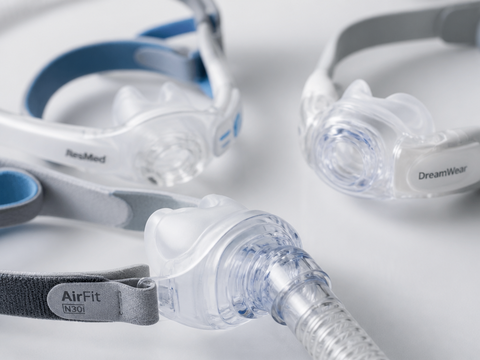
I used three current nasal masks — the ResMed AirFit N30i, the Philips DreamWisp, and the F&P Brevida (technically a nasal pillow, included as a control because people cross-shop them). For each, I obtained the two adjacent cushion sizes my face fell between: in N30i terms, Small and Medium-Wide; for the others, their nearest equivalents.
Six nights per mask, alternating sizes night to night, pressure fixed at my prescribed 9 cmH₂O on an AirSense 11. I pulled the leak figure the machine reports each morning — the 95th-percentile leak rate in litres per minute — and logged my own subjective notes before coffee, while the irritation was still honest. I am one person with one face. This is a case study, not a trial.
What the gauge measures, and what it ignores
The paper gauge keys off the bridge and base of your nose. That's a reasonable proxy for a full-face cushion, where the seal rides the nasal bridge. For a nasal-cradle design like the N30i, the seal sits under the nose, so bridge width is almost irrelevant — nostril spacing and upper-lip depth matter more, and no gauge measures those. This is the first honest "it depends": the right size depends on which part of your face the cushion actually touches, and the gauge often measures the wrong part.
The three masks, scored
I rated each on four named criteria: seal stability (leak rate across the night), side-sleep tolerance (leak when I rolled), morning marks (skin indentation and redness), and mouth-leak penalty (whether it forced my jaw open).
| Mask (size used) | 95th-pct leak | Side-sleep | Morning marks | Mouth leak |
|---|---|---|---|---|
| AirFit N30i (Small) | 8 L/min | Good | Faint, gone by 9am | Low |
| AirFit N30i (Med-Wide) | 24 L/min | Poor | None | Moderate |
| DreamWisp (S) | 14 L/min | Fair | Moderate, bridge | Low |
| DreamWisp (M) | 21 L/min | Poor | Light | Moderate |
| Brevida (S/M pillow) | 11 L/min | Good | Pillow-edge only | High |
The pattern held across all three: the smaller cushion leaked less. On the N30i, the Medium-Wide tripled my leak rate — from a clean 8 L/min on the Small to 24 L/min, which is into the territory where the machine's pressure compensation starts working audibly and my AHI crept up the next morning. The larger cushion didn't feel loose when I put it on awake. It felt gentler, which is exactly the trap. A cushion that's slightly too big seals fine under conscious, still breathing and then breaks the moment your face goes slack and you turn over.

The smaller cushions had the opposite failure mode, and it's the more useful one: when a too-small cushion is wrong, it tells you immediately. It pinches, it whistles, you cinch the headgear and it still complains. You know within twenty minutes. An oversized cushion lies to you for four hours and then dumps air across your eye at dawn.
Where it genuinely depends
I want to be careful here, because "always size down" would be a worse lie than the gauge.
Beards and stubble change everything. A nasal-cradle cushion seals against the upper lip and the underside of the nose — fine through stubble. But the under-nose contact suffers if you have a heavy moustache, and there the slightly larger cushion that bridges the hair can outperform the smaller one. I'm clean-shaven; I couldn't test this, and I'd treat my "size down" finding as suspended for anyone with significant facial hair below the nose.
Chronic congestion is the other variable. On the two nights I was mildly congested, the Small N30i felt tight in a way it hadn't before — my nostrils flare slightly when I'm blocked. If your nose changes size with the seasons, you may genuinely need both, and that's not indecision, it's anatomy.
Sleeping position decided more than I expected. Back-sleepers will see less difference between sizes; the cushion isn't getting shoved sideways into the pillow. Every leak advantage the smaller cushions showed widened when I slept on my side. If you sleep on your back and breathe through your nose, the size question is lower-stakes than this article implies, and you can pick on comfort alone.
Who should do what
- Size down if you're between sizes, sleep on your side, are clean-shaven, and breathe through your nose. This is the largest group and the clearest case.
- Size up if a too-small cushion visibly blanches the skin around your nostrils white, if you have a moustache the cushion must bridge, or if you wake congested most mornings.
- Switch styles, not sizes if neither cushion of a nasal-cradle mask works. Persistent mouth leak is not a sizing problem — it's a signal you may need a chin strap or a full-face mask, and no nasal cushion will fix an open jaw. The Brevida's high mouth-leak score in my notes is that exact story: a fine seal at the nose, undone by air escaping somewhere a nasal mask was never going to control.
If you remember one line: a slightly small nasal cushion fails loudly and early; a slightly large one fails silently at 4 a.m. Trust the one that complains.
A practical note that sits outside the size debate: none of this survives a dirty or aged cushion. Silicone takes a set and stops sealing somewhere around the six-month mark regardless of size, and facial oils degrade it faster than you'd think. If a fit that worked has slowly drifted, replace the cushion before you re-litigate the size. And if you've worked through size, style, and replacement and the leak persists, that's the point to bring the actual numbers — your leak rate and AHI trend — to whoever fitted you. They can see things on the data download you can't see from the chair.
What this didn't answer
I tested three masks, one face, one pressure, and a fixed-pressure machine. I can't tell you how this plays out on auto-adjusting (APAP) therapy, where the pressure itself moves through the night and may punish an oversized cushion differently. I didn't test full-face masks, where the bridge-of-nose seal the paper gauge actually measures becomes the deciding surface — there, sizing up may be the correct call, and my finding likely inverts. And I have no data on faces unlike mine: narrower, wider, with different nostril geometry.
If you're shopping a full-face mask, or running APAP, treat this piece as a question I happened to answer for nasal cradles and side sleeping, not a rule. The next thing worth measuring is whether the "size down" instinct holds when the pressure isn't holding still — which is the experiment I'd run next.