Here is the rule, as I have heard it stated on earnings calls and read in most of the ResMed financial news published since the Philips foam recall of 2021: a recall is a one-time charge, guidance is the actual business, and a market that confuses the two is handing you a discount. Recalls have a floor and an end date. Guidance has neither. So you buy the recall and you sell the guidance miss.
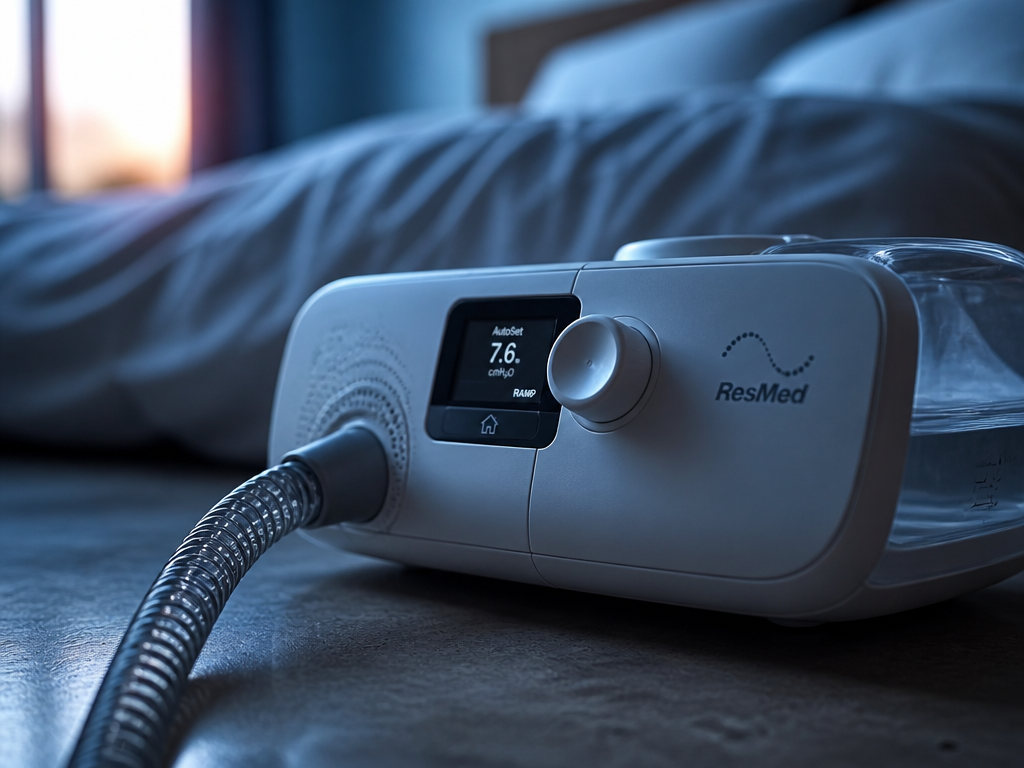
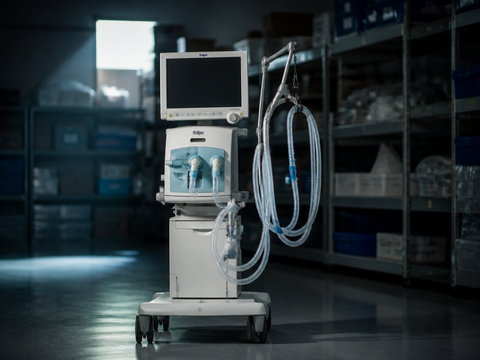
I spent two weeks testing that rule against what ResMed disclosed alongside its June-quarter results, which is not a recall. The company has suspended sales of its life-support ventilator platform and is routing constrained electronic components toward servicing the installed base rather than building new units. Management assigned roughly $75 million of fiscal 2027 revenue to the disruption. The stock ignored the profit beat entirely and traded down on the guide.
The verdict: the rule is roughly right about recalls and wrong about suspensions, and what the market repriced was neither.
What was actually in the print
The quarter itself was fine. Adjusted profit per share came in above the LSEG consensus; revenue landed in line. Gross margin held. None of that mattered for more than the first fifteen minutes of the session.
The fiscal 2027 revenue outlook came in below where the sell side had modeled it, and the gap was wider than the $75 million the company put against the ventilator suspension. Management said on the call that productivity savings no longer cover input cost inflation on their own, and that list prices would move to close part of the difference — a sentence that reads as routine and is not, because a company confident in its volume trajectory does not usually lead with price.
On the suspension itself, the disclosure was specific about mechanism and silent about duration. Components are scarce; the installed base has to be kept running; new-unit sales stop while parts go to repair and service. There is no restart quarter in the guidance, and none was offered when asked.
That combination — precise on cause, absent on end date — is the whole story, and it is the thing the received rule does not have a slot for.
Where the rule is roughly right
I want to give the received wisdom its due, because it earned its status honestly.
Recalls really do have terminal structure. A recall names a device population, names a remedy, and implies a finish line. The remediation cost is estimable within a range, a reserve gets taken, the reserve gets drawn down, and at some point the line item stops appearing. Investors who learned to look through recall charges learned a correct lesson from a decade of correct examples.
The arithmetic here genuinely is small. Life-support ventilators are a modest line against a business whose weight sits in masks, flow generators, and the software layer underneath. Seventy-five million dollars against a revenue base north of $5 billion is somewhere around 1.3% — closer to a rounding error than a thesis. A reader who shrugs at that number is not being careless. On the direct revenue math, the shrug is defensible.
And the share-transfer half of the rule has one enormous piece of supporting evidence. When Philips Respironics pulled roughly 5.5 million sleep and respiratory devices in June 2021 over degrading sound-abatement foam, the share did not evaporate. It moved. ResMed spent the following three years absorbing patients who needed a device from someone, and the resulting growth rate was the best evidence anyone has ever produced that a rival's recall is an asset. Philips lost roughly two-thirds of its market value over the eighteen months that followed and, after the April 2024 consent decree barring new US sleep and respiratory device sales pending remediation, never traded back to where it started.
So: recalls end, the recalled line here is small, and recalls transfer share. Three out of three for the conventional view. And yet the conventional view priced this event wrong.
Where it breaks
A recall ends on a date. A suspension ends on a condition.
This is the distinction the rule collapses, and it is the one that matters.
A recall is a defined obligation: these serial numbers, this remedy, this completion rate. You can model it because the company controls the variables. A suspension pending component availability and regulatory comfort is not an obligation with a cost — it is a gate whose key is held by someone else. A supplier, a qualification cycle, a reviewer's queue.

When I model a recall, I am estimating a number. When I model a suspension, I am estimating a duration, and duration risk does not behave like charge risk. A $75 million charge is $75 million. A suspension of unknown length is $75 million per year for an unknown number of years, plus the compounding question of whether the hospital and home-care accounts that bought that platform stay put while it is unavailable. Respiratory capital equipment is sticky, but it is sticky on the way out as well as the way in. An account that qualifies a substitute during a twelve-month gap does not un-qualify it when you come back.
The component redirection is the tell
Read the mechanism again: scarce parts are being sent to repairs and servicing rather than into new builds.
If the constraint were purely a quality or regulatory finding, you would not need to reroute anything. You would stop shipping, fix the design or the documentation, and resume. The rerouting says something narrower and more uncomfortable: the same input cannot both keep the installed fleet alive and produce new units, and keeping the fleet alive wins — as it should, because these are life-support devices and the alternative is unthinkable.
But that priority ordering also means the restart is not primarily in the company's hands. It is in the hands of whoever makes the part. That is a materially different risk profile from a remediation the company can staff its way out of, and it is why I stopped treating this as a charge and started treating it as a supply story wearing a quality story's clothes.
The guidance gap is mostly not the suspension
The cleanest evidence that the market was not repricing ventilators: $75 million does not fill the hole between the fiscal 2027 outlook and where consensus sat.
What got repriced was the durability of the post-2021 growth rate — the quiet assumption, embedded in a lot of sector modeling, that the share ResMed inherited when its largest competitor left the field would keep compounding at inherited-share speed. The suspension was the occasion. The multiple compression was about something slower and less quotable.
This is where I think the received rule does the most damage. It teaches you to sort every disclosure into "one-time" or "ongoing" and then to buy the first and sell the second. It does not teach you to ask whether a one-time item is being used, by the market, as a legible proxy for an ongoing one.
Five field actions, measured the same way
I hand-tabulated every major sleep-and-respiratory device field action I could reconstruct from public announcements and closing prices, and measured each one identically: peak drawdown from the announcement close, and trading days until the pre-announcement close was reclaimed.
| Event | Restart date known at announcement? | Peak drawdown | Days to reclaim |
|---|---|---|---|
| Philips foam recall, Jun 2021 | No | ~68% | Not reclaimed |
| Medtronic HVAD distribution halt, Jun 2021 | No (permanent exit) | ~4% | 11 |
| Getinge ventilator recall cycle, 2023–24 | Yes (field correction) | ~24% | ~180 |
| Philips US consent decree, Apr 2024 | No (conditions-based) | ~11% | Not reclaimed |
| ResMed ventilator suspension, Aug 2026 | No | ~10% (day one) | Open |
How I measured this, and what I could not
Closes only, no dividends, no currency adjustment between local listings and ADRs — which flatters or punishes the two European names by an amount I did not attempt to strip out. The Getinge row aggregates a sequence of related actions into one window, which is a judgment call another analyst would make differently.
More importantly, n = 5. That is not a sample; it is a set of anecdotes I lined up in a column. I am not claiming a distribution. I am claiming that when I looked at the five cases I could reconstruct, the same variable kept sorting them.
Things I could not test at all: I have not read the regulatory correspondence, so I do not know whether the component constraint has a quality finding sitting behind it. I have no channel checks with durable medical equipment distributors, so I cannot tell you whether hospital accounts are actively qualifying substitutes or waiting. And I cannot test the counterfactual — what the stock would have done on the guide alone, without a suspension to hang it on. That last one is the honest limit of the whole exercise.
What the tally actually sorted on
Not severity. Not revenue at risk. Not device class.

The Medtronic row is instructive precisely because it looks severe and traded like nothing. A permanent exit from a ventricular assist device line, Class I, patients affected — and the stock reclaimed its level inside three weeks, because the line was small, the exit was clean, and there was nothing left to be uncertain about. Certainty about a bad outcome repriced faster than uncertainty about a mild one.
Getinge is the middle case: real recalls, real drawdown, a defined field correction, and a recovery measured in months rather than years.
The two rows that never recovered share one property. In both, the date of resumption was set by a third party. That is the variable. Not how bad it was — who holds the key.
By that test, the current suspension belongs in the bottom half of the table, not the top. Which does not mean it will trade like Philips; the scale is nowhere close and the rest of the franchise is intact and profitable. It means the recall-discount reflex — the one that says wait for the charge to be reserved and then buy — has no traction here, because there is nothing to reserve against and no completion percentage to track quarter to quarter.
The part the rule was never built to hold
Two external developments keep getting folded into this trade, and they deserve separating out.
The first is the December 2024 approval of tirzepatide, marketed as Zepbound, for moderate-to-severe obstructive sleep apnea in adults with obesity — the first drug indicated for a condition that had only ever been treated mechanically. The second is the September 2024 clearance of sleep apnea notifications on Apple Watch, which puts a screening prompt on tens of millions of wrists.
The standard framing treats the first as a threat and the second as a tailwind. I think both are true and both are slower than the framing implies.
The wearable notification expands the top of the diagnostic funnel — it tells people something is wrong, and the referral pathway from a watch alert to a titrated device runs through a sleep study and a prescription, which is a pipeline measured in months and constrained by clinic capacity, not by awareness. The drug compresses the bottom of the funnel, but only for the subset whose apnea is weight-driven, only for as long as they stay on therapy, and only to the degree that severity reduction crosses the threshold where a device stops being indicated. Adherence to injectable weight-loss therapy past the two-year mark is the actual unknown in this entire sector, and I have no ability to test it. Nobody quoting a terminal-decline thesis on airway devices can test it either, which is worth remembering when you read one stated confidently.
What I will say plainly: the funnel expansion arrives before the substitution bites. The sequencing favors the incumbent for longer than the bear framing allows. That is a directional opinion, held with moderate confidence, and it is the piece of this I would most expect to be wrong about.
Who this framing is for, and who it isn't
It's for you if you hold or trade medical device names through field actions and have been applying one mental model to all of them. The recall/suspension split is a cheap upgrade: it costs one question — does the company control the date this ends? — and it sorted my five cases better than severity did.
It's for you if you are modeling fiscal 2027 and were about to add the $75 million back as a one-time item. It is not one-time until someone says when it stops.
It isn't for you if you are looking for a directional call. I am not making one. The core franchise beat, the margin held, and the disclosed revenue at risk is close to noise. Everything I have written here is about how to classify the disclosure, not about where the shares go.
It also isn't for you if your horizon is the next two quarters. The distinction I have drawn only pays out over the period in which duration risk resolves, and by construction nobody knows how long that is.
If you want one line to keep: buy recalls, rent suspensions, and never mistake a supply constraint for a legal one.
The myth is that a device recall is a one-time charge, so the dip it creates is the opportunity.
The more accurate version is that a device recall is a one-time charge only when the company controls the date it ends — and this one doesn't, yet.