The question arrives every August, usually from a parent, almost never in front of the student: do mattress toppers actually do anything on a dorm bed, or are they a checklist item that exists because someone sells them? It's a fair question and I've never had a good answer. I've slept on a lot of inherited mattresses — sublets, hostels, two years of institutional housing, one futon with a documented past — and my honest response has always been a shrug and a story.
So in June I bought a decommissioned dorm bed and slept on it for six weeks.
The verdict, in one sentence: a topper fixes comfort and does close to nothing for hygiene, a zippered encasement fixes hygiene and does close to nothing for comfort, and most people buy the first while believing they've handled the second.
If you stop reading here: buy the encasement now, sleep ten nights on the bare bed, and decide about the topper after that.
The bed
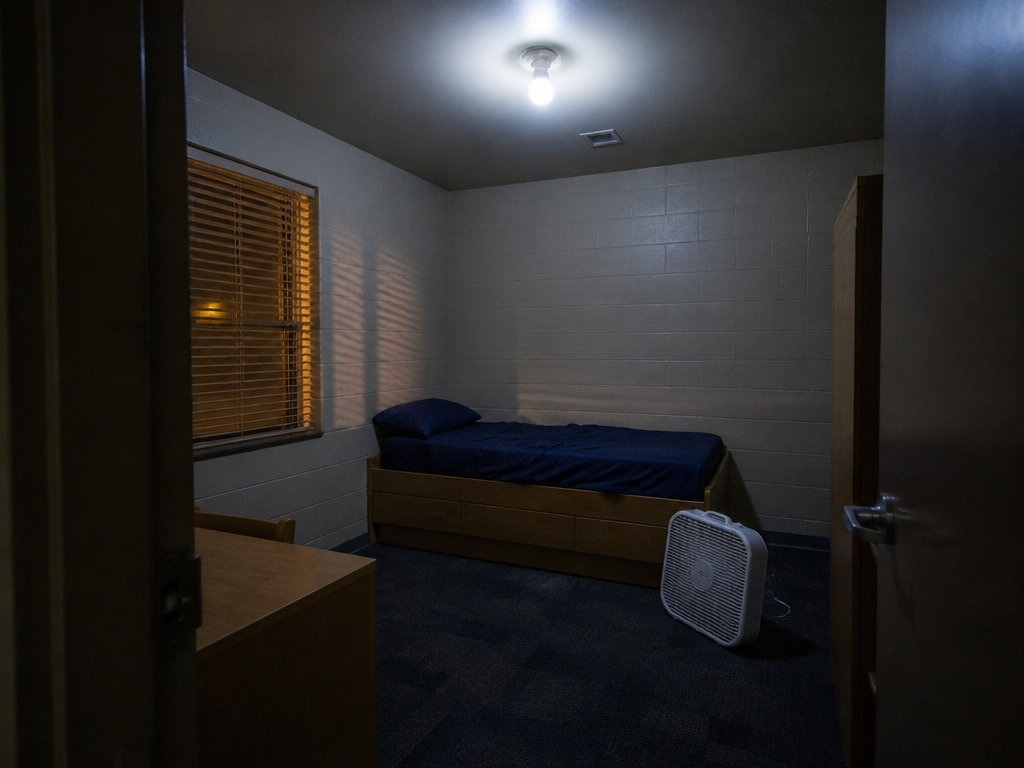
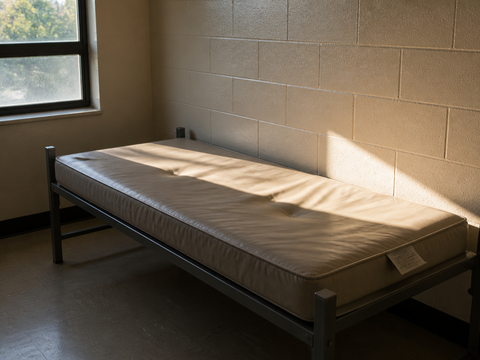
University surplus sales are a genre of retail I recommend to nobody and used anyway. Fifteen dollars got me a twin XL that had been in a residence hall since at least 2019, according to the law tag: 36 inches by 80 inches, six inches of polyurethane foam core, welded vinyl ticking with a seam that runs the full perimeter, and the word antimicrobial printed near the tag with no further explanation. It weighed 31 pounds. There were two shallow body impressions and a discoloration near the head end that I chose not to investigate and did wipe down twice with a bleach solution before anything else happened.
That's the bed. Not a mattress in the consumer sense — a piece of institutional furniture designed to be hosed off between occupants, survive a decade of undergraduates, and meet a flammability standard. Comfort isn't in the spec. That's not a scandal; it's a purchasing decision made by someone in facilities who is optimizing for something other than your shoulders.
Note the width. Some schools run 36 inches, some run the full 38-inch twin XL. That four-percent difference is the reason a topper arrives and hangs over one edge like a tablecloth. Confirm before you order.
How I tested it
Six weeks, five nights per configuration, with the bed stripped and everything washed between rounds. I logged lights-out and my best guess at the last time I saw the clock, then checked that estimate against a wrist tracker's number. Those two disagreed by up to eight minutes on any given night, so I'm reporting medians and asking you to hold them loosely.
Two things I held still. Room temperature stayed between 68 and 70°F with the same duvet and pillow throughout. Caffeine stayed at 180 mg before 11 a.m. and none after — one large coffee, early, every day including weekends. That second control turned out to matter more than anything else I measured, which I'll get to.
One thing I added because the vinyl made me curious: an infrared thermometer reading of the sleeping surface at the hip point, taken at 6 a.m. before I got out of bed. Same spot, same distance, same order of operations. It's a crude proxy for how much heat the surface was holding against me, but it's a number, and numbers beat adjectives here.
Sample size: one person, one body, one climate, six weeks. I'm a side sleeper who runs warm. If you sleep on your back and run cold, my temperature column is more interesting to you than my sleep-onset column.
Why the vinyl runs hot, and why foam makes it worse
The ticking is the whole story. A home mattress has a knit cover that lets water vapor through; you sweat, it moves outward, you stay dry enough not to notice. A welded vinyl institutional cover is a sealed bag. It's a sealed bag on purpose — that's what makes it wipeable and what makes it survive twelve residents. But it means the roughly half-litre of water you give off overnight has exactly one exit, which is up through your sheet, and if anything is in the way it condenses at the interface instead.
On the bare bed I measured 93.2°F at the hip at 6 a.m. and woke two or three times a night, usually to roll. Median sleep onset was 26 minutes. Firmness was the specific quality of a gym mat over a plank — not painful, just unyielding in a way that made me aware of my own hip bone as a distinct object.
Add three inches of closed-cell memory foam on top and you've added insulation to a surface that already can't breathe. That's not a marketing problem, it's a materials one, and it shows up in the numbers below.

The four, measured
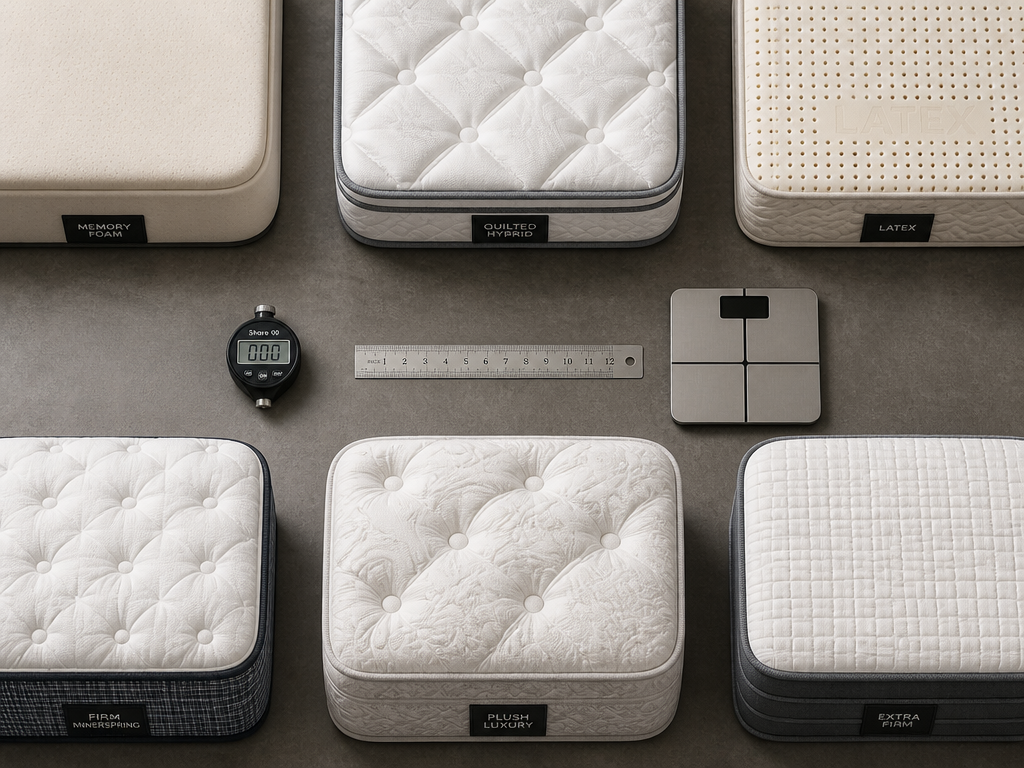
I'm giving you thicknesses I measured with a ruler after break-in, not the ones on the box. Every foam product I bought was thinner than advertised once it finished expanding, and the fiberbed was thicker on day one and much thinner by day seven. Prices are what I paid in June 2026.
| What it was | Paid | Measured after break-in | Median sleep onset | Hip surface, 6 a.m. |
|---|---|---|---|---|
| Bare institutional bed | — | 6.0" core | 26 min | 93.2°F |
| 3" gel memory foam | $72 | 2.6" | 17 min | 96.1°F |
| 2" ventilated latex | $148 | 2.0" | 15 min | 93.8°F |
| 3" down-alternative fiberbed | $46 | 0.9" at the hip | 21 min | 94.5°F |
| 1.5" wool | $110 | 1.4" | 19 min | 92.6°F |
The eleven-minute spread between the worst and best configuration is real but modest. What surprised me was the temperature column moving in the opposite direction from comfort for the memory foam: it was the second-best thing I slept on and by a wide margin the hottest, nearly three degrees above the bare vinyl. I woke up damp on four of five nights on that one. In a room I could keep at 69°F. In an un-air-conditioned residence hall in September, I think that topper is actively a bad idea.
Where each one actually failed
The memory foam slid. Not a little — it migrated four to six inches toward the foot of the bed every night, because vinyl on foam has essentially no friction, and the deep-pocket fitted sheet I'd bought wasn't deep enough to hold 8.6 inches of stack. Two elastic corner straps fixed it for $9. It also off-gassed for a solid four days, a sweet chemical smell that I'd describe as noticeable rather than terrible, and which I would very much not want to introduce to a shared 12-by-16 room on move-in day.
The latex was the best sleep and the worst logistics. Eighteen pounds, no handles, ships rolled and does not re-roll. It cost more than the other three combined minus one. It did not slide, did not smell after the first day, and was the only thing that gave me real pressure relief without a heat penalty — the pin-core perforations actually do something. If you're moving out in May and want to keep it, it's a nuisance. If you're throwing it away in May, it's an expensive nuisance.
The fiberbed is the one everyone's parent buys because it's $46 and it looks plush in the package. It is plush for about five nights. By the end of week one it had compressed at the hip and shoulder into something under an inch thick while staying fluffy everywhere I wasn't, which is the worst possible distribution. Fluffing helped for a night. It's the only one of the four I'd call a bad purchase, and it's the one most likely to be in a shopping cart right now.
The wool was the cool one and I want to be fair to it: 92.6°F, the only surface that measured below the bare vinyl, and no damp mornings at all. Wool moves moisture instead of trapping it, which is exactly the property the ticking lacks. But at 1.4 inches it barely touched the firmness problem — 19 minutes to sleep versus 26 bare, and I could still feel the core. It's a fix for the wrong half of the problem unless heat is your actual complaint.
The hygiene question, which is a different question
Here's where I have to be careful about what I actually know. I didn't swab anything. I have no lab, ran no cultures, and I'm not going to tell you what is living inside a mattress that has hosted a dozen strangers, because I don't know and neither does anyone writing the same sentence with more confidence.
What I can tell you is structural, and it's the most useful thing I learned all summer: the vinyl is not the hygiene problem. The topper is. That sealed cover, whatever else it does to your body temperature, wipes clean with a damp cloth in about ninety seconds. Nothing soaks into it. The moment you put three inches of open-cell foam on top, you've introduced an absorbent layer between you and the wipeable one — and unlike the vinyl, you cannot wipe it, wash it, or meaningfully clean it at all. You've taken the one thing about institutional bedding that was working and covered it up.

So the sequence matters. Zippered encasement on the bare mattress first — the full six-sided kind that closes, not a fitted-sheet-style pad that covers five sides and calls it done. Then the topper. Then a washable protector over the topper, which is the layer that catches everything and goes through a machine every two weeks. Two barriers, about $40 together, and the topper stays clean because it never touches anything.
Washability, briefly, because nobody puts this on the box: foam cannot be washed, ever, only spot-treated and regretted. Wool is spot-clean and airing-out only. The fiberbed is technically machine washable but not in a dorm machine — it needs a 30-pound commercial drum, meaning a laundromat trip and about ninety minutes of drying. Plan for the layer above them instead.
How thick, actually
Under two inches and you'll still feel the core through it; the wool proved that to me over five nights. Over three and a half and two other things start going wrong: the stack gets tall enough that standard fitted sheets stop reaching, and the edges get soft enough to feel unstable on a bed that's already narrower than the one at home. On a 36-inch frame, an inch of mushy perimeter on each side is a meaningful fraction of your usable width.
Two and a half to three inches of measured — not advertised — thickness is the band. Buy the four-inch product if you want, but measure it after 72 hours and don't be surprised when it's 3.2.
One more constraint the product pages will never mention: if your bed is lofted or bunked, adding three inches raises your sleeping surface by three inches, and residence-life agreements have clearance rules about what can sit how close to sprinkler heads and rails. Read yours before you commit to the tall option.
The thing that beat every topper
In week five I ran a deliberately bad experiment on the best surface I had. Same latex topper, same room, same everything — except 200 mg of coffee at 4 p.m. instead of 11 a.m.
Median sleep onset went to 31 minutes. Worse than the bare vinyl with no topper at all.
I'd spent six weeks and $376 moving my time-to-sleep from 26 minutes to 15, and one afternoon latte gave the whole gain back and then took another five minutes as a tip. That's a single week on a single person and I'm not going to over-read it. But it's the finding I'd actually put on a card and tape inside a dorm closet: the best mattress topper you can afford loses to a 4 p.m. coffee. The surface is worth fixing. It is the second thing to fix.
Who this is for, and who should skip it
Buy one if: you sleep on your side, you've looked at your assigned mattress and can see a body impression that isn't yours, or you've had hip or shoulder pain on a firm bed before. Side sleepers get the most out of the two-to-three inch band because that's the depth at which a shoulder can actually sink instead of stack.
Buy the wool, specifically, if: your building has no air conditioning and your complaint is waking up hot rather than waking up sore. Do not buy memory foam into that room. My numbers on that are as clear as anything I measured.
Skip it if: you're a back sleeper who genuinely likes a firm bed, in which case the encasement is the entire purchase and you can keep $100. Skip it also if your real problem is that the room sits at 76°F in September — no topper fixes an HVAC problem, and a fan and a window are cheaper than all four of these combined.
And skip the cheap fiberbed regardless. It's the most-purchased option and the only one I'd call a waste. Forty-six dollars for five good nights is worse value than nothing.
The line worth screenshotting
If you buy one thing, buy the zippered encasement. If you buy two, make the second a two-inch ventilated latex topper. Everything else I tested was a compromise with a specific cost attached.
What to do this week
Don't order a topper yet. Do one thing instead: find your housing portal or email residence life and get the actual mattress dimensions and depth in writing — width especially, because 36 versus 38 inches decides whether your sheets fit. Then buy a single item, a six-sided zippered encasement in that exact size, for somewhere around $25 to $35.
Put it on the bare bed on move-in day and sleep on it for ten nights before buying anything else. You'll know by night four whether your complaint is heat, firmness, or neither — and you'll be buying the topper in mid-September, after the August markup has come off, with a real answer instead of a guess.