The number gets recycled every summer: the average person washes their sheets every 24 days. It comes from a mattress-brand survey, not a laboratory, and it has mostly been doing work it was never designed for — shaming. The more interesting question is the one you've probably asked while stripping a bed that smelled faintly of yourself: does any of this actually matter, or is it aesthetics? Sleep hygiene, as a term, was coined to describe behavior — light exposure, caffeine timing, a consistent wake time. Nobody meant laundry. But the literal reading has become an industry, and some of it holds up better than the rest.
Here is what's true, what's plausible, and what is being sold to you.
What actually accumulates in a bed, in the order it happens
Start with the thing that makes a bed different from a couch: you sleep in it, and sleep is a thermoregulatory event.
About thirty to sixty minutes before you fall asleep, core body temperature begins to fall, and it keeps falling for the first several hours of the night. The body doesn't lose that heat by magic. It dumps it through the skin — distal vasodilation in the hands and feet, and evaporation across the whole surface. So the first thing that goes into your bedding is water. Insensible perspiration alone runs on the order of a few hundred milliliters over a night for most adults, more if the room is warm, more again if you're perimenopausal, feverish, or drinking.
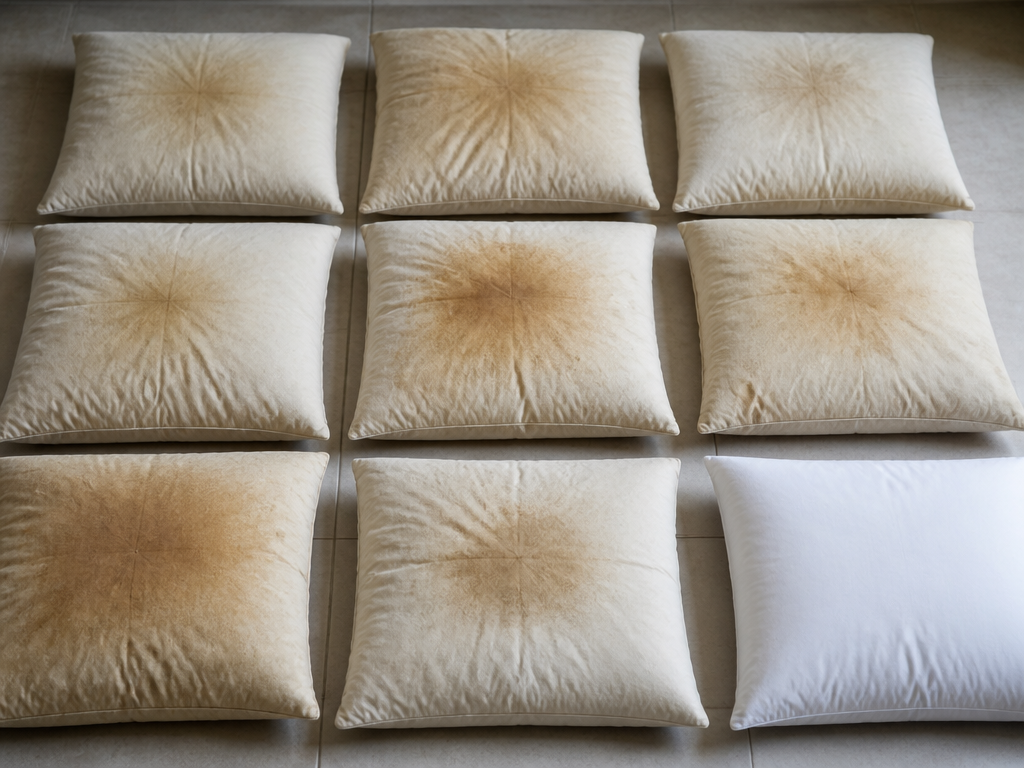
Second: sebum. Facial skin secretes it continuously, and the pillowcase is pressed against the highest-density sebaceous region on the body for seven hours.
Third: skin. The commonly cited figure is that humans shed roughly a gram of corneocytes a day, a meaningful fraction of it in bed.
Now the ecology. Dermatophagoides pteronyssinus and D. farinae — house dust mites — eat those skin scales. They do not drink; they have no way to. They pull water vapor directly out of the air through supracoxal glands, which means their entire population ceiling is set by humidity. Larry Arlian's group at Wright State spent decades establishing this, and the practical upshot is a threshold: sustained relative humidity below roughly 50 percent desiccates them. Above about 60 percent, they thrive. A mattress that absorbs a few hundred milliliters of water every night is a humidity reservoir sitting inside a room that might otherwise be dry.
What provokes allergy isn't the mite. It's Der p 1 and Der f 1, digestive proteases in mite feces, which are water-soluble and become airborne when you disturb the bed — which is to say, every time you get into it.
What the research actually measured
The temperature number everyone repeats — 140°F, 60°C — has a real study behind it. McDonald and Tovey (1992), in the Journal of Allergy and Clinical Immunology, washed mite-infested bedding at a range of water temperatures and counted what survived. Water at 55°C and above killed essentially all mites. Cold and warm washes did not; a substantial share of mites survived the cycle. But — and this is the part that gets dropped — the cold washes still removed most of the allergen, because Der p 1 is water-soluble and simply rinses away.
So the two goals come apart. Killing mites needs heat. Removing the protein that actually makes your eyes itch mostly needs water and agitation.
Then comes the deflation. Gøtzsche and Johansen (2008), in the Cochrane Database of Systematic Reviews, pooled more than fifty randomized trials and roughly three thousand patients testing house-dust-mite control measures for asthma, and found no clinically useful benefit. The largest single trial, Woodcock et al. (2003) in the New England Journal of Medicine, gave 1,122 adults with asthma allergen-impermeable bed encasings or control covers and measured morning peak expiratory flow at six months. No significant difference.
This is the honest center of the topic. Bedding measures reliably lower measured allergen. They do not reliably lower measured symptoms — probably because a mattress cover doesn't touch the allergen in your carpet, sofa, and car, and because getting under the threshold that matters clinically is harder than getting the number down.
The exception worth knowing: Morgan et al. (2004), also in NEJM, ran a multi-component environmental intervention with 937 inner-city children with asthma and did see fewer symptom days. But that trial changed bedding and pest control and air filtration at once. You cannot pull the sheets out of it and claim the credit.
How often should you actually wash your sheets?
Weekly if you sweat, are allergic, have eczema, or the room is warm and humid. Every one to two weeks otherwise. Wash at 60°C (140°F) if you're managing dust mite allergy or asthma; a normal 40°C (104°F) wash is fine for everyone else, because the allergen rinses out regardless of temperature. Pillowcases are the exception to the whole schedule — they get the sebum and the face, and they earn a change every two to three days.
| Item | Frequency | Temperature | Why |
|---|---|---|---|
| Pillowcase | Every 2–3 days | 40°C is fine | Sebum, facial contact, hair product |
| Sheets | Weekly (warm/humid) to biweekly | 60°C if allergic | Skin scales, moisture, mite food |
| Duvet cover | Every 2 weeks | 40°C | Less skin contact, still absorbs vapor |
| Pillow (the pillow itself) | Every 3–6 months | 60°C, or replace | The densest mite reservoir in the bed |
| Duvet / comforter | 2–3× per year | 60°C or professional | Rarely washed, heavily colonized |
Where the answer honestly depends
Eczema: plausible, evidence mixed. Atopic dermatitis flares with mite sensitization in a meaningful subset of patients, but trials of mite reduction have produced inconsistent results. The stronger and better-supported move is fabric and detergent: fully rinsed loads, no fabric softener, no fragrance. Residual surfactant on a compromised skin barrier is a real irritant, and that mechanism isn't in dispute.
Acne and oily skin: mostly folk wisdom. The dermatology literature contains almost no controlled work on pillowcase frequency and lesion counts. What's defensible is narrower: pillowcases accumulate sebum, and Malassezia — a lipophilic yeast that drives folliculitis often mistaken for acne — grows on lipids. Frequent pillowcase changes are cheap, harmless, and mechanistically reasonable. That is not the same as proven. Silk pillowcases, sold hard on this claim, have essentially nothing behind them.
Night sweats and hot sleepers: this is the strongest real case, and it's the least discussed. If you're soaking bedding, you're both raising local humidity above the mite threshold and degrading sleep directly — damp fabric conducts heat away unpredictably and fragments sleep. Weekly is a floor here, not a target.
Immunosuppression: different calculus entirely. Post-transplant, on biologics, mid-chemotherapy — follow your clinical team, not a magazine.
The honest rule of thumb
Tonight: change the pillowcase, open a window or run the dehumidifier, and put the sheets on the calendar for Sunday.
If you remember nothing else, remember the ratio. Humidity control does more than laundry frequency. A bedroom held under 50 percent relative humidity starves mites in a way that no wash cycle can match, because you're removing the water they live on rather than the population they've already built. Second: wash the pillow, not just the case. It is the single most colonized object in the bed and almost nobody touches it.
And if you're washing cold to save energy, tumble dry hot. Ten minutes of high dryer heat is commonly cited as sufficient to kill surviving mites — desiccation finishes what the wash didn't.1
The myth is that dirty sheets are quietly making you sick, and that a hot enough wash on a strict enough schedule will fix your allergies, your skin, and your sleep. The truer version is smaller and more useful: your bed is a humidity and skin-scale reservoir, laundry manages the symptoms of that, a dehumidifier manages the cause, and a fresh pillowcase is worth more to how tonight feels than the calendar you feel guilty about.
-
Cold-water detergents have improved enough that soil removal at 20–30°C is no longer the issue it was in the 1990s. Mite mortality is — enzymes clean, they don't kill arthropods. ↩