Almost every viral hack I tried made a pillow whiter. Almost none of them made it cleaner. Those are two separate problems, and somewhere in the last few years of scroll-optimised laundry content they got quietly welded into one.
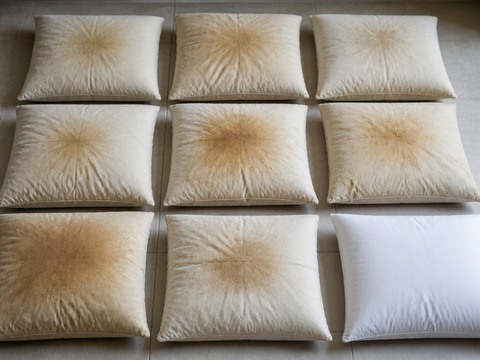
I spent three weeks testing eight pillow cleaning methods — five lifted from the videos my phone keeps handing me, three borrowed from care labels and a commercial laundry — on nine donated pillows aged between two and eleven years. I weighed them, photographed them against the same tile in the same window, and made two relatives sniff them blind.
The verdict, since that's what you came for: a six-hour soak in sodium percarbonate followed by a 60°C wash and a genuinely complete dry beat everything else on both whiteness and soil removal, and cost about forty-five cents a pillow. The most spectacular-looking method — hydrogen peroxide paste in direct sun — produced the whitest pillow in the test while removing less than half the material of a boring hot wash. Both of those things are true at once. That gap is the whole article.
The yellow is not dirt
The stain you're looking at is mostly your own sebum, and specifically what happens to it over time. Skin oil is largely triglycerides, wax esters and squalene. Squalene oxidises. Its breakdown products are yellow-brown and they bind to the fibre rather than sitting on top of it. Add sweat salts, urea, hair product, night cream, and years of eight-hour contact, and you get a stain that is chemically part of the fabric.
Detergent and agitation lift what is loose and water-soluble. They barely touch a bound chromophore. To remove the colour, you have to break the bonds that make it coloured — which means oxidising it. That's what chlorine bleach does, what UV does, what hydrogen peroxide does, and what sodium percarbonate does (percarbonate is essentially solid peroxide; drop it in warm water and it releases hydrogen peroxide).
So the whitening hacks aren't fake. They're doing real chemistry. They're doing it to the symptom.
What makes a pillow unpleasant to sleep on is mass: skin cells, mite waste, absorbed oil, and — if it's ever dried slowly — mould. That is a weight problem, and weight comes out through hot water, surfactant, mechanical action and a dryer you run longer than feels reasonable. None of that films well. All of it is what the pillow actually needs.
How I tested
Nine pillows: three of mine, two from my sister, four from colleagues who handed them over with an expression I'd describe as relief. Eight polyester cluster fill, one duck feather, one memory foam. The memory foam was excluded before testing began — its label says spot clean only, and the dry cleaner I asked declined it flatly.
Five measurements per pillow:
- Bone-dry weight, before and after, on a kitchen scale reading to 1 g. "Bone dry" meant tumbled until three consecutive ten-minute weigh-ins agreed within 2 g. This turned out to matter enormously.
- Yellowness. Each pillow photographed flat beside the same white ceramic tile, same north window, between 10 and 11 a.m., phone locked to a fixed exposure and white balance. I sampled a 300 × 300 px patch from the worst-stained quadrant and converted it to CIELAB, recording b*, the blue-to-yellow axis. This is not a spectrophotometer. I'd trust it to about ±1.5.
- Odour. Three people, pillows in identical unmarked cases, sniffed at roughly 20 cm. Scale of 0 (nothing) to 5 (I would not sleep on this).
- Loft. Uncompressed centre height, steel ruler, average of three placements.
- Cost and hands-on time, tracked as I went.
What this test is not: it's one cycle of each method on one pillow. There is no repetition, no allergen assay, no mite count. Two of my three noses are genetically related to the third. I can tell you what came off and what changed colour. I cannot tell you what's living in there.
One pillow arrived with a coffee ring on it — a full mug, apparently, at about 11 p.m. I kept it in the test on purpose, because tannin stains and sebum stains fail differently, and I wanted to see which methods knew the difference.
The five viral methods
The lemon bathtub soak
The hottest tap water I could get (51°C at the spout, measured), six sliced lemons, half a cup of washing soda, a squeeze of dish soap. Pillow submerged, weighted down with a saucepan, four hours, agitated every hour by hand. Then a rinse cycle in the machine and a full dry.
b* 18.2 → 12.4. Weight down 14 g. Odour 1.0. Loft unchanged. Cost $3.40, almost all of it lemons.
The water turns brown, and I understand why this footage travels. But I ran a control tub: same soda, same soap, same four hours, no lemons. That one went 18.5 → 13.1. The lemons bought me 0.7 points of b* and a pleasant-smelling bathroom. Citric acid at bathtub dilution is a decent chelator for mineral and rust marks; it is not what breaks down oxidised squalene. The washing soda and four hours at 45–50°C were doing the work.
Worth naming the other cost: a full tub is roughly 130 litres of heated water per pillow. This was by a wide margin the most resource-expensive thing I did.

The bleach strip-wash recipe
Borax, washing soda, powdered detergent and chlorine bleach, hot cycle, extra rinse. This is the recipe reposted with the most confidence, usually over a shot of grey water.
Straight out of the dryer it looked like the best result of the day: b* 17.6 → 11.9. Weight down 18 g. Odour 0.7.
Then it drifted. Forty-eight hours in a linen cupboard and the same patch measured 14.2. I re-shot it twice because I assumed I'd fumbled the exposure. I hadn't. The usual explanation is that chlorine degrades the optical brighteners in the fabric and reacts with residual nitrogen compounds, and heat accelerates the result — a pillow that un-whitens in storage. Whatever the precise mechanism, it happened, and it happened only to the bleached pillow.
The loft was worse news: 11 cm down to 8.5 cm, with the fill clumped into ropes that never came back, including after a tumble with tennis balls. Of everything I tested, this is the one I'd actively steer someone away from.
Hydrogen peroxide paste, then sun
3% pharmacy peroxide, dish soap and bicarbonate mixed into a loose paste, painted onto the stain, three hours in direct sun, then a normal hot wash.
b* 18.9 → 6.8. That is the largest colour change anything produced in this test, by a comfortable margin. Weight down 11 g. Cost $1.20.
I had this filed as theatre and I was wrong. Peroxide at alkaline pH under UV is a genuinely aggressive oxidative system, and an eleven-year-old sebum stain did not survive it. It also took the coffee ring out completely, which the plain hot wash had not touched.
And then look at the weight column. Eleven grams. It out-whitened the 60°C wash by eight points of b* and removed half as much material. The pillow that photographs best in this test is the fourth-cleanest thing in it.
Sun alone
Six hours out, flipped at three. b* 18.4 → 13.6, which is more than plain washing achieved. Weight down 3 g, and that's moisture. Odour improved from 1.6 to 1.3 — sunlight does deal with a lot of what smells.
It is free and it works on colour. It also brought back the entire contents of a July hedgerow. My eyes streamed for an hour and the pillow smelled faintly of pollen for two days. If you have hay fever, this is a straight trade of one problem for another.
Twenty-four hours in the freezer
The no-wash hack: bag the pillow, freeze it, kill the mites.
b* 18.1 → 18.0, which is inside my error bars. Weight down 1 g. Odour 2.6 before, 2.4 straight out of the freezer, and back to 2.6 within a day of normal use.
A domestic freezer runs around −18°C, and cold can kill mites given long enough exposure. It does nothing to the allergen protein in their waste, which is the part people actually react to. Dead mites are still full of it. I had no way to measure that, so I'm reporting only what I could measure, which is: nothing changed that I could weigh, photograph or smell.
The three boring methods
A plain 60°C wash
Liquid detergent, extra rinse, two pillows at a time to keep the drum balanced, then dried with wool balls until bone dry. That took 95 minutes in my machine — about forty minutes longer than I'd have guessed, and the last twenty minutes were removing water from the core, which is exactly the water that causes trouble if you leave it.
b* 19.1 → 15.0. Weight down 21 g. Odour 0.3, the lowest score in the entire test. Loft 11 cm → 10.5 cm.
This is the least impressive photograph and the second-best pillow. It removed twice the material of the peroxide paste and stayed visibly yellow. If you only judge by looking, you will conclude this method failed.
Sodium percarbonate presoak, then a hot wash
Two tablespoons per pillow in a bucket of 50°C water, six hours, topped up with hot water once when it dropped below 40°C — percarbonate goes sluggish below about 40. Then a standard 60°C wash and a full dry.
b* 18.7 → 7.9. Weight down 23 g. Odour 0.3. Loft 11 → 10.5. Roughly $0.45 a pillow.
Within 1.1 points of the peroxide paste on colour, and more material removed than the plain hot wash. Nothing else in the test scored well on both axes. It also took the coffee ring out, which makes sense — oxygen bleach is good on tannins.
The laundromat
An 18 kg machine, 60-minute sanitise cycle, 45 minutes of high heat. Four pillows in one load.
b* 18.3 → 14.1. Weight down 24 g, the highest figure I recorded. Odour 0.2. About $3.40 a pillow and 105 minutes, all of which I spent sitting there.
Best mass removal, best smell, unremarkable whitening — because a sanitise cycle is heat and agitation, not a six-hour oxygen soak. Dessie, who has run the place for nineteen years, watched me weighing pillows and told me hotels don't whiten them either. They replace them. "Two years, out."
The grid
The five viral methods

| Method | Yellowness b* | Soil removed | Odour after | Cost | Hands-on |
|---|---|---|---|---|---|
| Lemon tub soak | 18.2 → 12.4 | 14 g | 1.0 | $3.40 | 45 min |
| Bleach strip-wash | 17.6 → 14.2* | 18 g | 0.7 | $0.90 | 20 min |
| Peroxide paste + sun | 18.9 → 6.8 | 11 g | 0.5 | $1.20 | 25 min |
| Sun alone | 18.4 → 13.6 | 3 g | 1.3 | $0 | 10 min |
| Freezer, 24 h | 18.1 → 18.0 | 1 g | 2.4 | $0 | 5 min |
*Measured 11.9 out of the dryer; drifted to 14.2 over 48 hours.
The three standard methods
| Method | Yellowness b* | Soil removed | Odour after | Cost | Hands-on |
|---|---|---|---|---|---|
| 60°C wash + full dry | 19.1 → 15.0 | 21 g | 0.3 | $0.60 | 15 min |
| Percarbonate soak + 60°C wash | 18.7 → 7.9 | 23 g | 0.3 | $0.45 | 25 min |
| Laundromat sanitise cycle | 18.3 → 14.1 | 24 g | 0.2 | $3.40 | 105 min |
Read the two tables against each other and the pattern is unmissable. The viral methods own the colour column when they involve an oxidiser and the sun. The boring methods own the weight and odour columns. Exactly one row in either table is strong in both, and it isn't a hack — it's the presoak that commercial launderers have used for decades, done at home in a bucket.
The winner
Two tablespoons of sodium percarbonate, a bucket of 50°C water, six hours, then a hot wash and a dry that runs twenty minutes longer than you think it needs to. Forty-five cents a pillow, and most of the six hours is you doing something else.
Who this is for, and who it isn't
Worth doing if your pillow is polyester cluster fill, under about four years old, yellowed, and you have access to a dryer. That's the exact case where the presoak pays: the fibre tolerates the oxidiser, the fill recovers its loft, and you get both columns.
Skip the submersion entirely if you don't have a dryer. A soaked pillow drying on a rack indoors holds moisture in its core for days, and that is a mould problem you've created on purpose. A slow-dried pillow is worse than the pillow you started with, and it is worse in a way you won't be able to see.
Feather and down: not like this. I put the duck feather pillow through the lemon tub soak and it was the one outright casualty of the project. Three dryer cycles to get it dry, a persistent wet-bird smell for a week, and loft that came back to maybe 70% of where it started. Down wants a front-loader, a down-specific detergent that won't strip the natural oils, and a very long low-heat tumble with something to break up the clumps. That's a different test and I didn't run it.
Memory foam: don't submerge it. You cannot get the water back out of a solid foam core with any equipment you have at home, and the water that stays becomes the problem. Nobody I asked would clean it either.
If your pillow is old, none of this is the answer. The eleven-year-old pillow in the test came out of the percarbonate soak beautifully white and still folded in half under its own weight. I made a clean pillow that doesn't hold a neck up. Dessie's two-year rule is doing more work than any recipe here.
What I couldn't answer
Four things, and they're not small.
Allergen load. This is the reason a lot of people wash a pillow at all, and I measured none of it. I weighed material out of the fill; I have no idea how much of that mass was mite faecal protein, or what fraction of what remained was still allergenic. The received threshold for killing mites in a wash is 60°C, but killing mites and removing the protein they leave behind are different outcomes, and only one of them is the thing that makes you sneeze. Home test kits for Der p 1 exist and are not expensive. Anyone willing to run pre- and post- assays across these same methods would have the version of this article I actually wanted to write.
Durability. One cycle each. I don't know what a six-hour oxygen soak every eight weeks does to polyester cluster fill over two years, and the loft column is where I'd expect to find out. That's a twelve-cycle test with a ruler at every step, and it takes a year.
Memory foam. Still open. Nobody would touch it, and I wasn't willing to destroy mine to find out. Whoever works out how to wash a foam core and dry it through the middle has the piece that nobody has published.
Whether any of it changes how you sleep. I didn't measure sleep, and I'd distrust myself if I had — I spent three weeks becoming extremely invested in these pillows, which is precisely the sort of expectation that wrecks a sleep experiment. What I bought myself was the feeling that the pillows were clean. That feeling cost forty-five cents, and I'd want a much better-blinded setup than one enthusiastic person and a phone before I'd claim it was worth anything more than that.