You have probably heard the short version. Somebody snores, somebody stops breathing in the night, and the advice arrives almost before the diagnosis does: lose some weight and it'll clear up. It is the most repeated explanation for sleep apnea, and among the sleep apnea causes a doctor might list, body weight usually leads. The advice is not wrong, exactly. It is just doing a lot of work that it cannot finish on its own, and the gap between what it promises and what it delivers is where a lot of people get stuck — losing twenty pounds, sleeping no better, and concluding that something is broken in them specifically.
Something probably is. It's just not the thing the advice assumed.
This piece is about that gap. Where the weight story holds, where it falls apart, and what a more honest version of the rule would sound like if anyone said it out loud in the exam room.
The advice, stated fairly
Start by giving the conventional wisdom its due, because it earned its place.
Obstructive sleep apnea is, mechanically, a plumbing problem. The upper airway — the soft tube running from the back of your nose down past the base of your tongue — has no rigid scaffolding to hold it open. It stays open because the muscles around it keep tension, and because there is enough room inside it for air to pass. During sleep, muscle tone drops. That is normal and happens to everyone. The question is whether the airway can stay open anyway.
Fat changes the math. Adipose tissue deposits in the neck, the tongue, and the soft tissue of the pharynx narrow the tube before sleep even begins. A 2014 study by Kim and colleagues in Sleep, using MRI, found that tongue fat volume specifically — not just neck circumference — tracked with apnea severity, and that obese patients with apnea had measurably more fat in the tongue than obese patients without it. The tongue is a muscle, but it stores fat like anywhere else, and a heavier tongue falls back more easily when tone drops.
The population numbers back the intuition. In the Wisconsin Sleep Cohort, the long-running study most often cited on apnea prevalence, a 10 percent gain in body weight was associated with roughly a sixfold increase in the odds of developing moderate-to-severe apnea over four years. The Sleep AHEAD trial, an arm of the larger Look AHEAD diabetes study, put intensive lifestyle weight loss against general counseling in adults with type 2 diabetes and apnea; the weight-loss group saw a meaningful drop in apnea severity, and the more weight they lost, the more the apnea improved.
So when a clinician points at the scale, they are pointing at a real lever. For a large share of patients — particularly middle-aged men carrying central weight, who are the textbook presentation — weight is the dominant, modifiable cause. The advice is not folk wisdom. It is well-established, and it is the first thing to try for good reason.
The trouble is that "first thing to try" quietly became "the explanation," and those are not the same claim.
What sleep apnea actually is, in the order it happens
To see where the story breaks, it helps to watch one apnea event unfold in real time, in the order your body lives it.
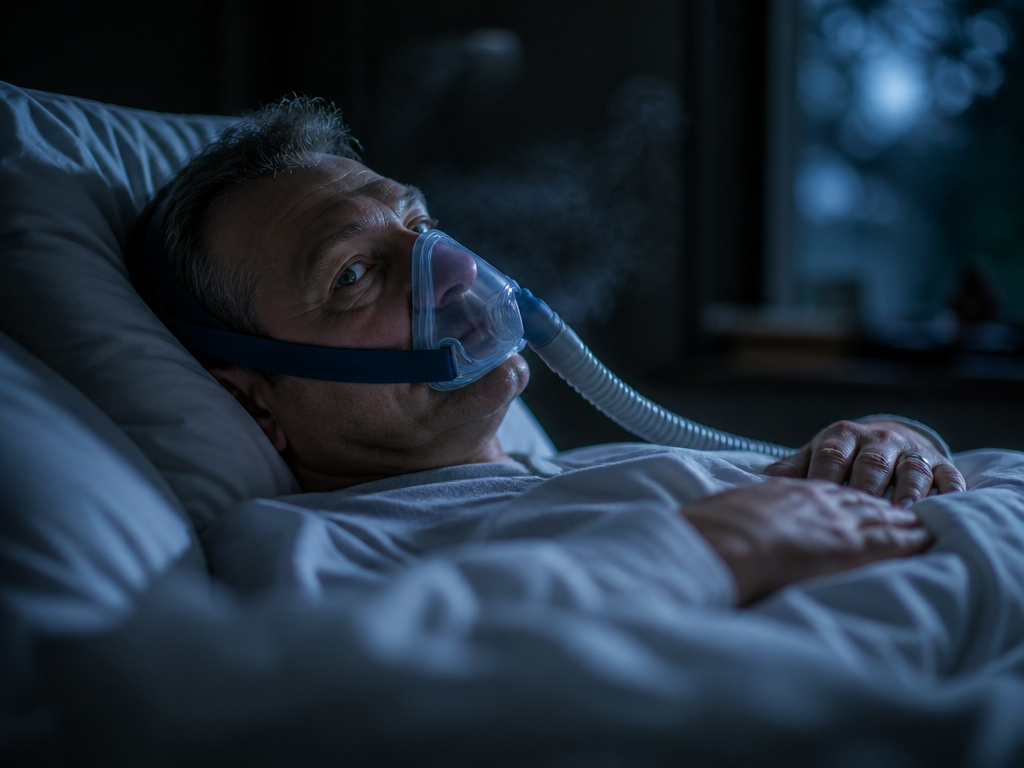
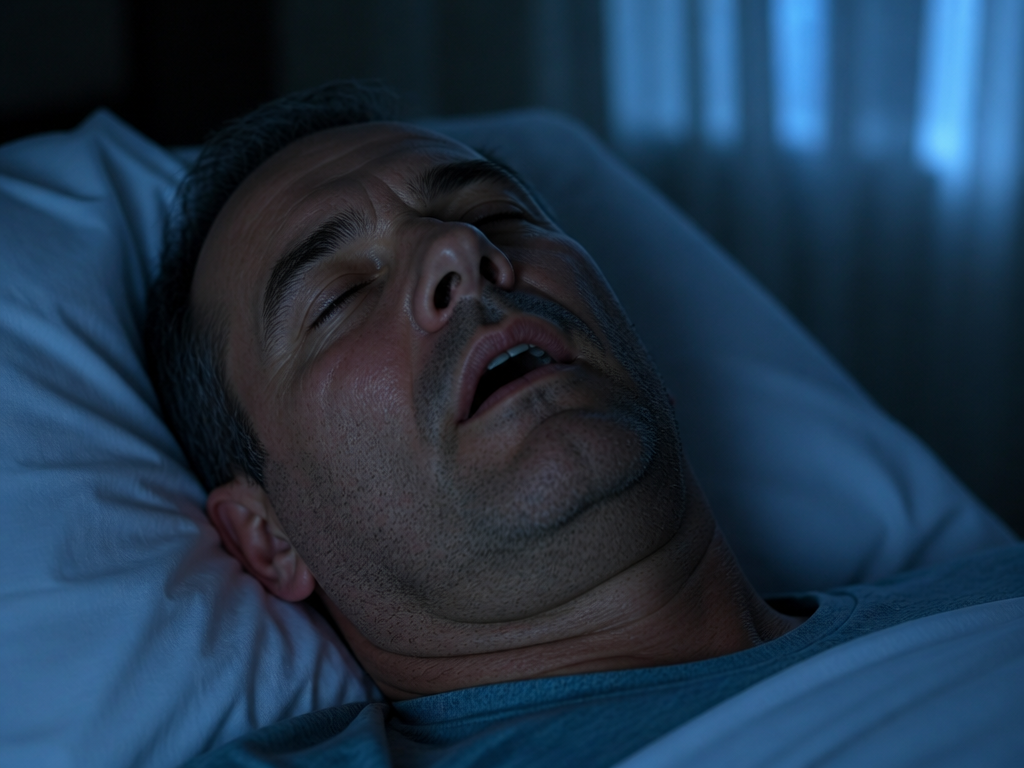
You fall asleep. Muscle tone in the throat eases off, as it does in everyone. In a vulnerable airway, the walls of the pharynx draw closer together. You keep trying to breathe — the chest and diaphragm are still pulling — but the airway has narrowed to a slit or closed entirely. This is the obstructive part: the effort is there, the airflow is not. A partial collapse that reduces airflow is a hypopnea; a full stoppage is an apnea. Either way, the seconds stack up. Ten, twenty, sometimes forty.
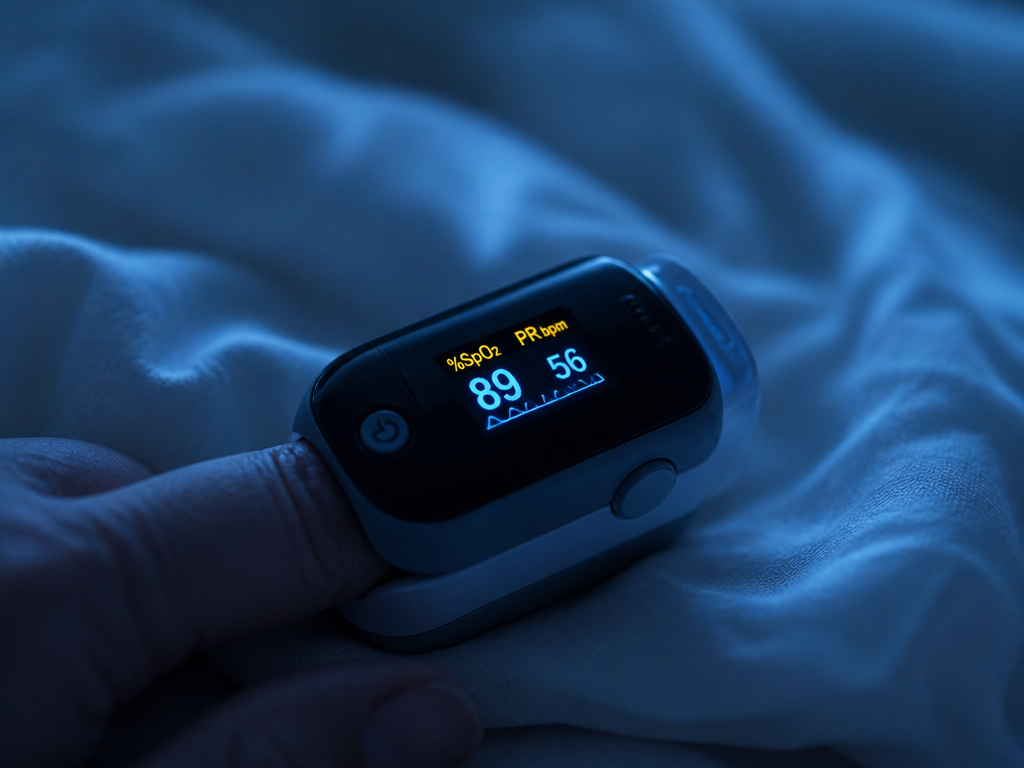
While no air moves, the oxygen saturation in your blood begins to drop. It might fall from a healthy 97 percent to the low 90s, the 80s, occasionally further. Carbon dioxide rises in parallel. Your brainstem, monitoring these gases, registers a problem and does the only thing it can do quickly: it wakes you up. Not into consciousness, usually — into a brief micro-arousal, a few seconds of lighter sleep, just long enough for muscle tone to snap back and the airway to reopen. You gasp, the breathing resumes, the oxygen recovers, and you sink back down.
Then it happens again. In severe apnea, this cycle repeats hundreds of times a night. You will not remember a single one of them.
Clinicians score this with the apnea-hypopnea index, or AHI: the number of these events per hour of sleep. Five to fifteen is mild, fifteen to thirty is moderate, above thirty is severe. The number matters less than what it represents — a night spent in a slow-motion fight to breathe, broken into fragments so small they never register as waking, which is exactly why people with serious apnea so often swear they slept fine.

One important fork in the road. Most apnea is obstructive: the airway closes while the body tries to breathe. A smaller share is central sleep apnea, where the problem is upstream — the brainstem briefly stops sending the signal to breathe at all. There is no obstruction; there is no effort, because no command was issued. Central apnea shows up in heart failure, after stroke, with certain opioid medications, and at high altitude. It is a different mechanism with different causes, and weight has little to do with it. Mixed forms exist too. Holding these apart matters, because the moment you assume all apnea is the obstructive, weight-driven kind, you have already narrowed your view of the causes to one slice of the picture.
What causes sleep apnea?
The short answer: sleep apnea is caused by anything that either narrows the upper airway, weakens the muscles that hold it open, or — in central apnea — disrupts the brain's drive to breathe. Body weight is one major contributor, but the airway can be compromised by the bones of your face and jaw, the size of your tonsils and tongue, your age and sex, nasal blockage, alcohol and sedatives taken before bed, and several medical conditions. Most people with apnea have more than one of these working at once.
That is the honest one-paragraph version. The longer one is worth your time, because the causes cluster into things you were handed and things you do.
The anatomy you were born with. A small or set-back lower jaw (retrognathia), a high narrow palate, a long soft palate, enlarged tonsils or adenoids, a thick neck, a tongue that sits large relative to the space available — these are structural, and they are heritable. Apnea runs in families partly because faces run in families. You can be lean, fit, and sober and still have an airway that was built one size too small.
Age and the loss of muscle tone. Pharyngeal muscle tone declines with age, and apnea prevalence climbs steadily into the 60s. This is not a moral failing; it is the same tissue softening that shows up everywhere else in an aging body, in a place where a few millimeters decide whether air moves.
Sex and hormones. Men develop apnea earlier and more often than women through midlife — the usual estimate is roughly two to three times the rate before menopause. Then the gap narrows. After menopause, women's risk rises markedly, which points at a protective role for progesterone and estrogen, both of which influence breathing drive and airway tone. The hormonal story is plausible and supported by the epidemiology, though the exact mechanisms are still being worked out.
Fluid that moves at night. Here is a cause almost no one mentions. When you lie down, fluid that pooled in your legs during the day redistributes upward, and some of it settles in the neck, narrowing the airway from the inside. This "rostral fluid shift" is why apnea is worse in people with heart failure, kidney disease, and unmanaged high blood pressure, and why some patients are worse on the nights they sat the longest. Redolen and Yumino's work in the late 2000s helped establish this; it remains one of the more elegant and underappreciated pieces of the puzzle.
Things you took before bed. Alcohol relaxes the pharyngeal muscles and blunts the arousal response, meaning the airway collapses more easily and your brain is slower to rescue you. Sedative-hypnotics and opioids do versions of the same thing. None of these cause apnea from nothing, but they convert a borderline airway into a frankly obstructed one, night after night.
Nasal obstruction. A deviated septum, chronic congestion, or polyps force mouth-breathing and change the pressure dynamics of the whole airway. On its own, nasal blockage rarely produces severe apnea, but it lowers the threshold for everything else.
Medical conditions. Hypothyroidism can cause tissue changes and weight gain that worsen apnea. Acromegaly enlarges the tongue and soft tissue. And as noted, heart failure and stroke open the door to central apnea specifically.
Read that list again and notice how much of it has nothing to do with the scale.
Where the weight story breaks down
The cleanest evidence against "it's just weight" is the person who walks into a sleep clinic with an AHI of 40 and a perfectly ordinary BMI.
They are not rare. Estimates vary, but a meaningful minority of obstructive apnea patients are not overweight — depending on the population studied, somewhere between a fifth and a third. In these patients, the cause is usually skeletal: a jaw and midface built in a way that leaves the airway small no matter what the body around it weighs. You cannot diet your way out of the shape of your mandible.
This is also where ethnicity enters, and where the data is genuinely interesting rather than just politically careful. Studies comparing apnea across populations — work by Ip and colleagues in Hong Kong, among others — found that East Asian patients tend to develop apnea at lower BMIs than their white counterparts, and that craniofacial structure carries more of the explanatory weight. Meanwhile, some research suggests obesity contributes more heavily to apnea risk in white and Black populations. The same disease, in other words, is reached by different roads in different bodies. A weight-first model fits some of those roads and badly misreads others.

Children break the story most completely. Pediatric obstructive sleep apnea is, in the typical case, not about weight at all — it is about enlarged tonsils and adenoids crowding a small airway. The standard treatment is to remove them, and it often works. A child who snores, pauses, and sleeps fitfully needs an ENT evaluation, not a diet, and treating their apnea as a lifestyle problem is a category error.
Even the weight-loss success stories come with an asterisk worth reading. In Sleep AHEAD, the lifestyle group's apnea improved, yes — but a large fraction still had clinically significant apnea at the end, and the benefit faded as weight crept back. Weight loss reduced severity more reliably than it produced cures. For someone with significant craniofacial contribution layered under their weight, losing the weight peels back one layer and reveals the airway that was always going to be too small.
So the honest accounting looks like this:
| The weight story is roughly right when… | The weight story breaks down when… |
|---|---|
| The patient has gained weight and apnea appeared alongside it | The patient is lean and has severe apnea |
| Neck and tongue fat are clearly elevated | The airway is small for skeletal reasons |
| The patient is a middle-aged man, central adiposity | The patient is a child with large tonsils |
| Modest weight loss tracks with symptom relief | Apnea is central, not obstructive |
| Hormonal shifts (menopause) drive new onset |
None of this means weight loss is pointless. It means weight is a cause among causes, with a share that varies enormously from one person to the next — and that "lose weight" as a stand-alone prescription quietly assumes a share of 100 percent it can almost never claim.
What you can actually change, and what you can't
Sort the causes into two piles and the path forward gets clearer.
In the can't-change pile: the bones of your face, your jaw position, the size of your tongue and palate, your age, your sex, your genes. These set the baseline — the airway you start with. You don't get to renovate them with behavior, and pretending otherwise is how people end up blaming themselves for a problem that was partly built in.
In the can-change pile: body weight, certainly, and it remains worth pursuing because it is one of the few levers that shifts severity at all. But also alcohol in the hours before sleep, which is among the most underrated reversible aggravators. Also sleeping position — a subset of people have apnea that is markedly worse on their back, where gravity drops the tongue straight into the airway, and side-sleeping genuinely helps them. Also treating nasal obstruction, managing the conditions that drive nighttime fluid shifts, and reviewing sedatives with a doctor.
And then there is the lever that isn't about cause at all. CPAP, oral appliances, positional therapy, and in selected cases surgery don't address why your airway collapses — they keep it open regardless. For an airway that is small for structural reasons, mechanical support is not a failure of willpower. It is the appropriate tool for a structural problem, the way glasses are the appropriate tool for an eye that focuses light short of the retina. Nobody tells you to squint harder.
An honest rule of thumb for tonight: If you snore, wake unrefreshed, or someone has watched you stop breathing, treat that as a reason to get an actual sleep evaluation — not as a reason to start a diet and wait. Cut alcohol in the three hours before bed and try sleeping on your side this week; if symptoms ease, you have learned something useful, and if they don't, you have lost nothing and confirmed it's worth investigating further.1
The one thing not to do is treat your weight as both the diagnosis and the cure. It might be a large part of the story. It is almost never the whole of it, and the only way to know your particular share is to have the airway looked at by someone who can measure it.
The number, reconsidered
Come back to where we started — the snorer who is told the apnea will clear up if the weight comes off. The Wisconsin cohort number is real: gain weight, and your odds of apnea climb steeply. But run the same logic backward and it doesn't reverse as cleanly as the advice implies. Lose the weight and severity drops, often substantially; cures are the exception, not the rule, and what's left behind is the airway you were always working with.
Sleep apnea is not a verdict on how you've lived. It is the shape of your airway meeting the weight of your body meeting the chemistry of your night — and weight is only one of those three.
-
One caveat: a home test of side-sleeping and skipped nightcaps is a clue, not a diagnosis. People with severe or central apnea can feel "a little better" and still be desaturating dangerously every hour. The bedside experiment is for motivation and information, never as a substitute for a polysomnogram or a validated home sleep test ordered by a clinician. ↩