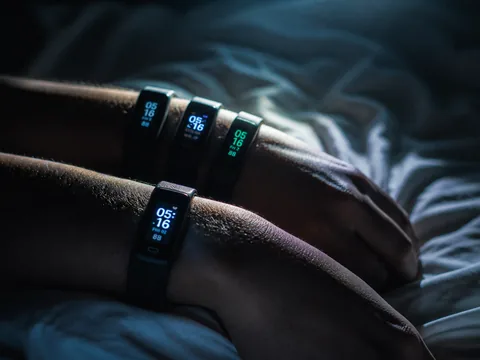
On the ninth night I finally did the thing I'd been putting off: a double espresso at 4:12 p.m., timed against the kitchen clock, and then four budget fitness trackers strapped across two wrists like someone wearing their entire watch collection to bed. Roughly 137 mg of caffeine, depending on the grind. Lights out at 11:06 p.m. The question was small and slightly petty — can a $40 band tell me what that espresso costs me?
Three of the four said I slept fine. The fourth said I slept fine as well, but credited me with 41 minutes of deep sleep where its neighbour on the same wrist, over the same eight hours, reported 1 hour 22. My overnight resting heart rate, though, was up five beats on all four.
The verdict in one sentence: cheap sleep trackers are close to useless at telling you which stage of sleep you were in, genuinely reliable at telling you how long you lay still, and unexpectedly good at showing you what a late coffee does to your body overnight — which was the only thing I wanted to know.
What I ran, and what I couldn't
Four bands, all bought at retail, all under $100:
- Amazfit Band 7 — $39
- Xiaomi Smart Band 9 — $52
- Fitbit Inspire 3 — $84
- Amazfit Active 2 — $99
Nineteen nights, one body, one bed. On ten of them I drank a double espresso between 4:00 and 4:30 p.m. On nine I had nothing caffeinated after midday. Two bands per wrist, rotated every few nights, so that a tight strap or a bony landing spot didn't quietly become the finding.
Here is what I could not do. There is no sleep lab in my spare room. Nobody was reading my brainwaves. This piece contains no ground truth — only an index card on the nightstand and four devices disagreeing with each other in a dark room. I also cannot time my own sleep onset, because the one moment nobody is conscious for is the moment they stop being conscious. And this is a single sleeper: a side sleeper who runs warm, in a cool room, in one climate, for three weeks. Your wrist is not my wrist.
The three things I could actually check
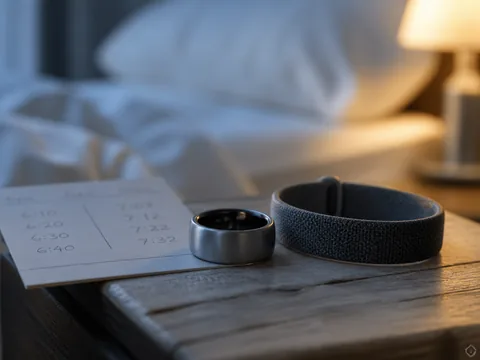
Lights-out. I wrote the time on the card before the lamp went off. Every band credited me with falling asleep earlier than that on at least four nights. The worst single miss was the Inspire 3 logging sleep from 11:04 p.m. on a night I read until 11:30 — because to an accelerometer, a person holding a paperback very still is a person asleep. Median error across all devices and all nights: 14 minutes early. Best behaved was the Xiaomi at 9 minutes; the Active 2 ran 21.
Wake time. Trivial for all of them. Every band landed within three minutes of when I dismissed the alarm, all nineteen nights. This is not impressive. The alarm is the event.
Awakenings I could verify. Seven nights I actually got up — bathroom, mostly, and once a fox arguing with something outside. All four caught all seven. But on five other nights I woke, stayed still, and read the clock: 2:14, 3:31, and so on, eleven episodes in total that I logged in the morning. The bands caught two of eleven. If you don't move, you are asleep, as far as $50 of hardware is concerned.
Why the stage numbers are guesswork
Zoom out from my bedroom and the reason is not mysterious. A band under $100 has two sensors that matter overnight: an accelerometer and a green LED shining into your wrist to read blood flow. Real sleep staging is done with electrodes on the scalp, reading electrical activity from the brain. Nothing on your wrist is reading your brain. It is watching movement and pulse, and inferring the rest.
Movement-based sleep estimation has a well-known and consistent bias: it overestimates total sleep in people who lie still, and it misses wake after sleep onset for the same reason. That matches exactly what I logged — early onset, missed quiet awakenings. It is not a flaw in these specific models. It is the physics of the sensor.
What the price tier adds is not accuracy but invention. Each brand's staging algorithm is proprietary and different, which is how two bands on the same arm, fed the same wrist, produce 41 and 82 minutes of deep sleep for the same night. On another night one reported 2 hours 4 minutes of REM and another 1 hour 11. They are not measuring different things badly. They are guessing differently from identical inputs.
Under $100 you are not buying accuracy. You are buying repeatability — and for a caffeine question, repeatability is the whole game.

The one number that held up
Overnight resting heart rate is the thing a green LED can genuinely measure, and it is where the espresso showed up. Averages across the ten caffeine nights against the nine clean ones:
| Band | Price | Clean nights | Espresso nights | Difference |
|---|---|---|---|---|
| Amazfit Band 7 | $39 | 54 bpm | 59 bpm | +5 |
| Xiaomi Smart Band 9 | $52 | 53 bpm | 58 bpm | +5 |
| Fitbit Inspire 3 | $84 | 55 bpm | 59 bpm | +4 |
| Amazfit Active 2 | $99 | 54 bpm | 60 bpm | +6 |
Four different algorithms, four different price points, same direction and nearly the same size. That agreement is worth more than any individual number in the table. Caffeine clears with a half-life somewhere around five hours for most people, which means a third of that 4 p.m. espresso was still in circulation when the lamp went off — and my cardiovascular system apparently noticed even when I didn't.
Because I didn't. Subjectively the espresso nights felt ordinary. Total sleep came out 12 minutes shorter on average, which is well inside the noise of nineteen nights and not a finding. The heart rate was a finding.
What they're like to actually live with
The Band 7 is the bargain and behaves like one: dim in daylight, a plastic body you forget entirely at night, twelve days per charge. Nothing about it is nice; nothing about it is wrong.
The Smart Band 9 has the best screen of the four and about ten days of battery. The app wants an account and greets you with a sleep score I ignored from night two onward, but the overnight heart-rate graph is readable on the band itself, which mattered more than I expected — I could check it before I'd made coffee and formed an opinion.
The Inspire 3 was the most internally consistent night to night, and it is also the one with a toll booth. Duration and stages are free; the trend views that let you compare this week against last sit behind Premium at $9.99 a month. For a three-week experiment that is $10 to see the shape of your own data.
The Active 2 is the nicest object here and the one I stopped wearing to bed. It has GPS and a proper watch presence, and it also has a hard bezel that left a mark on my forearm twice. A device you take off at 1 a.m. tracks nothing.
Who this is for, and who should skip it
Buy one if you have a specific variable you want to interrogate: a caffeine curfew, a nightcap, late training, a new mattress, a partner who claims you snore. The bands are bad at absolutes and decent at differences, so give them a difference to find.
Buy one if you want a step count, a bedtime nudge, and a reason not to spend $400 on a watch. That is a completely legitimate purchase and nobody needs to apologise for it.
Skip it if you are chasing a symptom. Gasping awake, eight hours that leave you flattened, a bed partner who has watched you stop breathing — none of that is a wrist problem. That is a doctor and a real study. Skip it, too, if you already know that a number labelled 61 will follow you around all day. And skip it if what you actually want is stage data, because at this price the stage data is fiction with a nice gradient on it.
Back to the espresso
If you're buying one band to answer a caffeine question, buy the $52 Xiaomi Smart Band 9 — it matched the more expensive devices on every figure I could verify, gates nothing behind a subscription, and shows the graph on your wrist. At $39 the Band 7 gives up almost nothing but the screen.
What changed my afternoons wasn't a score. It was the shape of a line. On clean nights my overnight heart rate found its floor by about 1 a.m. On espresso nights it kept drifting down until nearly 3, as though the whole first half of the night was spent getting to the starting line. Four bands, nineteen nights, one curve I could see with my own eyes at breakfast. That is more than I expected from $234 of plastic, and considerably less than the packaging promised.
So, tonight: buy the cheapest band with a nightly resting heart-rate graph, ignore everything it tells you about deep sleep, and ask it one question at a time — starting with whether your last coffee was before or after two o'clock.