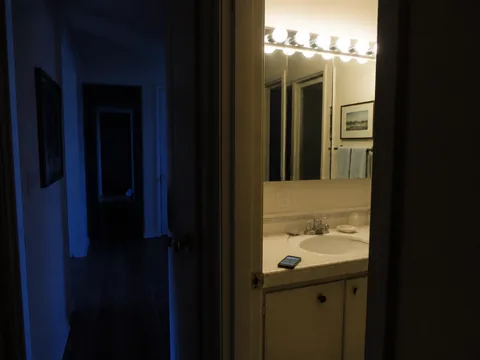
Here is the claim, stated plainly: the blue light coming off your phone at 11 p.m. is probably not what's keeping you awake. The overhead light in your bathroom is the better suspect. Sleep technology has spent a decade teaching us to worry about the color of our screens, when the variable that actually moves the circadian needle is how many photons reach the retina and for how long. By that measure, a phone held at arm's length is a rounding error next to four vanity bulbs eighteen inches from your face.
That sounds like contrarianism for its own sake. It isn't, and the rest of this is me earning the right to have said it.
The mechanism, in the order your body runs it
Start with the cell nobody mentions in the ads. In 2002, Berson, Dunn and Takao published work in Science describing a retinal cell that isn't a rod or a cone: the intrinsically photosensitive retinal ganglion cell, or ipRGC. It contains a pigment called melanopsin, and its peak sensitivity sits around 480 nanometers — blue-cyan, roughly the color of a clear sky at noon. This is the entire scientific basis for the blue-light panic, and it is real.
Here's what happens next. Light hits the melanopsin. The ipRGC fires down the retinohypothalamic tract — a dedicated cable that bypasses the visual cortex entirely — into the suprachiasmatic nucleus, the hypothalamic clock that keeps your body on a roughly 24-hour schedule. The SCN then routes a signal out through the spinal cord and back up through the superior cervical ganglion to the pineal gland, which is where melatonin is made. Light on the retina at night means the pineal gets told to stop. Melatonin drops. Your body's internal timestamp says not yet.
Notice what that pathway is doing. It is integrating light over time — counting photons, essentially — not identifying a hue and reacting to it categorically. Melanopsin responds most efficiently to blue-ish wavelengths, but a lot of dim blue and a little bright blue are not the same input. Intensity and duration are inside the equation. This is the part the marketing drops.
What the research actually measured
The foundational number comes from Zeitzer and colleagues (2000), in the Journal of Physiology. They exposed 23 subjects to a range of nocturnal light intensities and mapped the dose-response curve for melatonin suppression. Half-maximal suppression landed at roughly 100 lux. The response saturated somewhere near 1,000 lux — meaning that past a certain brightness, more light buys you very little additional disruption, and below about 10 lux you're in the shallow tail of the curve.
The study everyone cites for screens is Chang et al. (2015), in PNAS. Twelve participants — a small sample, and worth holding lightly — spent 14 days in a lab, reading either an iPad or a printed book for four hours before bed on five consecutive nights. The e-reader nights delayed melatonin onset by about an hour and a half, added roughly ten minutes to sleep onset, and left people measurably groggier the next morning. Damning for phones, apparently.
Except read the methods. The iPad, at reading distance, delivered about 31 lux at the participant's eye. And it did so for four uninterrupted hours, five nights running, in an otherwise dim room. That is the study. Not "scrolling in bed for twenty minutes."
Do blue-light glasses actually work?
Probably not for sleep, on current evidence — and the honest answer is that the trials are too small and too short to say much either way. A 2023 Cochrane review (Singh, Downie and colleagues) pooled 17 randomized trials covering 619 participants wearing blue-light-filtering spectacle lenses. It found no clear benefit for eye strain, and judged the sleep-outcome evidence too sparse and inconsistent to support a conclusion. Cochrane reviews are conservative by design, but "we cannot tell" is a very different sentence from the one on the packaging.
Software filters have fared no better. The study usually pointed to here is a 2021 trial published in Sleep Health, out of Brigham Young University, which compared Night Shift mode on, Night Shift off, and no phone at all before bed in about 167 young adults. Across the full sample, the groups looked essentially the same. Night Shift changes the color temperature of your display; it does not meaningfully change how many photons leave it.
The number that isn't printed on the box
Lux is illuminance — light arriving at a surface, in this case your cornea. Rough figures, at the eye:
| Source | Roughly, at the eye |
|---|---|
| Outdoors, overcast midday | 5,000–10,000 lux |
| Bright office | 300–500 lux |
| Bathroom vanity, face near the mirror | 200–500 lux |
| Living room with lamps on | 50–150 lux |
| Phone at reading distance, full brightness | 20–60 lux |
| One candle across the room | under 5 lux |
Now put that next to your actual evening. You dim the living room. You put your phone on Night Shift. Then at 10:40 you walk into a small white-tiled room, flip on a fixture designed for applying eyeliner, and stand a foot from a mirror for fifteen minutes with your face in the brightest light you'll see after sunset. Somewhere in there you also brushed your teeth under it.
This, incidentally, is why the viral dark-shower trend keeps half-working. The lamps sold for it aren't doing anything mystical to cortisol. They're just replacing a 300-lux fixture with a 5-lux one during the last waking hour — which is a real intervention, dressed in the wrong explanation. You can get the same effect from a hallway light and an open door.1
Why your ring can't settle this for you
Here's the thing that undercuts every n=1 experiment, mine included. Phillips et al. (2019), also in PNAS, exposed 55 healthy adults to controlled evening light and found something startling: the intensity required to suppress melatonin by 50% varied more than fiftyfold between individuals. Some people were half-suppressed at around 6 lux. Others needed over 350. Same protocol, same lab.
So when a wellness account tells you 10 lux is the safe ceiling, they are quoting a population median at a distribution that is enormously wide, and you have no idea where you sit on it.
Your smart ring can't tell you either. Rings and watches infer sleep stages from heart rate, heart-rate variability, movement and skin temperature. They are decent at total sleep time and unimpressive at staging. None of them measure melatonin, which requires dim-light saliva or plasma sampling in a controlled setting. A readiness score is a downstream proxy with real error bars.
I tried the dim-bathroom thing for two weeks, tracked. Week one looked promising. Week two my period arrived, I was up at 2:40 a.m. with cramps twice, and the data turned to confetti. That's not a failed experiment so much as an accurate portrait of what a fourteen-night personal trial can resolve, which is close to nothing.
An honest rule of thumb
Tonight, before you touch a single setting on your phone: turn the bathroom vanity off. Shower and do your teeth by whatever light is dimmest — the hallway fixture, a lamp outside the door, the nightlight. Keep the phone. Change the room.
The consensus target, from an expert panel led by Brown and published in PLOS Biology in 2022, is under 10 lux melanopic EDI in the three hours before bed and under 1 lux while asleep. You will not hit that with your bathroom lights on, and you might hit it with them off while still scrolling. That's the whole argument, in two sentences.
What this piece didn't answer
Three things, at least. Whether chronic low-dose evening light does cumulative damage that a two-week study can't see — that's plausible but thin. Whether the bigger problem is actually the other end of the day: most of us get a fraction of the morning daylight our clocks evolved to expect, and a poorly anchored circadian rhythm is more fragile at night. And whether individual light sensitivity can be measured outside a lab, which, if the Phillips spread holds up, is the question that determines whether any of this advice should be personalized at all.
If you want to chase it, the useful next step isn't another wearable. It's a cheap melanopic light meter and ten minutes walking your own apartment at 10 p.m., writing down numbers. Until then, the honest version is this: light is a drug with a dose-response curve, and we have spent ten years arguing about its flavor.
-
Lux is a photopic measure — weighted to the sensitivity of the cones that handle daytime vision, which peaks around 555 nm (green). Melanopsin peaks near 480 nm, so lux systematically misrepresents circadian impact. The corrected unit is melanopic EDI (equivalent daylight illuminance), standardized under CIE S 026. The lux figures above are useful for comparing magnitudes; they are not the unit your suprachiasmatic nucleus is actually reading. ↩


