Every March the coverage arrives on schedule. Heart attacks tick up in the days after the country springs forward. So do car crashes, workplace injuries, and — depending on which paper you read — hospital admissions for atrial fibrillation. The conclusion follows so smoothly it barely registers as an argument: the switching is the dangerous part, so stop switching. Pick a clock. Leave it alone.
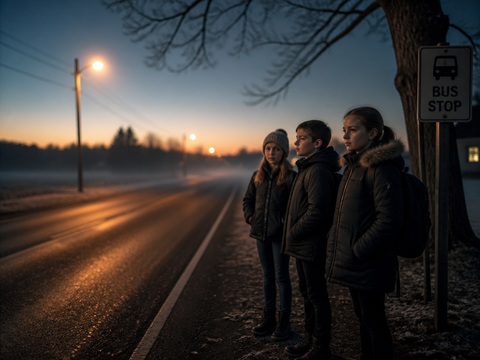
That reasoning has carried permanent daylight saving time further through Congress than most sleep researchers ever expected it to get. It is a real finding wrapped around a bad inference. The transition does hurt people. But the transition costs a few rough days, twice a year. A permanent choice changes every winter morning for decades. And nearly every scientific body that studies circadian biology has asked for the other option — permanent standard time — for reasons that have nothing to do with switching, and everything to do with when the sun clears the treeline over a bus stop in Smith County.
The myth, stated as fairly as I can state it
The myth is not that the clock change is harmless. It isn't harmless, and the researchers who study it are the ones who documented that.
The myth is the assumption riding underneath: that once you stop switching, the two remaining options are biologically equivalent, and the choice between them is a matter of preference — evening light for the ball fields and the grill, versus whatever it is morning people are into. On that view, the health argument was only ever about the transition. Remove the transition and the science goes quiet.
Smart people believe this. It is the framing that dominates legislative debate, and it is not stupid; it follows directly from the only sleep research most people have encountered, which is the March spike. It's just incomplete in a specific way. The spike is the acute signal. It is not the whole finding. The same body of work that produced it also says something about which of the two clocks you'd want to land on, and that part rarely makes the segment.
What the evidence actually measured
Start with the study that gets cited most and described least. Kantermann, Juda, Merrow, and Roenneberg (2007), in Current Biology, worked with chronotype questionnaire data from roughly 55,000 people in Central Europe. What they measured was not health. It was sleep timing across the year. Under standard time, people's sleep drifts seasonally — a little earlier as spring dawns arrive earlier, later as they retreat. That seasonal tracking is what you'd expect from a clock being set by the sun.
What they found was that during the daylight-shifted months, the seasonal adjustment didn't happen. Sleep timing on free days stayed locked to the social clock rather than the solar one, and the mismatch didn't resolve after a week of adaptation the way the transition-only story predicts. It persisted for the whole shifted period, and it was worst in late chronotypes — the people whose internal timing already runs behind everyone else's.
That is a study about self-reported bedtimes, not about disease. Take it as what it is: evidence that the body clock does not simply absorb an hour of imposed offset and move on.
The natural experiment nobody designed
The cleaner evidence comes from an accident of American geography. Time zone boundaries are political lines, not solar ones. Two counties can sit a few miles apart, share weather, income, and industry, and have sunsets — and sunrises — that differ by close to an hour, because one is on the eastern edge of a zone and the other is on the western.
Giuntella and Mazzonna (2019), in the Journal of Health Economics, used those boundaries. Comparing people on either side, they found that those on the late-sunset side of a line slept measurably less — on the order of twenty minutes a night — and showed worse outcomes on several health and productivity measures. Living where the clock runs ahead of the sun is, functionally, living under permanent daylight saving time. That's the point of the design.
Gu et al. (2017), in Epidemiology, ran a related analysis on cancer incidence by longitude position within time zones across more than four million U.S. cases, and reported a risk gradient moving west. I'd file that one under plausible but thin. Longitude within a time zone correlates with rurality, income, and health care access in ways that adjustment can reduce but not eliminate.
The study I find hardest to argue with is Fritz, VoPham, Wright, and Vetter (2020), also in Current Biology. They examined 732,835 fatal traffic accidents in the U.S. between 1996 and 2017 and found roughly a 6% increase in fatal crash risk in the week following the spring transition. That much you may have heard. The part that matters here is the gradient: the increase was larger the further west a location sat within its time zone. If the spring spike were purely about one lost hour of sleep, it should be geographically flat. It isn't. It scales with how far your clock already runs ahead of your sun.[^1]
Then there is 1974, which everyone brings up and almost nobody describes accurately. Congress did enact year-round daylight time in January of that year, in response to the oil embargo. Public approval did collapse — from roughly 79% before it started to something in the low 40s within two months — and Congress did reverse course by October. Reports of schoolchildren struck in dark Florida mornings drove much of that collapse. But the subsequent federal review did not establish a statistically clear increase in morning child fatalities attributable to the change; the numbers were small, the period was short, and the winter had other things going on. The political history is documented. The causal claim is folk wisdom that hardened into fact through repetition. It deserves to be treated as motivating rather than probative.

Why do sleep scientists want permanent standard time?
Because the human circadian clock is set mostly by light in the morning, and a clock that runs ahead of the sun deletes morning light in winter without deleting the alarm. That's the whole argument in one sentence. Standard time keeps civil time closer to solar time, which means the sun comes up nearer to when people are actually getting up. Shifting an hour into the evening doesn't create daylight; it moves it from a slot where the body is highly sensitive to it into a slot where the body is, if anything, harmed by it.
This is not a fringe position. The American Academy of Sleep Medicine issued a formal position statement (Rishi et al., 2020, Journal of Clinical Sleep Medicine) calling for permanent standard time, and the Society for Research on Biological Rhythms published a similar recommendation. The consensus among people who study the clock is unusually lopsided for a policy question — which is itself worth noticing, and also worth not overreading. Scientific consensus about a mechanism is not the same as evidence about a population-level outcome, and I'll come back to that.
What happens when light hits a child's eye at 7 a.m.
Follow it in order.
Photons enter the eye and land on the retina. The cells that matter for timing are not the rods and cones you learned about. They're a sparse population called intrinsically photosensitive retinal ganglion cells — ipRGCs, roughly 1% of the ganglion cells — which contain a pigment called melanopsin. Berson, Dunn, and Takao (2002), in Science, showed these cells fire in response to light even when disconnected from rod and cone input. They are slow, they integrate over minutes rather than milliseconds, and they are most sensitive to short-wavelength light around 480 nanometers, which is to say the blue in an open sky.
Their axons travel a dedicated pathway, the retinohypothalamic tract, to the suprachiasmatic nucleus — about 20,000 neurons sitting in the hypothalamus just above where the optic nerves cross. This is the master clock. Inside each of those neurons is a transcription–translation feedback loop: the proteins CLOCK and BMAL1 drive expression of the PER and CRY genes, whose products accumulate, fold back, and shut down their own transcription. The cycle takes a little over 24 hours. Light delivered at the right moment nudges its phase.
From there the signal goes outward. Via the paraventricular nucleus, down the spinal cord, out through the superior cervical ganglion, and into the pineal gland, where it determines what time melatonin secretion will begin that evening. Not tonight's sleepiness on demand — tonight's timing, set this morning. The same output shapes the cortisol rise that peaks shortly after waking and the core body temperature rhythm that bottoms out in the small hours.
Direction depends entirely on when the light arrives. The pivot is the core body temperature minimum, which for most people falls roughly two to three hours before habitual wake time. Light after that point advances the clock — you get sleepy earlier that night. Light before it delays. Khalsa, Jewett, Cajochen, and Czeisler (2003), in the Journal of Physiology, mapped this in 23 subjects using single 6.7-hour bright light pulses at varying clock times, and found shifts of up to roughly two and a half hours in either direction near the crossover. That's the phase response curve, and it's about as well-established as anything in this field.
One thing the popular version of this advice gets wrong: the dose. Zeitzer, Dijk, Kronauer, Brown, and Czeisler (2000), also in the Journal of Physiology, found the melatonin phase-shifting response was already at half its maximum around 100 lux and approaching saturation near 550. You do not need 10,000 lux. For context, a well-lit classroom runs 300 to 500 lux; an overcast East Texas morning outdoors runs a few thousand; clear morning sun runs tens of thousands. A gray drizzle outside beats every room in your house by a factor of ten.
And the effect size under real conditions is not small. Wright et al. (2013), in Current Biology, sent eight adults camping in Colorado for a week with no electric light. Melatonin onset moved about two hours earlier, and internal timing locked onto sunrise. Eight people is not many. Stothard et al. (2017) repeated it in winter and found the shift was, if anything, larger.
Children are not small adults about this
A child's eye transmits more light to the retina than yours does. The pupil is larger, and the lens is clearer — the human lens yellows progressively with age, filtering exactly the short wavelengths melanopsin cares most about. By your fifties you are getting substantially less circadian signal from the same room than your third-grader is.
That cuts both ways, and there's direct evidence for the downside. Crowley, Cain, Burns, Acebo, and Carskadon (2015), in the Journal of Clinical Endocrinology & Metabolism, measured melatonin suppression in response to evening light and found pre- and early-pubertal children were meaningfully more sensitive than adolescents further along. Fewer than forty participants, so hold it loosely. But the direction is consistent with the optics.
Then puberty does something else entirely: it pushes the clock late. Roenneberg et al. (2004), in Current Biology, using chronotype data from roughly 25,000 people, showed that internal timing drifts progressively later through adolescence, peaks somewhere around age 19 or 20, and then reverses — the sharpest biological marker anyone has proposed for the end of adolescence. The fifteen-year-old who cannot fall asleep at ten is not being difficult. Her clock is genuinely running late.
Stack the pieces. A biologically delayed clock, a first bell somewhere between 7:30 and 8:15, and winter mornings in which the strongest available signal for pulling that clock earlier — daylight before school — has been legislated out of existence.

What happens when you relieve one of those pressures is reasonably well documented. Dunster et al. (2018), in Science Advances, tracked about 90 Seattle sophomores with wrist actigraphy across two school years, before and after the district pushed high school start times 55 minutes later. Students got 34 more minutes of sleep on average, and course grades rose about 4.5%. Attendance improved at the lower-income of the two schools. It wasn't randomized, and grade effects across a single district-wide change are noisy. Wahlstrom et al. (2014), in the University of Minnesota CAREI study of more than 9,000 students across eight high schools, reported similar associations, including lower crash rates among teen drivers in one district. Observational, again.
The honest summary: the sleep gain from later starts is solid and replicated. The downstream academic and safety effects are consistent, plausible, and not as tightly nailed down as they are usually reported.
What an East Texas winter morning would actually look like
Tyler sits at about 95.3° west. The Central time zone is anchored to the 90th meridian. That means clocks in East Texas already run roughly 21 minutes ahead of the sun before any policy is applied — solar noon here falls closer to 12:21 than to noon. The region is well into the western half of its zone, which is precisely the geography where Fritz's crash gradient was steepest.
Here is what the difference looks like on the ground. Times are for Tyler, accurate to within a couple of minutes:
| Date | Sunrise, standard time | Sunrise, permanent DST |
|---|---|---|
| Nov 1 | 6:41 a.m. | 7:41 a.m. |
| Dec 1 | 7:04 a.m. | 8:04 a.m. |
| Jan 5 | 7:22 a.m. | 8:22 a.m. |
| Feb 1 | 7:16 a.m. | 8:16 a.m. |
| Mar 1 | 6:49 a.m. | 7:49 a.m. |
The latest sunrise of the year in Tyler currently lands around 7:22, in the first week of January. Under a permanent shift it would land at 8:22. Sunrise would fall after 8 a.m. from roughly Thanksgiving through the third week of February — call it three months of the school year. Buses run 45 to 75 minutes ahead of first bell. For that whole stretch, the pickup, the ride, and in many districts the first period would happen before the sun came up.
An honest rule of thumb
If you do one thing tonight, make it a plan for tomorrow morning: get your kid outside, not next to a window, for ten to fifteen minutes within an hour of waking. The bus stop counts. The walk from the parking lot counts. Overcast counts, and glass doesn't — window glass and car windshields cut the intensity enough to matter, and sunglasses defeat the point. If the sun genuinely isn't up yet, turn on every light in the kitchen as a weak substitute and get real daylight at the first recess or passing period. Then hold the weekend wake time within about an hour of the weekday one, because the clock responds to the week's average, not to Sunday's good intentions.
Sort the confidence honestly:
- Well established: morning light advances the human circadian clock, and the magnitude and direction depend on timing relative to the core temperature minimum.
- Well established: adolescent clocks run late for biological reasons, and earlier school start times cost them sleep.
- Plausible but thin: that chronic loss of winter morning light, at the specific dose a permanent clock shift would impose, produces measurable population-level harm to children. The mechanism is solid. The multi-year dose–response has never been measured.
- Folk wisdom: the precise "ten minutes within thirty minutes of waking" prescription. The thirty-minute window is a communication device, not a finding. Nothing in the literature identifies a cliff there.
What we don't know
There has never been a randomized trial of one national clock against the other, and there never will be. The closest thing the United States has is 1974, which lasted about ten months inside an oil embargo and a recession — a natural experiment with more confounders than subjects.
The traffic question is genuinely unresolved in an uncomfortable way. Modeling studies generally find that shifting light into the evening prevents more pedestrian fatalities than dark mornings cause, because evening traffic volume is higher and drivers are more impaired. That finding is probably right in aggregate. But the aggregate is mostly adults, and the morning cohort skews sharply toward children walking to bus stops in the dark. "Net lives saved" and "which population bears the risk" are different questions, and the second one is partly a values judgment that no study resolves.
And underneath all of it sits a gap nobody talks about: essentially the entire quantitative literature on light dose and phase shifting — Khalsa's curve, Zeitzer's intensity threshold, the whole apparatus behind every confident number in this piece, including mine — was built on adults, mostly young adults, mostly in windowless laboratories on carefully controlled schedules. Children's eyes transmit more light. Children's clocks are still developing. We have extrapolated a policy argument about eight-year-olds from data collected on undergraduates.
So here's the question I'd actually like answered before anyone locks the clocks: what is the smallest amount of real morning light that still does the work in a developing circadian system — and is a nine-year-old at a dark bus stop losing something a twenty-two-year-old in a light lab was never in a position to show us?