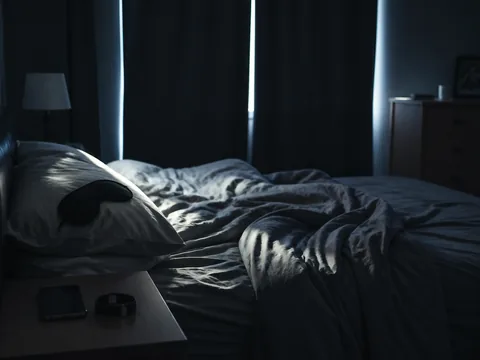
Here is the question I actually wanted answered, the one I could never get a straight reply to from a manager or a forum: does your body ever adapt to shift work, or do you spend the whole time just enduring it and calling that coping?
I asked because I was about to start a job with a schedule I didn't understand, and because everything I read either treated the answer as obvious (no, you're doomed) or refused to answer it at all. So I ran three different nontraditional schedules back to back over about seven months, tracked my sleep the whole way, and kept notes. The short answer is that partial adaptation is real, it is smaller than you hope, and it collapses the moment the schedule moves — which means the schedule type matters more than your willpower or your blackout curtains.
What I actually measured, and why you shouldn't trust it too much
I need to say this before anything else: this is a sample size of one. My results are mine. I am a moderate morning-type in my late thirties with no children, which makes me an easy case — nobody was waking me up at 2 p.m. for daycare pickup. If you have a household, a partner on a different clock, or a body that runs late naturally, your numbers will be worse than mine on the fixed-night schedule and possibly better on the evening one.
What I tracked, every day, across all three rotations:
- Sleep onset latency — how long from lights-out (or eye-mask-on) to actually asleep, timed with a phone I put face-down across the room.
- Total sleep time — from a wrist tracker, corrected against a manual sleep diary. The tracker consistently overcounted by 20–40 minutes, so every number below is the diary figure.
- Awakenings I remembered — a crude measure, but the only honest one I had for fragmentation.
- A 1–10 alertness score logged at the midpoint of each shift, before caffeine's second hit.
I did not measure cortisol, melatonin, or core body temperature. Those are the actual markers of circadian phase, and without them I can only infer where my internal clock was pointing. Keep that in the back of your mind every time I say the word "adapt." I'm inferring adaptation from behavior, not confirming it from hormones.
Caffeine was held roughly constant: two cups on waking, one at the shift midpoint, nothing in the final four hours before intended sleep. That last rule was the hardest to keep and the one I broke most.
Rotation 1: Fixed nights (11 p.m.–7 a.m.), five weeks
This was supposed to be the hard one, and for the first ten days it was. My baseline sleep onset on a normal day schedule was about 12 minutes. On night three of fixed nights it was 47 minutes, lying in a dark bedroom at 8 a.m. with the birds fully committed to their work outside. Total sleep dropped to a little under six hours. Alertness at the 3 a.m. midpoint of my shifts sat around 4 out of 10, which is the number where you reread the same sentence three times.
Then something genuinely shifted around day twelve. Not dramatically — I want to be careful here, because the internet promises you a magic threshold and there isn't one. But onset latency fell to the low twenties of minutes and mostly stayed there. Total sleep climbed back to roughly 6 hours 40 minutes. Midpoint alertness settled at a 6.
That partial recovery is the thing nobody tells you about, and it's the closest I came to answering the original question with a yes. Given a fixed direction — same shift every night, aggressive light control, a hard rule about wearing sunglasses on the drive home so the morning sun couldn't reset me — my body did something like adjustment. Not full adjustment. My weekends were a disaster; I'd flip back toward day-living to see people, and Monday's first night undid a chunk of the progress. But within the workweek, held steady, there was a real trend line pointing up.
The ceiling was low, though. I never got back to my baseline 12-minute onset or my baseline eight hours. The best fixed-nights week averaged about 90 minutes less sleep per day than my normal life. That deficit doesn't feel like much on Tuesday. It feels like a lot by Friday.
Rotation 2: Fast forward rotation (two days, two evenings, two nights, then off), six weeks
This is the schedule that exists because it's operationally convenient, and it is the one that did the most measurable damage. The pattern moved forward — days, then evenings, then nights — which is the "kinder" direction according to the light-exposure literature, because you're delaying your clock rather than dragging it backward, and the human clock delays more easily than it advances.
Kinder is doing a lot of work in that sentence.

My clock never got to point anywhere in particular, because the schedule moved every two days. Onset latency was erratic in a way the fixed schedule never was: 14 minutes after a day shift, 38 after the first evening, over an hour after the first night of each block. Total sleep averaged 5 hours 50 minutes across the whole rotation, worse than fixed nights, and the variance was brutal — a good day of 7 hours followed by a 4-hour day.
The number that scared me: on the second night shift of block four, my midpoint alertness score was a 2, and on the drive home I don't remember two of the exits. Nothing happened. But "nothing happened" is not a safety plan, and drowsy driving after night shifts is a documented risk, not a personal failing. I started taking a longer route with more stoplights on purpose, because staying stopped kept me awake better than the highway did.
There was no adaptation curve here at all. You can't adapt to a target that moves every 48 hours. All I did was accumulate a debt and pay it down on the days off, which is not the same thing. By the end I was sleeping ten hours on my first day off and calling it recovery when it was really just the body seizing what it could.
Rotation 3: Fixed evenings (3 p.m.–11 p.m.), five weeks
I saved this one for last on a hunch, and the hunch paid off. Fixed evenings were, by a wide margin, the most livable schedule I ran.
The reason is almost boringly simple: an 11 p.m. finish means you can sleep at a mostly normal time. I was in bed by 12:30 or 1 a.m. and waking naturally around 8:30 or 9. That's a late schedule, not an inverted one, and the difference is everything. My clock only had to shift by an hour or two, well inside the range it can absorb without a fight.
Onset latency returned almost to baseline: about 15 minutes. Total sleep averaged 7 hours 20 minutes — still shy of my normal eight, but the closest of the three by a mile. Midpoint alertness, logged at around 7 p.m., held at a steady 7 to 8. And the social cost, which the sleep numbers don't capture, was the lowest: I could still get breakfast with people, still see morning light, still exist partway inside the daytime world other people live in.
There was no dramatic adaptation curve on evenings because there was very little to adapt to. That's the point. The best schedule was the one that asked the least of my circadian system in the first place.
The three, side by side
Here's the whole experiment in one grid. Alertness is the shift-midpoint average. "Recovery on days off" is my subjective read of how wrecked I felt.
| Criterion | Fixed nights | Fast forward rotation | Fixed evenings |
|---|---|---|---|
| Avg. sleep onset | ~22 min (after wk 2) | 14–65 min, erratic | ~15 min |
| Avg. total sleep | 6 h 40 m | 5 h 50 m | 7 h 20 m |
| Midpoint alertness | 6 / 10 | 2–5 / 10 | 7–8 / 10 |
| Sign of adaptation | Yes, partial, by day ~12 | None | Little needed |
| Social/family cost | High | High | Low–moderate |
| Recovery on days off | Slow | Very slow | Fast |
The rotating schedule loses on nearly every line, and it's worth being clear about why. It's not that rotation is inherently more punishing minute-to-minute — a night on the fixed schedule and a night on the rotating one felt similar in the moment. It's that rotation never lets the partial-adaptation trend from Rotation 1 get started. You pay the front-loaded cost of a schedule change over and over without collecting the modest interest that comes from holding steady.
So does the body actually adapt? What "adaptation" turned out to mean
Here's where I have to separate what I felt from what I can defend.
The light-exposure research is reasonably settled on the mechanism: your internal clock is set primarily by light hitting your eyes, and it shifts a limited amount per day — roughly an hour or two, and it delays (going later) more comfortably than it advances (going earlier). A permanent night worker who controls their light exposure with real discipline — bright light during the shift, hard darkness on the commute home and in the bedroom — can shift their clock partway toward their work schedule. Partway is the operative word. Almost nobody fully inverts, because the sun and the daytime world keep tugging you back on every day off, every errand, every social meal.
My Rotation 1 data is consistent with that story. The onset latency dropping from 47 minutes to the low twenties by day twelve is exactly what a partial phase shift would look like from the outside. But — and this is the honest part — I can't prove that's what happened. I never measured melatonin timing. It's entirely possible that some of my "adaptation" was just sleep debt getting so heavy that I fell asleep faster out of sheer exhaustion, which is a very different and much less rosy explanation. Faster sleep onset can mean your clock moved. It can also mean you're too tired to keep your eyes open. From the outside they look identical.

So my defensible conclusion is narrower than I'd like: on a fixed schedule, held steady, with disciplined light control, something improves over one to two weeks. Whether that something is true circadian adaptation or just a body giving up and taking what sleep it can get, I couldn't distinguish with the tools I had. On a rotating schedule, nothing improved, and I'm confident about that one because there was no trend to interpret in the first place.
If there's a single practical takeaway buried in that hedge, it's this: the "it depends" in the shift-work question depends far less on you than on the schedule's stability and direction. A steady late schedule barely challenges the clock. A steady inverted schedule challenges it a lot but permits partial adjustment. A rotating schedule denies you adjustment entirely and hands you a permanent debt. Those are structural facts, not motivational ones.
Who this life works for, and who it doesn't
I'm wary of prescribing, because the whole point of this piece is that individuals differ. But the experiment surfaced some patterns that generalize better than my sleep numbers do.
Nontraditional schedules can genuinely work for you if:
- You run late naturally — a true evening-type who's miserable at a 6 a.m. alarm may sleep better on an evening or night schedule than on days.
- Your schedule is fixed, not rotating. This is the single biggest predictor in my data.
- You have real control over your light and can defend your sleep window from daytime interruption. A household that respects a "do not wake" sign is worth more than any supplement.
- The premium pay or the reduced commute or the quiet of an empty facility actually matters to your life, not just your paycheck.
They probably won't work, or will cost more than they're worth, if:
- You're on a fast rotation, especially one that includes back-to-back day-to-night flips. This is the configuration that produced my worst alertness scores and the drive home I can't fully remember.
- You're a firm morning-type being asked to invert. The clock advances poorly; you'll be swimming upstream every day.
- Your household or social obligations force you back onto a day schedule during your off periods, so you never hold any schedule long enough to adjust to it.
- You already have insomnia or an untreated sleep disorder. Shift work doesn't create those from nothing, but it will find every weakness you already have and lean on it.
If you're an HR or occupational-health reader, the actionable version is short: stability and direction of rotation are levers you control, and they matter more than any wellness perk you can bolt on afterward. A fixed-shift assignment or a slower, forward-rotating pattern will do more for your workers' sleep than a nap room or a mindfulness app. The nap room is nice. It is not a schedule.
The line you can screenshot
Of the three schedules I ran, fixed evenings won by a wide margin, fixed nights was a distant but real second, and fast forward rotation lost on nearly every measure — and the reason is that the best schedule is the one that asks your body clock to move the least.
What I couldn't answer, and where to look next
Plenty. I'll name the biggest gaps so you know exactly how far to trust any of this.
I couldn't measure my actual circadian phase, so I can't tell you whether my Rotation 1 improvement was real adaptation or just deepening exhaustion. That distinction matters enormously, and it needs melatonin or temperature data I didn't collect. If you want the rigorous version, look for studies using dim-light melatonin onset as the phase marker — that's the gold standard the light-exposure research is built on.
I couldn't test the long game. Seven months tells you nothing about the outcomes that actually worry occupational-health specialists — the associations between long-term night work and metabolic and cardiovascular risk. Those show up over years, in populations, not in one person over one season. For that you want the large epidemiological cohort studies on shift work and health outcomes, and you want to read them carefully, because the effect sizes are real but often smaller and more confounded than headlines suggest.
I couldn't test the schedule that most workers actually have, which is worse than all three of mine: unpredictable, short-notice, algorithmically assigned shifts with no fixed pattern at all. If a two-day rotation gave me no chance to adapt, a random one gives even less. Someone should measure that population directly, because they're the ones the tidy taxonomy of "fixed vs. rotating" leaves out entirely.
And I couldn't separate my own body from anyone else's. The next honest version of this experiment isn't one person over three schedules. It's many people over one schedule, sorted by chronotype, so we can finally say which of the "it depends" actually depends on you — and which, as I suspect, mostly depends on the schedule you were handed.