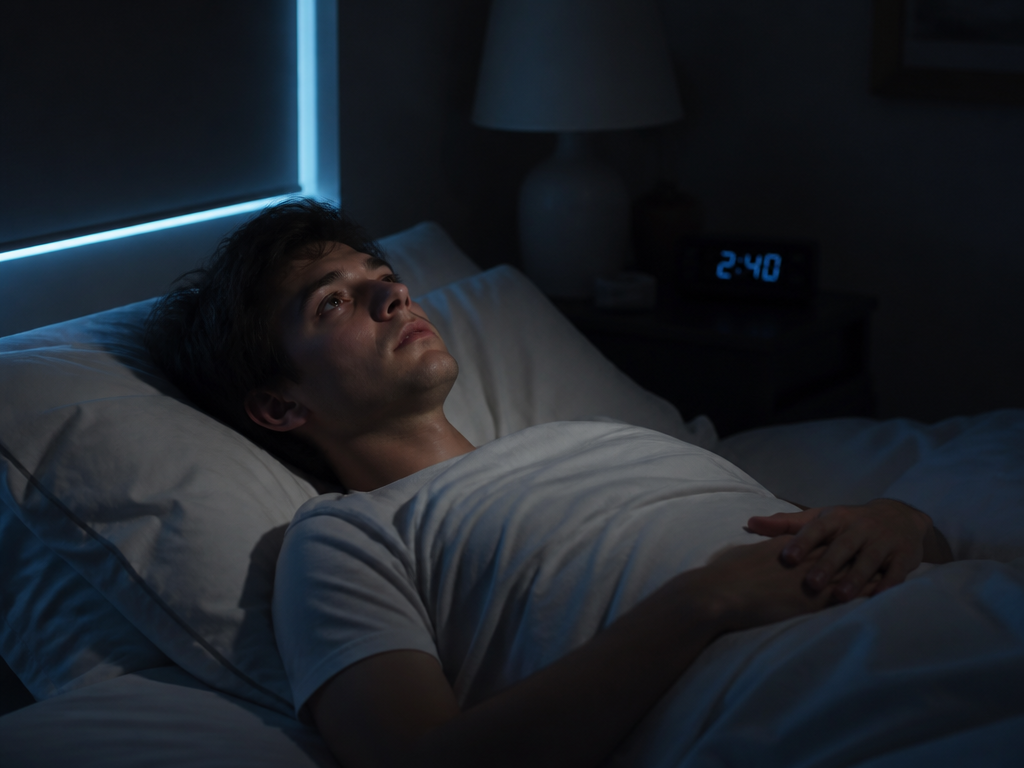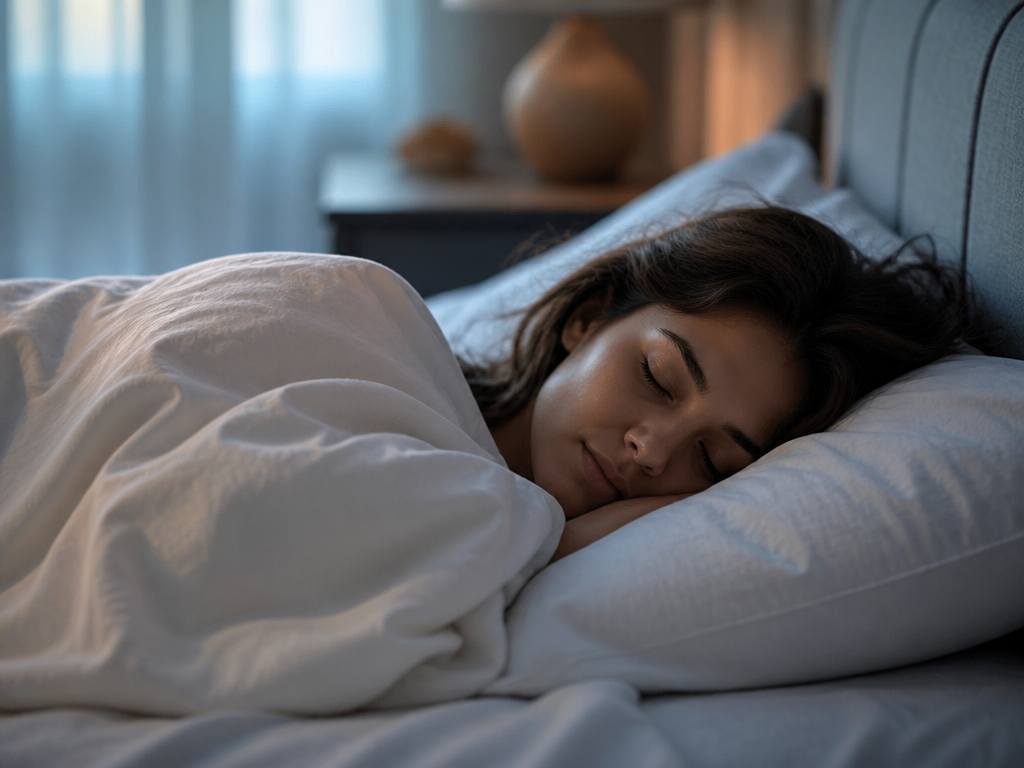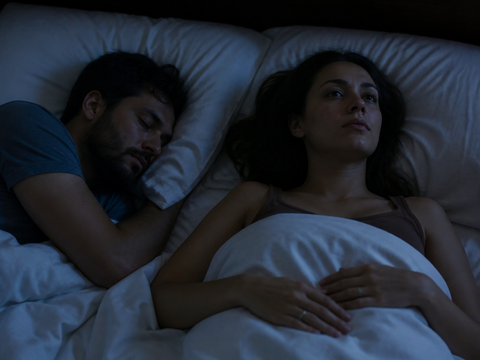
You have heard the clean version of this story. Everyone runs on a 24-hour clock. Light sets it, melatonin obeys it, and if you lie awake at 1 a.m. while your partner is already three hours into untroubled sleep, the problem is your discipline — your screens, your nightcap, your refusal to keep a schedule.
The clean version is mostly wrong, and the sleep quality disparities it papers over are larger and stranger than the wellness-blog framing admits. The circadian system is real and powerful. It is also not identical from person to person, not stable across a lifetime, and not equally cooperative across sexes. Before you blame your habits, it is worth knowing what your clock is actually doing.
Why do I sleep worse than my partner?
Often because you are running two different clocks under the same roof. Intrinsic circadian period — the length of one internal "day" when you strip away light cues — averages close to 24 hours but varies measurably between people, and it differs on average between the sexes. A shorter internal day pulls you earlier; a longer one pushes you later. Add age, hormones, and chronotype, and two people in one bed can be biologically scheduled to fall asleep an hour or more apart. Neither of you is failing. You are simply not on the same train.
That is the counterintuitive part. We treat the bed as a shared environment with a shared correct answer. It is closer to two overlapping timetables that happen to use the same platform.
What the research actually measured
The most cited number here comes from Charles Czeisler's group at Harvard. In a forced-desynchrony protocol — where subjects live on artificial day lengths so their internal clock reveals itself — Czeisler et al. (1999, Science) estimated the average human intrinsic period at about 24.18 hours, far closer to 24 than the loose "25-hour clock" that floated around older textbooks. Tight, but not 24 exactly, and not the same for everyone.
The sex difference is where it gets interesting. Cain et al. (2010, PNAS) ran a forced-desynchrony study and reported that women's intrinsic circadian period was on average about six minutes shorter than men's, and that a larger share of women had periods under 24 hours. Six minutes sounds trivial. Compounded night after night against a fixed social schedule, a shorter clock tends to advance your timing earlier — which fits the broad survey finding that women report both earlier preferred bedtimes and, simultaneously, more insomnia. Both can be true. A clock that wants to sleep early, colliding with a world that does not let it, produces exactly that friction.
Age moves the clock too, and predictably. Across adulthood the circadian phase tends to advance — older adults get sleepy earlier and wake earlier — while the amplitude of the rhythm, the difference between your biological day and night, flattens. Dijk and Duffy's work over the past two decades has documented this steady erosion: the signal that says now is night simply gets quieter with age. That is part of why "I wake at 4 a.m. and can't get back" becomes a sixties complaint more than a twenties one.
Then there is menopause, where the survey data and the mechanistic data finally agree. Large cohort studies, including analyses from the Study of Women's Health Across the Nation (SWAN), find sleep complaints rising sharply through the menopausal transition — difficulty staying asleep reported by roughly half of women in some samples. Some of that is hot flashes fragmenting the night. But some appears to be the circadian and thermoregulatory machinery itself shifting as estrogen and progesterone decline. This is well-established as a pattern; the precise share that is "clock" versus "symptom" is still genuinely debated.
The mechanism, in the order it happens
Here is the chain, roughly as your body runs it each night.
It starts in the suprachiasmatic nucleus (SCN), a cluster of about 20,000 neurons above the optic chiasm. The SCN is your master clock, and it sets itself primarily by light landing on specialized retinal cells. When that light disappears in the evening, the SCN releases its brake on the pineal gland, which begins secreting melatonin. Melatonin is not a sedative — it is a timing signal. Its rise is the body's internal announcement that biological night has begun, a moment researchers call dim-light melatonin onset.

Behind that signal, your core body temperature has been falling. This matters more than people realize. Sleep onset tends to happen on the downslope of the temperature curve, a couple of hours after melatonin starts climbing. The window where falling temperature, rising melatonin, and accumulated sleep pressure all line up is sometimes called the sleep gate.
Now layer the disparities back on. A shorter intrinsic period shifts that whole sequence earlier — melatonin onset, temperature drop, sleep gate, all advanced. Aging flattens the temperature swing and quiets melatonin output, so the gate gets vaguer and easier to miss. The menopausal transition disrupts thermoregulation directly: a hot flash is, in part, the body's temperature-control system misfiring, and it tends to strike during the exact descending-temperature phase that should be ushering you into sleep.
So when two people in one bed fall asleep ninety minutes apart, you are not watching one person succeed and one person fail. You are watching two different clocks open two different gates at two different times.
A rule of thumb you can use tonight
Stop benchmarking your sleep against the person next to you, and start benchmarking it against your own clock. The most useful single move is to find your natural sleep gate and stop fighting it: on a few free days, note when you get genuinely sleepy — not bored-tired, but eyelid-heavy — and treat that as data, not a verdict.
Light is the one lever with strong evidence behind it. Morning light advances your clock earlier; evening light delays it. If you run late and want to shift earlier, the leverage is bright light soon after waking, not heroic discipline at midnight.
Here is the rough map of who tends to run when. Treat it as a tendency, not a diagnosis.
| Group | Typical clock tendency | What it feels like |
|---|---|---|
| Teens / early 20s | Phase-delayed | Wired at midnight, dead at 7 a.m. |
| Many adult women | Slightly shorter period | Earlier bedtime, easier early waking |
| Menopausal transition | Disrupted thermoregulation | Wakes mid-night, hot, can't resettle |
| Older adults (60+) | Phase-advanced, low amplitude | Sleepy by 9, awake before dawn |
If your pattern matches one of these, that is reassuring, not alarming — it means your experience is tracking known biology. The thing worth a doctor's attention is change: a clock that suddenly stops behaving like your clock.1
The honest takeaway
The myth said the circadian rhythm is universal and your sleep is a willpower problem. The evidence says the rhythm varies by minutes that compound into hours, drifts across decades, and bends under hormones — and that the resulting sleep quality disparities are mostly biology doing what it does, not character revealing itself in the dark.
But here is where the science stops short, and I won't pretend otherwise. We can describe these differences cleanly. We cannot yet say whether they are differences we should accommodate — designing schedules and treatments around the clock we have — or differences we are partly causing, through decades of electric light, shift work, and social schedules that never asked the SCN's permission. The flattening of the rhythm with age, for instance: how much is intrinsic aging, and how much is the slow accumulated cost of living against our own clocks? The honest answer is that we don't yet know which one we're looking at.
So the open question isn't whether your clock is different from your partner's. It is: which of the disparities we measure are the body's design, and which are the body's record of how long we've been ignoring it?
-
"Change" is the underrated signal in sleep medicine. A lifelong night owl sleeping six fragmented hours is usually a chronotype. A former sound sleeper newly waking at 3 a.m. every night for a month is a question, not a personality. ↩