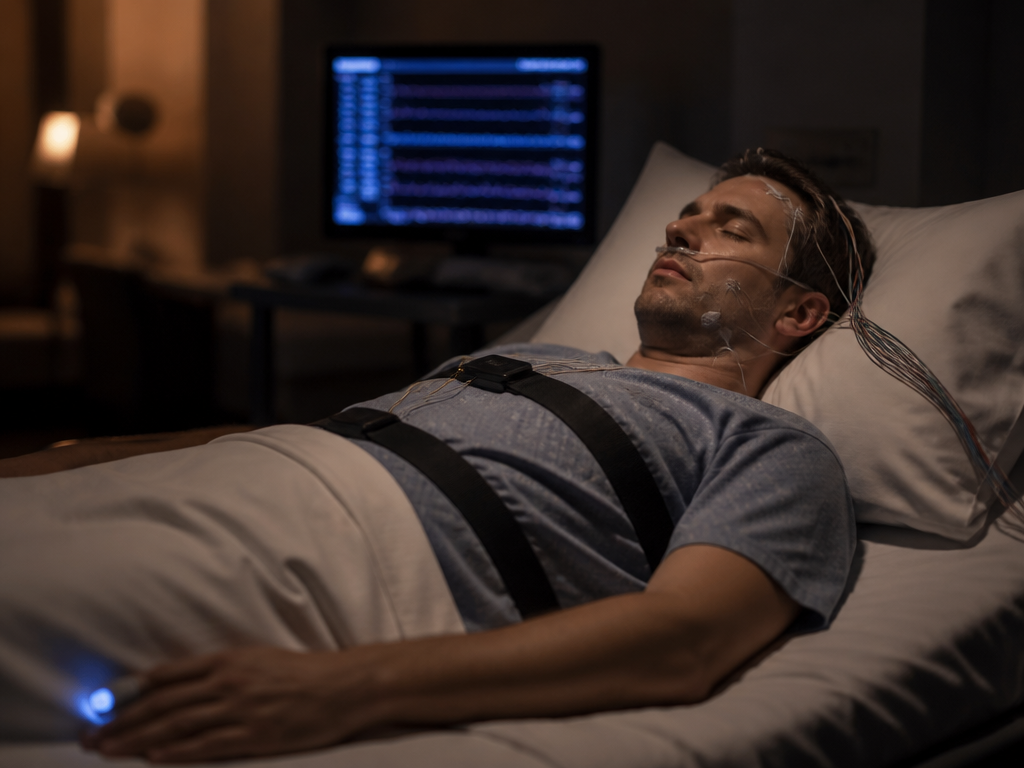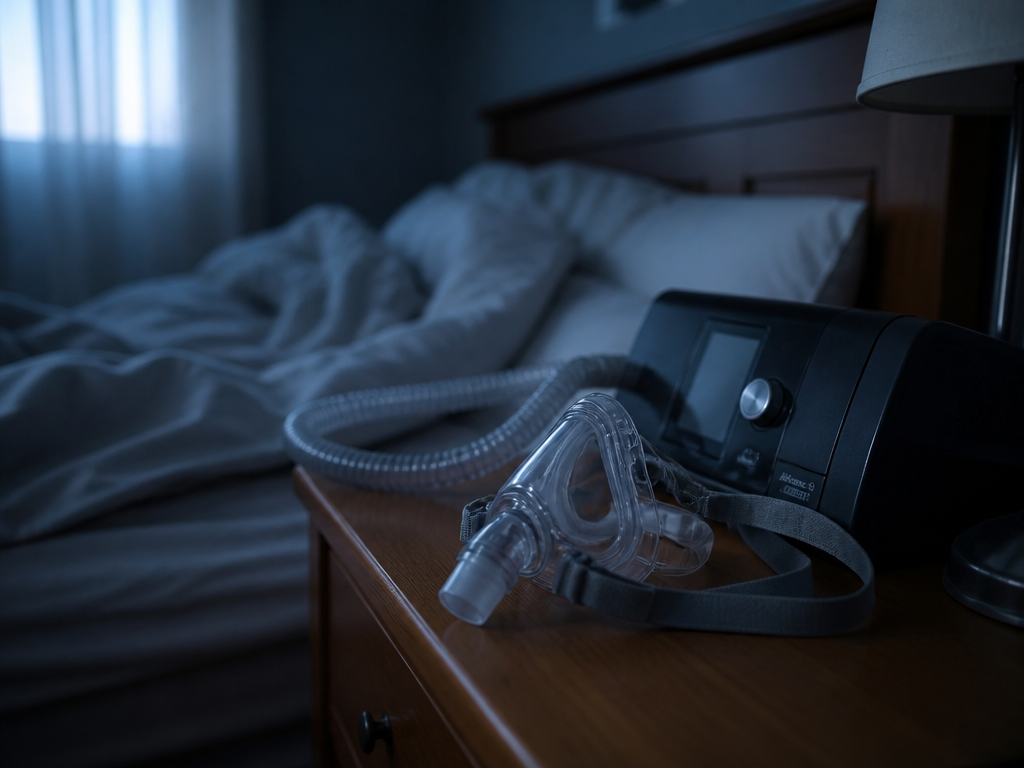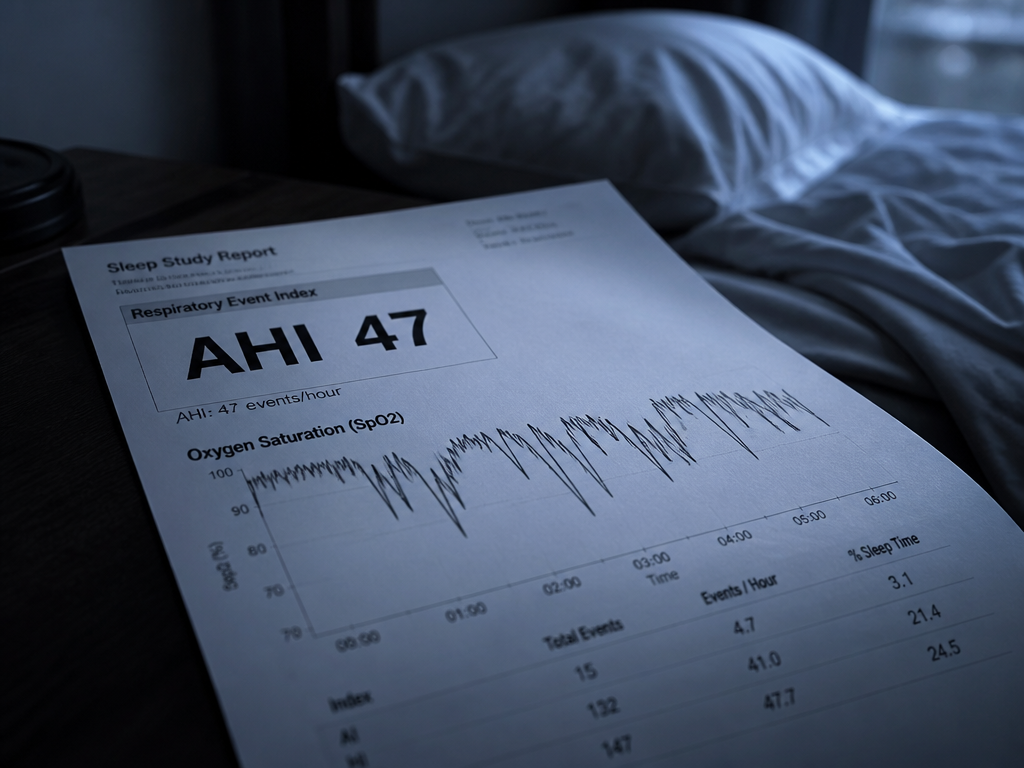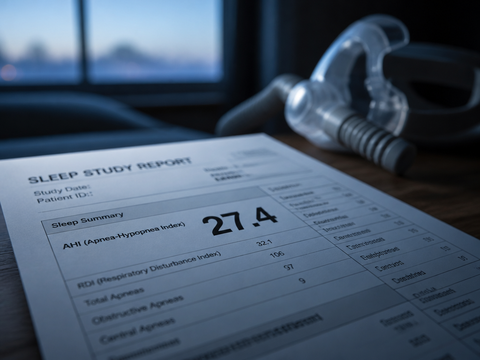
There is a number on your sleep study, and it probably has a decimal point. Maybe it says 27.4. Maybe 8.1, or 62.0. That number is your AHI — your Apnea-Hypopnea Index — and it is the single statistic that decides your sleep apnea severity, your insurance approval, and whether a stranger in a sleep lab recommended you wear a mask to bed for the rest of your life. The decimal point suggests the measurement is precise to a tenth of an event per hour. It is not. Understanding why is the most useful thing a newly diagnosed person can do.
Let's start with what the number is, then walk back into what it actually counted, and then — the part nobody tells you — what it leaves out.
What the AHI actually counts
The AHI is the number of breathing disruptions you have per hour of sleep. There are two kinds, and they happen in a specific order in your throat.
When you fall asleep, the muscles around your upper airway relax. In most people this is fine. In obstructive sleep apnea, the soft tissue at the back of the throat — the tongue base, the soft palate — collapses inward and narrows the tube air has to travel through. If the airway narrows partway and your airflow drops while you keep trying to breathe, that's a hypopnea. If it closes all the way and airflow stops for at least ten seconds, that's an apnea. Either way, oxygen in your blood begins to fall. Your brain, sensing the trouble, fires off a brief arousal — usually too short for you to remember — that stiffens the airway muscles and lets you gasp the airway back open. Then you drift down again, and the cycle repeats.
Add up every apnea and every hypopnea, divide by the hours you were actually asleep, and you get the AHI. The American Academy of Sleep Medicine draws the lines like this: an AHI under 5 is normal; 5 to 14.9 is mild; 15 to 29.9 is moderate; 30 and above is severe.
That is the whole machinery behind the headline number. It is genuinely useful. It is also, on closer inspection, much softer than it looks.
What "an AHI of 27" doesn't tell you
Start with the obvious problem: it's an average. An AHI of 27 could mean a steady drumbeat of one event every two minutes all night long. Or it could mean you breathe peacefully on your side for hours and then, the moment you roll onto your back during REM sleep, you stop breathing every forty seconds. Same number. Completely different night. The index washes out when and where the events cluster, and clustering — especially in REM, when your muscles are most relaxed — may matter more for your heart than the average implies.
Then there's the scoring rule, which is where the AHI gets genuinely slippery. An apnea is unambiguous — airflow basically stops. A hypopnea is a judgment call, and the AASM has changed its mind about how to make it. Under one accepted rule, a partial airflow drop counts as a hypopnea only if it's paired with a 4% drop in blood oxygen. Under the other, a 3% drop or a brief arousal is enough. The second rule is more sensitive, so it counts more events. The same overnight recording, scored both ways, can move a person from "mild" to "moderate" without anything about their actual breathing changing. A 2018 analysis by Won and colleagues in the Journal of Clinical Sleep Medicine found that switching scoring criteria reclassified a substantial share of patients across severity categories. The disease didn't shift. The ruler did.
And the AHI is silent on intensity. A hypopnea where your oxygen dips to 94% counts exactly the same as an apnea where you desaturate to 78% and your heart strains for thirty seconds. One event, one tally mark, regardless of how violent it was. This is the criticism that has driven the most interesting work in the field, and we'll come back to it.
What is considered severe sleep apnea?
Severe sleep apnea is an AHI of 30 or more events per hour — meaning your breathing is disrupted at least once every two minutes, on average, across the night. That is the standard clinical threshold, and crossing it is what typically triggers strong recommendations for treatment and, in many health systems, easier coverage for a CPAP machine.
Here is the full grading scale most labs use:
| Category | AHI (events per hour) | Roughly what it means |
|---|---|---|
| Normal | Under 5 | Fewer than one disruption every 12 minutes |
| Mild | 5–14.9 | Up to about one every 4 minutes |
| Moderate | 15–29.9 | Up to about one every 2 minutes |
| Severe | 30+ | One every 2 minutes or more often |
The numbers are easy to read. The trouble is believing they're as solid as they look.
Why the threshold is a convention, not a cliff
There is nothing magic about 30. A person with an AHI of 29.8 and a person with 30.2 are, biologically, the same patient. The categories are a clinical convenience — a way to sort a continuous spectrum into buckets that doctors can act on. Risk doesn't jump at the boundary; it climbs steadily across it.
This is why a growing body of research argues the AHI is the wrong primary metric — not useless, but blunt. The most cited alternative is hypoxic burden, a measure of the total depth and duration of the oxygen dips across the night, rather than just how often events occur. Azarbarzin and colleagues, in a 2019 paper in the European Heart Journal, analyzed data from two large cohorts and found that hypoxic burden predicted cardiovascular mortality better than the AHI did. People with the same event count but deeper, longer desaturations fared worse. That makes intuitive sense: the heart presumably cares how starved of oxygen it got, not how many times the airflow sensor twitched.
Other candidates are circling — measures based on the intensity of arousals, on heart-rate response, on the duration of the events themselves. None has yet displaced the AHI in routine practice. This is the honest status of the field: the case that the AHI is incomplete is well-established; the case that any single replacement is ready for the clinic is plausible but still thin. If your report gives you only an AHI, you are getting a real number that captures real risk — just not the whole picture.[^1]
An honest rule of thumb for reading your own report
Tonight, if you have your sleep study in front of you, don't stop at the AHI. Find three other things. Look for your lowest oxygen saturation (the nadir) — a number in the 70s tells you more about strain on your body than the event count does. Look for whether the report breaks out a supine AHI or a REM AHI, because if your events concentrate there, position therapy or how you sleep may matter as much as a machine. And check which hypopnea scoring rule the lab used, especially if your number landed near a category line; a borderline "moderate" scored under the 4% rule might be "severe" under the 3% rule, or the reverse.
These four numbers together tell a story the single index can't. Bring them to whoever is interpreting your results, and ask which one they're weighting most heavily, and why.
The question that isn't settled
Here is what I can't resolve for you, because the science hasn't. We know severe sleep apnea is associated with hypertension, stroke, atrial fibrillation, and early death. What we are much less sure about is whether treating it reverses that risk for everyone. The SAVE trial — McEvoy and colleagues, New England Journal of Medicine, 2016, more than 2,700 patients with moderate-to-severe apnea and existing cardiovascular disease — found that CPAP relieved symptoms and improved mood and daytime function, but did not significantly reduce subsequent heart attacks, strokes, or cardiovascular deaths over an average of 3.7 years. The likely culprit was adherence: participants wore the machine only about 3.3 hours a night. Maybe the medicine works and people just couldn't take enough of it. Maybe the association between apnea and heart disease is real but not fully reversible once the damage is underway.
So the number on your report tells you, with reasonable confidence, how disrupted your nights are. What it still can't tell you — what no study has cleanly answered — is exactly how many of your healthy years you buy back by fixing it.