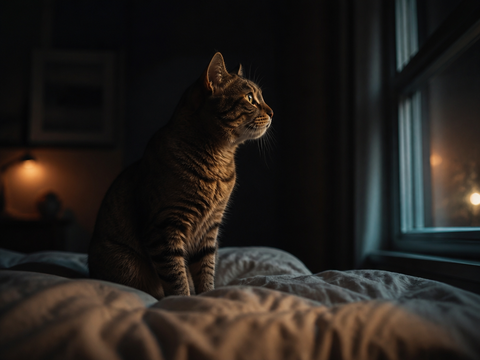
There is a comforting idea floating around the internet, and a smart version of you has probably heard it: that sleeping with your pet doesn't just feel good, it measurably improves your sleep. The claim usually arrives with a citation attached — a 2017 Mayo Clinic study, real and peer-reviewed — and it usually arrives mangled. So I spent a month testing the gap between what that research said and what good pet sleep hygiene actually does to a night of sleep, using my own bed, my own dog, my own cat, and a CPAP machine that complicates everything.
The short version: the dog in the bedroom but off the bed was my best sleep of the month; the dog on the bed and the cat anywhere were both worse than sleeping alone — but the size of the penalty surprised me, and so did the part the myth gets right.
The myth, stated fairly
The Mayo Clinic Center for Sleep Medicine published a small study in 2017 that tracked 40 adults and their dogs over seven nights using actigraphy — wrist accelerometers that estimate sleep from movement. The finding that traveled: dog owners maintained good sleep efficiency (around 81%) when the dog was in the bedroom. The finding that got quietly dropped in the retelling: that efficiency held when the dog was in the room but not in the bed. On the bed, efficiency dropped.
The myth, then, isn't a lie. It's a true sentence with the load-bearing clause amputated. "Pets help you sleep" became the headline. "Pets in the room, on the floor, in their own spot, are compatible with good sleep" was the actual result — and that is a meaningfully different claim, especially if you currently have forty pounds of retriever pinning your duvet.
I wanted to know which version held up in one specific bed.
What I measured, and what I couldn't
Thirty nights, split across four conditions, roughly a week each, in winter so the thermostat stayed constant at 18°C. The cast:
- One mixed-breed dog, 24 kg, eight years old, a settled sleeper but a frequent repositioner.
- One cat, six years old, nocturnal by inclination and unbothered by my opinions on the matter.
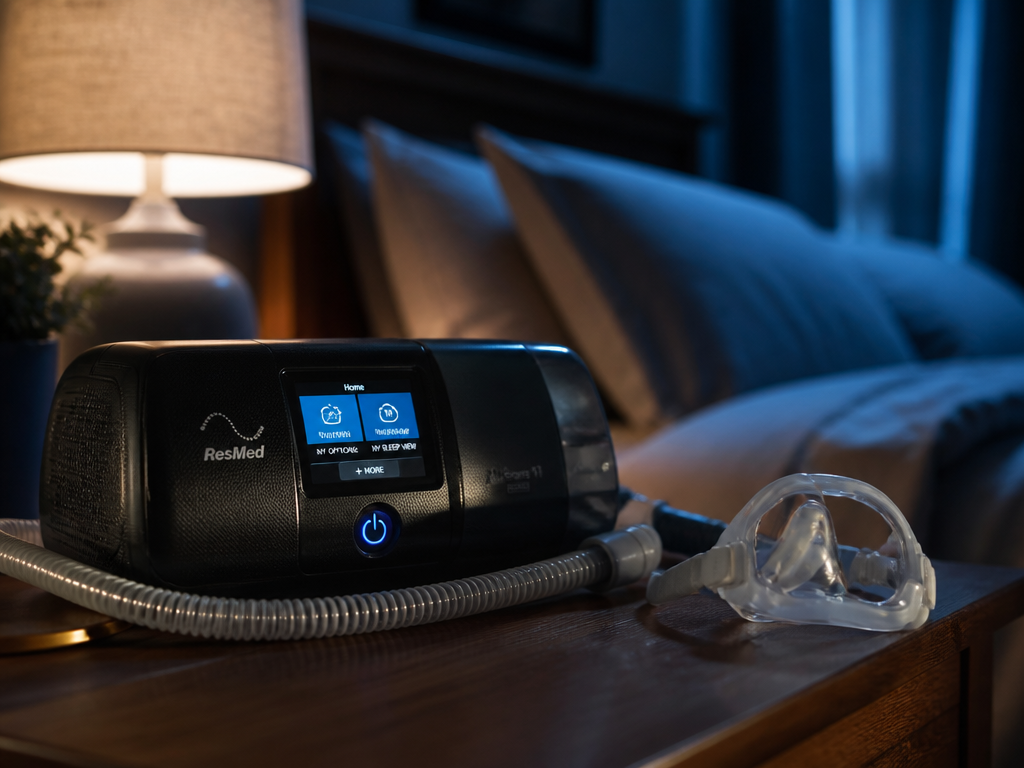
- Me, a CPAP user (moderate sleep apnea, pressure set at 9 cmH₂O), which means a mask, a hose, and a machine that logs its own data every night.
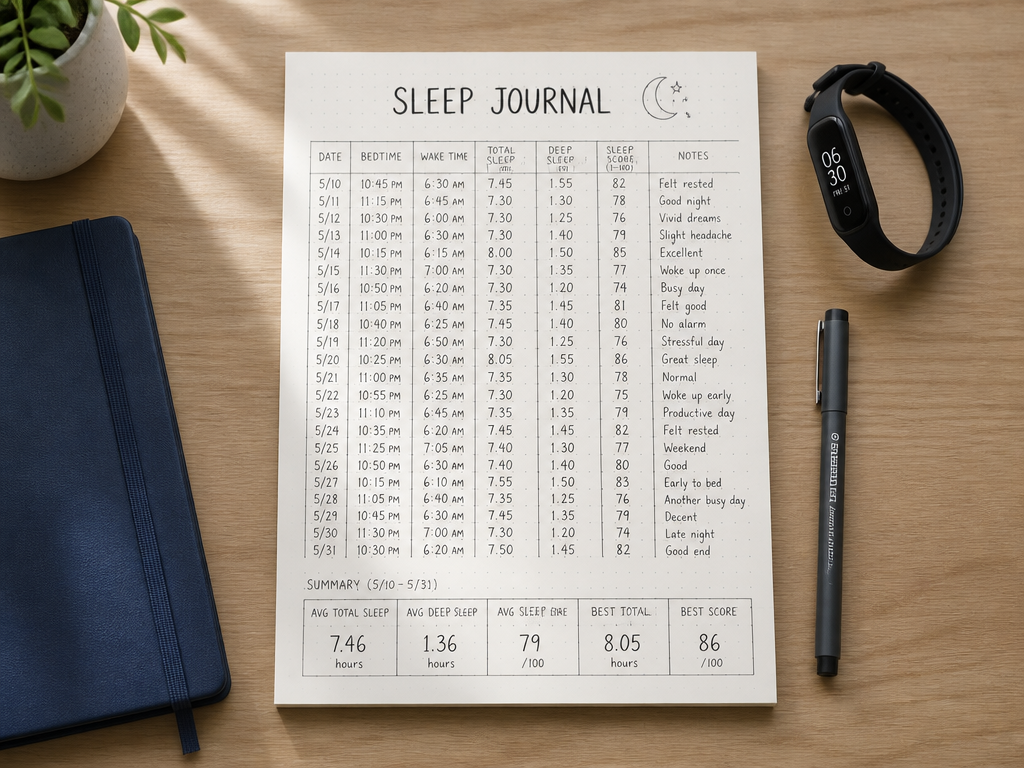
My instruments: a CPAP machine that reports AHI (apnea-hypopnea index) and mask leak rate; a contact-free radar sleep tracker under the mattress for sleep onset latency and wake events; and a paper notebook for the things machines don't catch, like "woke at 3:10, cat on chest."
What this is not: a study. It's an n-of-1 with no control over the weather of my own life — a stressful Tuesday contaminates a night no actigraph can correct for. I ran each condition for about seven nights to blunt that, but a single bad-news email outweighs a dog. Treat the numbers as a careful diary, not a finding. My palate for sleep, so to speak, is one person's.
The four conditions
The conditions were: alone (pets out, door shut); dog in room, on floor bed; dog on the bed; and cat with access (cat could enter; in practice it always did, and the dog stayed on its floor bed during this week as a constant).
Here is the month, averaged.
| Condition | Sleep onset (min) | Wake events/night | CPAP mask leak (L/min) | AHI |
|---|---|---|---|---|
| Alone | 18 | 2.1 | 4 | 3.8 |
| Dog on floor | 14 | 1.9 | 5 | 3.9 |
| Dog on bed | 21 | 4.3 | 11 | 4.6 |
| Cat with access | 26 | 5.7 | 9 | 5.1 |
A few of these numbers need defending, because the table flattens them the way the headline flattened Mayo.
Dog on the floor beat sleeping alone, and I didn't expect that. Onset dropped from 18 minutes to 14, wake events ticked down slightly. This is the part of the myth that survived contact with reality. There is something — and I'll get to the mechanism — about a large animal breathing slowly six feet away that settled me faster than an empty room. Four minutes of onset isn't a miracle. But across a week it was consistent, not noise.

Dog on the bed undid all of it. Wake events more than doubled, from 1.9 to 4.3. The dog isn't restless by dog standards — but a 24 kg animal repositioning even three times a night transmits through a mattress, and twice it leaned against the CPAP hose hard enough to tug the mask. Which brings the leak rate from 5 to 11 L/min, a number that matters more than it looks.
The cat was the worst sleep of the month, and it wasn't close. 5.7 wake events. The cat does not negotiate. Its activity peaks at the hours mine bottoms out, and a cat that decides your sternum is the warmest available surface at 3 a.m. will inform you of this decision with its whole body.
Why the dog and the cat are not the same animal at night
The table says the cat was worse. The mechanism says it almost had to be.
Sleep architecture doesn't line up
Dogs are, like us, largely diurnal — awake in daylight, asleep at night — and they consolidate a good share of sleep overnight even if they nap heavily by day. A dog on the floor is, broadly, asleep when you're asleep. Its movements cluster in the same windows as yours, so a repositioning at 2 a.m. often lands during your own lighter sleep and costs you nothing.
Cats are crepuscular, most active at dawn and dusk, with activity spilling well into the night. A cat is running its own schedule, and that schedule is close to the inverse of yours. This is the single biggest reason the cat week looked the way it did: it wasn't being difficult, it was being a cat, awake on cat business while I was trying to clear my deepest sleep of the night.
The movement is differently sized
A wake event in my data is triggered by motion crossing a threshold. The dog generates fewer, larger movements — a heavy shift, then stillness for an hour. The cat generates many small ones, plus the occasional precise, deliberate walk across a sleeping human. The radar caught the dog's repositions; it caught the cat's arrivals, which is worse, because an arrival ends in a cat parked on you.
Heat, and the thing the myth gets right
Here is the part I want to be honest about, because it's the part marketing copy loves and I almost dismissed. A large warm animal nearby does something to onset latency. My four-minute improvement with the dog on the floor isn't placebo I can rule out — but it tracks with what we know about thermoregulation and sleep onset. We fall asleep as core temperature drops; a stable, low-stimulation source of warmth and slow rhythmic breathing in the room appears to ease the transition for some people. The dog wasn't in the bed, so it wasn't disrupting my thermal envelope or my mattress — it was just present, breathing, warm, six feet off. That's the version of "pets help you sleep" that held up here. Presence, not contact.
The cat, warm as it is, never got to demonstrate this, because the cat doesn't do presence. The cat does contact, on its schedule, and the warmth arrives as a 3 a.m. event rather than an ambient condition.
The CPAP wrinkle, which is its own review
If you don't use a CPAP machine, you can skim this section. If you do, it might be the only section you needed.
Two numbers moved with pets in a way that ought to concern any CPAP user: mask leak and AHI. Leak rate jumped from a clean 4–5 L/min sleeping alone or with the dog on the floor, to 9–11 L/min in the dog-on-bed and cat weeks. Leak is the rate of air escaping the mask seal. Above roughly 24 L/min on my machine the therapy starts genuinely degrading, so I never hit a danger zone — but the cause of the increase is the problem, not the size of it.

The dog caused leak by tugging the hose. The cat caused it twice by sitting on the hose and once, memorably, by batting at the mask itself, which it had apparently decided was a toy. Each disturbance broke the seal, which let pressure drop, which is the likely reason AHI crept from 3.8 alone to 4.6 and 5.1. Those aren't clinically alarming jumps. But they're the wrong direction, and they're entirely caused by an animal interacting with medical equipment in the dark.
There's a second, slower cost I couldn't measure in a month but won't pretend away: dander. A CPAP pulls room air through a filter and into your airway all night. More pet hair in the bedroom means a dirtier filter, faster, and more particulate riding the airstream if you let it lapse. I changed my filter twice as often during the pet weeks as I'd normally need to. That's not a verdict against pets in the room — it's a maintenance line item nobody mentions when they sell you on co-sleeping with the dog.
And one risk I'll name plainly because it has a cost beyond sleep: a chewed hose. A dog with the run of the bed has access to a length of soft tubing that, to a bored animal, is indistinguishable from a toy. I didn't lose a hose this month. People do. They run about $30 to replace and they're not optional.
Who this is for, and who it isn't
Good pet sleep hygiene — pet in the room, off the bed — is for you if: you sleep better with company than alone, your animal is a settled overnight sleeper, and you can give it a comfortable spot of its own within sight. This was, comfortably, my best condition. The bond stays. The duvet stays yours.
The dog on the bed is for you if: you are a genuinely heavy sleeper, you don't use airway equipment, and the emotional value clears the cost of a few extra wake-ups — which for some people it absolutely does, and I'm not here to argue you out of a thing you love. Just don't tell yourself the research says it's helping. The research, read honestly, says the opposite.
The cat with bedroom access is for you if — and I say this as someone fond of the cat — you've decided the relationship is worth the sleep tax and you're not also managing a sleep disorder. If you use a CPAP, the cat and the hose are a standing appointment with a broken seal.
This isn't for you if you have diagnosed sleep apnea and you're chasing every fraction of an AHI point. In that case the equipment wins the argument. Not because pets are bad, but because a mask seal is a binary your dog doesn't understand.
The line you can screenshot
Across thirty nights, the dog in the room but off the bed beat every other arrangement, including sleeping alone — and the cat, beloved and warm, gave me the worst sleep of the month by a wide margin.
I went in expecting the myth to be either true or marketing. It turned out to be neither: a real result wearing the wrong headline. Presence helps. Contact, weight, and a competing schedule cost. The trick isn't choosing between your sleep and your pet. It's putting six feet of floor between them.
Try this, this week
Don't reorganize your whole night on the strength of one stranger's diary. Do one thing: put a real dog bed or cat spot on the floor, in your bedroom, within sight of your pillow — not in the hall, not in the bed — and use it for seven nights. Within sight matters; the presence effect needs line of breathing, not a closed door.
If you track sleep at all, even with a phone under the pillow, note your wake count for those seven nights and compare it to a normal week. If you use a CPAP, glance at your leak rate while you're at it. You'll have your own table soon enough, and your animal's habits aren't mine. Mine settled on the floor by night three and stopped asking for the bed. Yours might tell you something different — but at least you'll be reading your own data instead of someone else's headline.
The dog is asleep on its floor bed as I write this. It seems fine about the arrangement. So am I.