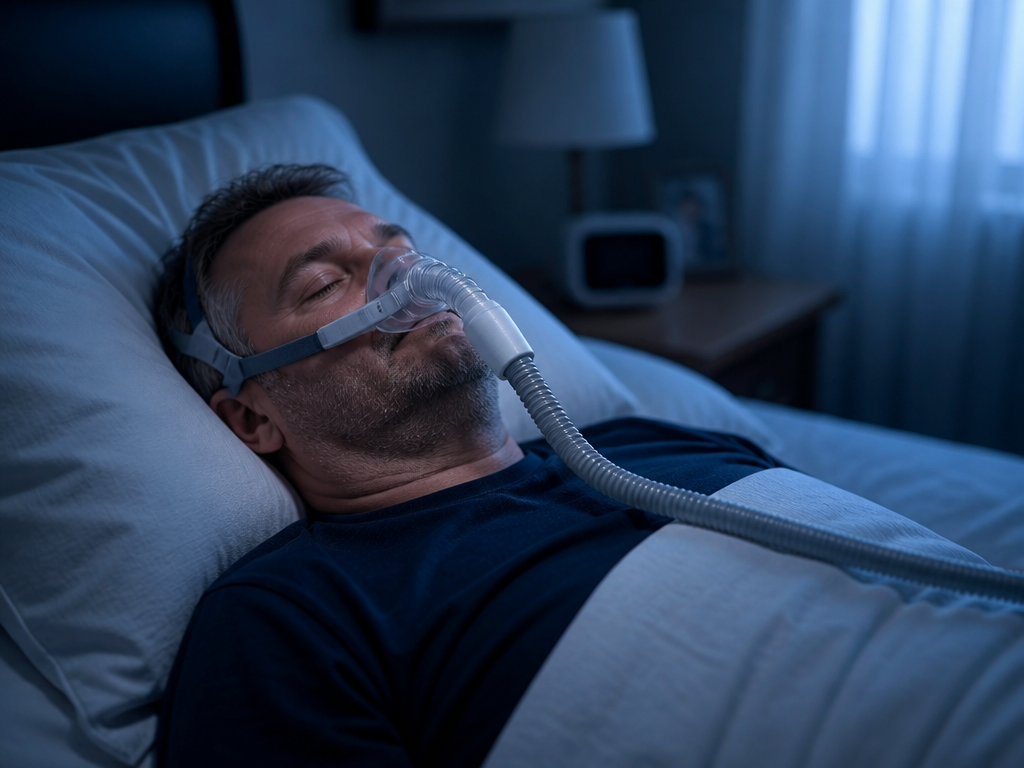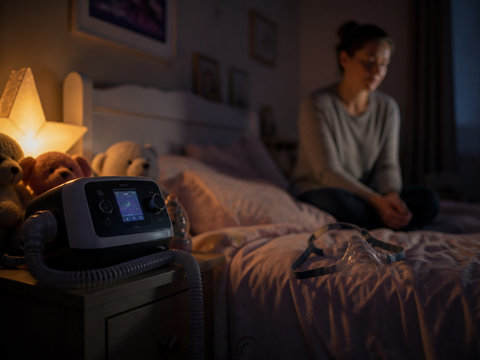
There is a particular silence in a house where a child has just been prescribed CPAP. The machine arrives in a box. It hums. It has a hose that looks medical in a way a child's bedroom is not supposed to look. And the parent stands there holding a mask sized for a face that still loses teeth, wondering how, exactly, this is supposed to happen every single night.
Pediatric sleep apnea is the reason that box is on the nightstand, and it is worth saying plainly up front: for most kids, CPAP is not the first move. Obstructive sleep apnea in children is usually driven by enlarged tonsils and adenoids, and adenotonsillectomy resolves it in a large share of cases. CPAP enters the picture for the subset of children whose apnea persists after surgery, who can't have surgery, or who have underlying conditions — obesity, Down syndrome, craniofacial differences, neuromuscular disease — that make the airway a more complicated problem. If you're here, your child is probably in that subset. That doesn't make the diagnosis worse. It makes the path narrower, and narrower paths are easier to walk once you can see them.
Is CPAP actually necessary for a child with sleep apnea?
Sometimes, yes — and the honest answer is that it depends on what the sleep study found and what's already been tried. CPAP becomes the recommended treatment when obstructive sleep apnea is moderate to severe and surgery either isn't an option or didn't fully fix it. Untreated, the consequences in children are not the same as the daytime drowsiness adults complain about. Pediatric OSA is more often expressed as hyperactivity, attention problems, poor school performance, and, over years, cardiovascular and metabolic strain. So when a pediatric sleep specialist prescribes CPAP, it is usually because the airway is collapsing enough times per hour that the developing brain and body are paying a measurable cost. The machine isn't a precaution. It's a correction.
What the air is actually doing
It helps to know the mechanism in the order it happens. During sleep, the muscles that hold the throat open relax. In a child with OSA, the soft tissue at the back of the throat then narrows or collapses, and airflow stops or drops — an apnea or hypopnea. Oxygen falls. The brain registers the threat and jolts toward wakefulness just enough to reopen the airway, fragmenting sleep without the child remembering any of it. CPAP — continuous positive airway pressure — interrupts that cascade at the first step. It pushes a steady column of pressurized air through the nose (and sometimes mouth), and that air acts as a splint, holding the soft tissue open so the collapse never starts. No collapse, no oxygen drop, no micro-arousal. The sleep architecture is allowed to assemble itself the way it's supposed to.
What most parents do
Most parents, understandably, treat night one as the test. They put the mask on at bedtime, the child cries or claws at it, and the parent either forces the issue or gives up — and both feel like failure. Then comes the bargaining, the after-school exhaustion arguments, the quiet fear that this will be a war every night for years. Compliance gets framed as a battle of wills. The mask becomes the enemy, and the bedroom becomes the battleground.
This is the most common approach and close to the least effective one. Adherence research in pediatric CPAP is sobering: studies repeatedly find that a substantial fraction of prescribed children use the machine far less than recommended, with average nightly use in many cohorts falling below the four-hours-per-night threshold often used to define "adherent." Marcus et al. (2012), in a randomized trial published in Pediatrics, found that even with behavioral support, usage varied enormously between children — and that the families who succeeded were rarely the ones who started by demanding a full night of wear.
What the evidence suggests
The evidence points away from the all-or-nothing first night and toward desensitization — slow, graded exposure that lets the child build tolerance to each component separately. The principle is borrowed from straightforward behavioral psychology: you reduce fear by approaching it in steps small enough that none of them triggers the alarm.
In practice, programs at major pediatric centers break the task apart. The child first handles the mask while awake and calm, no pressure, no hose — just holding it, then resting it against the face for seconds, then minutes, often during a favorite show. The straps come later. The hose and airflow come later still. Only once each piece is unremarkable does anyone attempt a full night. This staged approach has better-documented success than willpower, and it's the reason mask design matters: lighter pediatric interfaces and fit kits exist specifically to lower the sensory cost of that first contact. The data here is more "clinically established practice" than "large randomized trial," and it's fair to hold it at that confidence level — but it is the approach the field has converged on.
Two numbers worth keeping: mask fit is the single most fixable cause of failure, and pressure can be adjusted. If your child fights the machine, the problem is often an interface or a setting, not the child's temperament.
What I actually do
Here is the honest rule of thumb, the one to use tonight: don't aim for a full night. Aim for the next small step the child can tolerate without panic, and stop there.
That means letting the machine be boring before it is useful. Run it during the day. Let it sit on the floor, on, hissing, while your kid does homework. Let them wear the mask with no air for the length of one song. Reward the step, not the outcome — and treat a thirty-second wear as a win, because behaviorally, it is.
| Phase | Goal | Don't yet |
|---|---|---|
| 1 | Touch and hold the mask, awake | Use straps |
| 2 | Mask on face, no airflow, minutes | Connect hose |
| 3 | Airflow on, awake, short bursts | Expect sleep |
| 4 | Wear during sleep onset | Demand all night |
Loop in the sleep clinic the moment a step stalls for more than a week — they can re-fit the mask, ramp the pressure, or add a humidifier for nasal dryness, and any of those can be the thing that unsticks it.
The machine is loud the first week and silent by the second. The fight is real, but it is shorter than the fear of it.
You are not forcing a mask on a child. You are giving a tired brain its nights back.