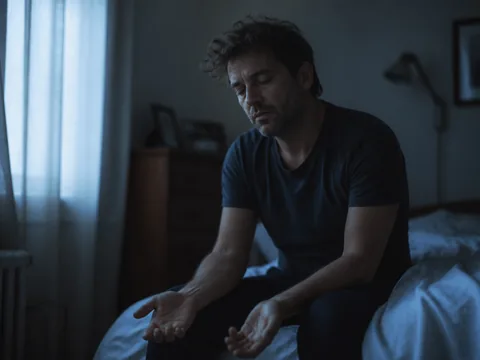
Nine volunteers at a Harvard-affiliated sleep lab did simple arithmetic at intervals after waking. In the first few minutes, their performance was worse than it was after more than a day without sleep. That result, from Wertz et al. (2006), JAMA, is the cleanest number we have on sleep inertia and morning grogginess. It also undercuts a story many tired people tell themselves. If you slept eight hours and still feel wrecked at 6:45, the eight hours may not be what went wrong. You may simply be meeting your brain before it has finished starting up.
Nine people is a small study. The direction of the finding has held up, though. Tassi and Muzet (2000), Sleep Medicine Reviews, surveyed the literature and found that post-waking impairment usually clears within 15 to 30 minutes and occasionally lasts much longer. The disputed part is what makes it worse, and whether morning light, the remedy most often offered for it, really fixes it.
How light became the answer
The belief that light cures bad mornings has a traceable origin, and that origin is narrower than the belief.
Until 1980 the standard view was that human melatonin, unlike a hamster's, was largely insensitive to light. Then Lewy et al. (1980), Science, showed that bright light, around 2,500 lux, which is far brighter than a living room, suppressed nighttime melatonin in human volunteers. Ordinary indoor light had not done so in earlier experiments. That one finding, that humans respond but need a lot of light, gave rise to a whole clinical field.
That field was seasonal depression. Through the 1980s, researchers including Norman Rosenthal and Michael Terman treated winter depression with light boxes. Terman's group and later Avery et al. (2001), Biological Psychiatry, tested dawn simulation, a bedside light that brightens slowly before the alarm. The results for seasonal mood were real but modest. Note the population, though: patients with a diagnosable seasonal disorder, not healthy people who dislike Tuesdays.
The last piece arrived in 2002, when Berson, Dunn, and Takao (Science) described a third kind of light-sensing cell in the retina. These intrinsically photosensitive retinal ganglion cells contain melanopsin, respond most strongly to short-wavelength blue light, and report to the brain's master clock instead of its visual system. Now there was an anatomy to go with the story, and from there the story spread to product pages.
The evidence for dawn light as a fix for ordinary grogginess is thinner. The study usually cited is Van de Werken et al. (2010), Journal of Sleep Research, a small Dutch study in which artificial dawn reduced subjective sleep inertia and nudged up skin temperature. It did not clearly change the cortisol response. Gabel et al. (2013), Chronobiology International, found some cognitive and well-being benefits from dawn light in sleep-restricted subjects. Both are small, and both are worth taking seriously. Neither is the large consensus that the marketing implies.
What happens in the first hour, in order
The biology is better established than the products, so it helps to go through it in sequence.
First, melatonin is supposed to fall before you wake. On a well-timed night its levels drop in the last hours of sleep. If your alarm goes off while melatonin is still high, you are waking during your biological night.
Second, light reaches the melanopsin cells, which signal the suprachiasmatic nucleus (SCN), the clock in the hypothalamus. Morning light tells the SCN that the day has started, which shifts the next night's timing earlier.
Third, cortisol rises sharply. Pruessner et al. (1997), Life Sciences, measured an increase of roughly 50 to 75 percent in the 30 to 45 minutes after waking, now called the cortisol awakening response. Whether light amplifies it in healthy adults is still debated.

Fourth, core body temperature climbs from its overnight low, which normally falls a couple of hours before habitual wake time. Alertness tends to rise with it.
Fifth, and least settled, is leftover adenosine. Sleep clears the sleep-pressure molecule that caffeine blocks, but whether some remaining adenosine contributes to post-waking fog is a reasonable hypothesis that has not been confirmed.1
Why do I wake up groggy after eight hours of sleep?
The most common reason is timing, not quantity. If your alarm goes off during your biological night, while melatonin is still elevated and body temperature is near its low, you will feel the worst of sleep inertia no matter how long you slept. Waking from deep slow-wave sleep makes it worse, which is part of why it varies so much from one morning to the next.
The best demonstration of the timing problem is Wright et al. (2013), Current Biology. Eight people spent a week camping in Colorado with no artificial light. Their melatonin rhythms shifted about two hours earlier, and their natural wake times began to line up with the end of melatonin secretion. Back home, under electric light, the same people woke while their bodies still signaled night.
This is why grogginess often gets worse in October. Sunrise moves later, while work start times stay fixed. Your clock drifts later and your alarm stays put. Till Roenneberg calls the resulting gap "social jet lag," and the term is more accurate than most coinages.
Where coffee fits
Caffeine does not cure sleep inertia, but it covers for it. The well-established part is that caffeine blocks adenosine A1 and A2A receptors and improves alertness and reaction time. The plausible-but-thin part is that caffeine specifically shortens post-waking impairment. Hilditch and McHill (2019), Nature and Science of Sleep, list it as a candidate countermeasure, but most of the supporting evidence comes from naps and night-shift settings, not from ordinary mornings. Caffeine takes roughly 30 to 45 minutes to reach peak blood levels, so by the time your first cup is fully working, much of the inertia would have cleared anyway.
The practical part
| What you try | What it plausibly does | How solid |
|---|---|---|
| Bright light within an hour of waking | Shifts your clock earlier over days | Well-established |
| Dawn-simulating alarm | Eases the waking itself, subjectively | Plausible but thin |
| A consistent wake time, weekends included | Keeps the alarm inside your biological day | Well-established |
| Coffee on waking | Masks the fog; may not speed recovery | Partly established |
| Avoiding bright screens late | Protects the evening melatonin rise | Established in labs; modest effect at home |
An honest rule of thumb: for the next week, get outside or next to a bright window within 30 minutes of waking, keep your wake time within an hour every day, and give yourself 20 minutes before you judge how you slept.
Notice what this asks of you. It doesn't require a device. It requires light, consistency, and patience with the first 20 minutes, and the evidence for those three is stronger than the evidence for any gadget.
My own version is unglamorous. Since early October I have drunk my first coffee on the back step, facing east, at the same time every day, including Sundays. I set no alarm light, and I no longer judge the night by how I feel at minute five, because I now know minute five is when everyone feels worst.
-
Adenosine is hard to measure in a living human brain. Most of what we know comes from animal work and from indirect markers, which is one reason the adenosine account of sleep inertia remains a hypothesis. ↩


