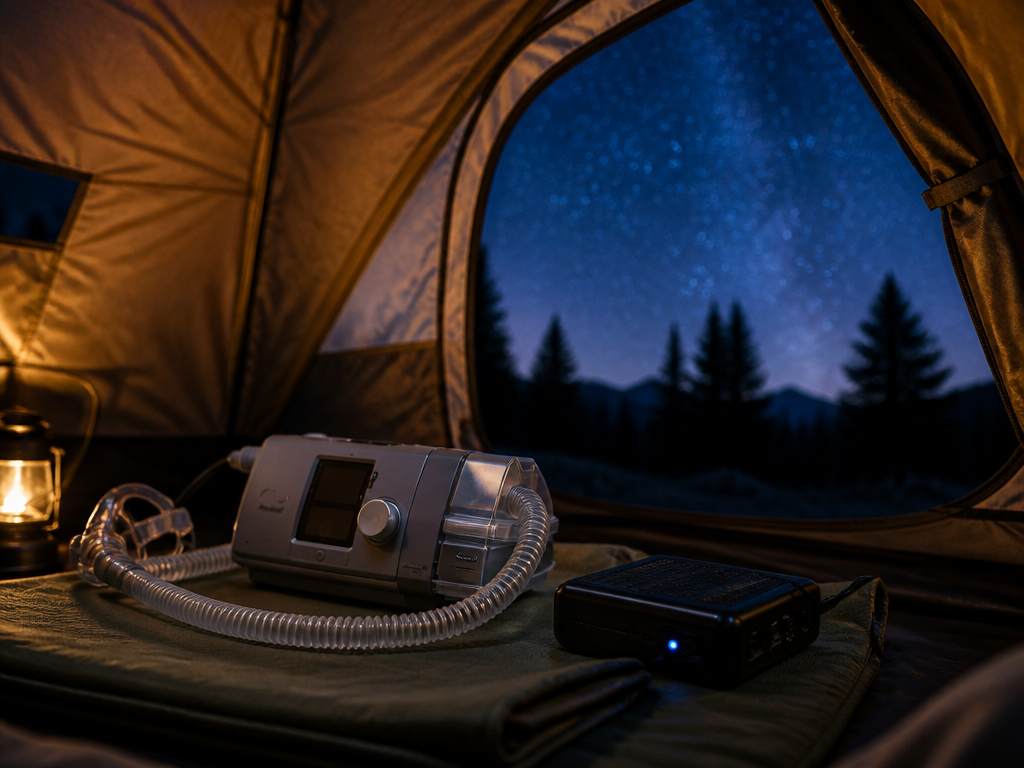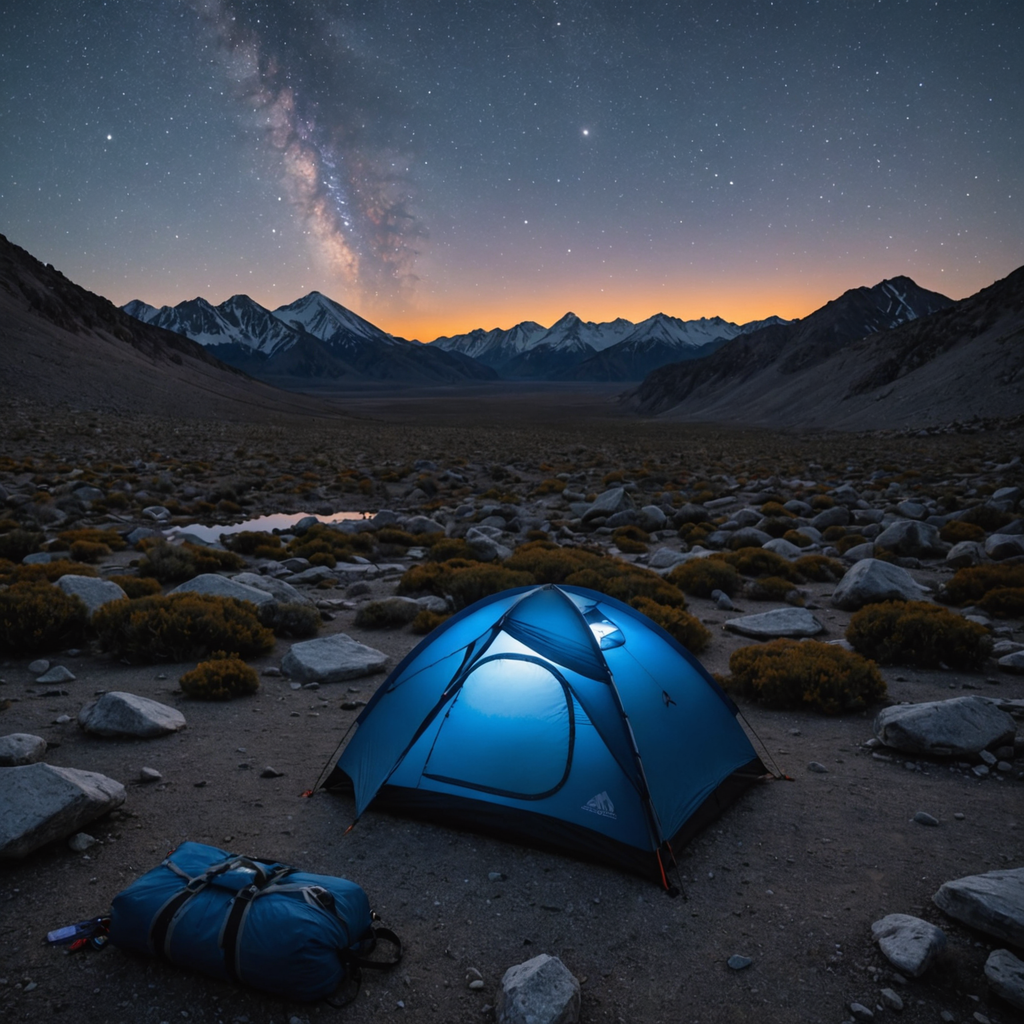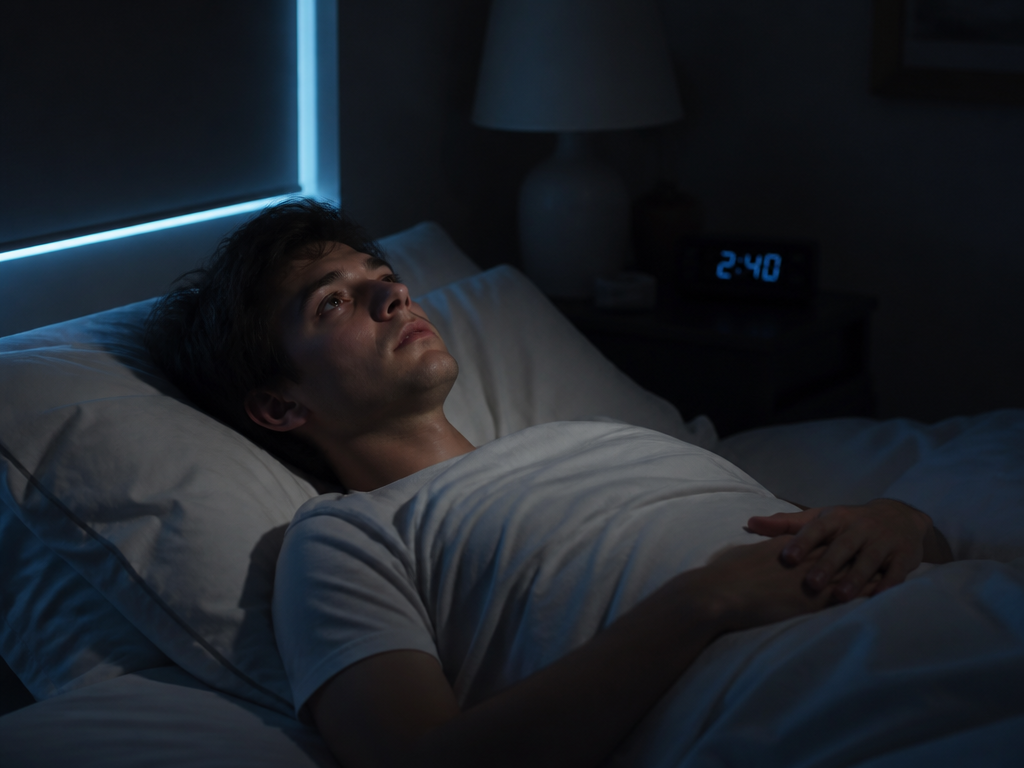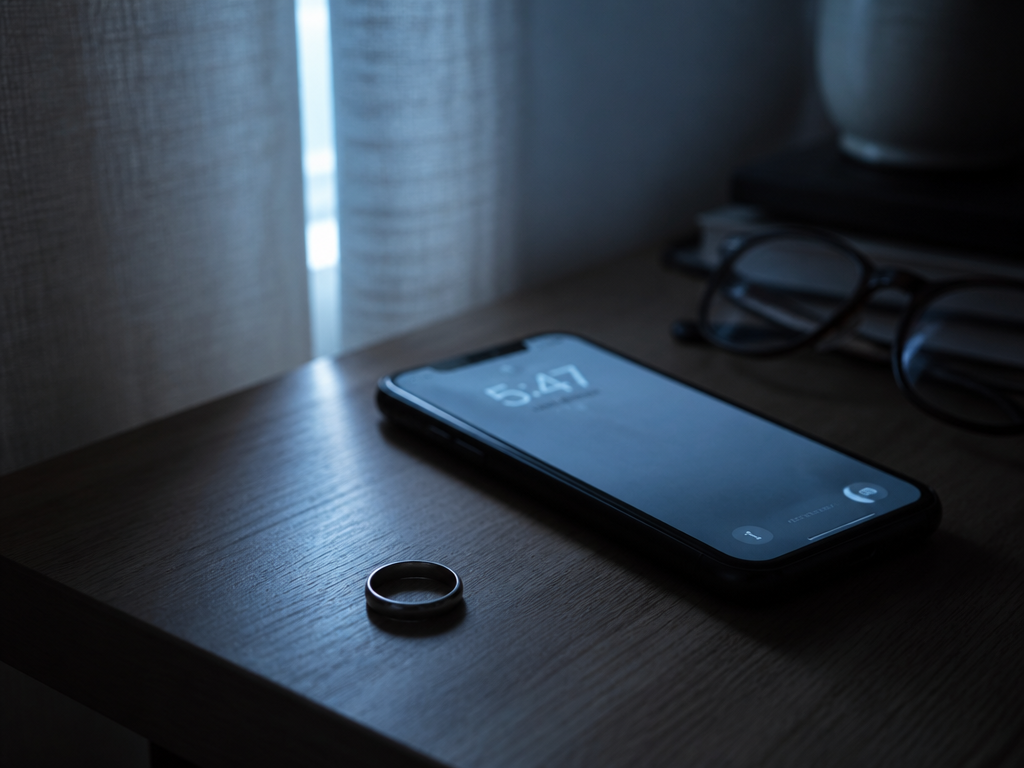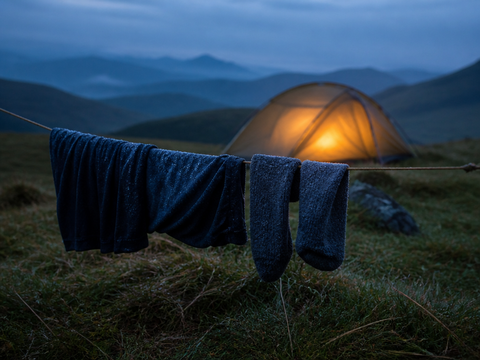
Two nights, same patch of grass in Eryri, last July. Same tent, same bag, same tired body. On the first I lay awake for the better part of an hour doing the arithmetic you do at one in the morning. On the second I was gone in about twenty minutes. The weather barely moved between them. What moved was a flask of coffee at 4:40 in the afternoon, and the fact that on night one I slept in the base layer I'd walked eleven miles in. Two variables, both dull, both belonging to a conversation nobody has: outdoor clothing and caffeine, in the same sentence, on the same night.
I had one measurement, which is one more than most people take camping — a nine-pound thermo-hygrometer clipped inside the mouth of the sleeping bag. An hour after I got in on night one: 78% relative humidity. Same clock time on night two, dry base layer, dry socks: 58%. That's the entire dataset. Sample size one, confounds somewhere north of nine, and I'm telling you about it anyway, because that twenty-point gap points at a mechanism far better established than my ability to sleep on a hillside.
What your body has to do before it will let you sleep
Core temperature falls before sleep onset — roughly 0.3 to 0.5 °C across the hour or two around lights-out. It does not fall because you generate less heat. It falls because you get rid of heat, and you get rid of it almost entirely through your hands, feet, and face, where specialized vessels called arteriovenous anastomoses open up and shunt warm blood to the surface to be thrown away.
The order it actually happens in
In dim light, melatonin secretion begins to rise about two hours before your habitual bedtime. Melatonin is not a sedative so much as a signal, and one of the things it signals is vasodilation: the vessels in your fingers and toes open, and skin temperature at the extremities climbs by a degree or two. Heat pours out at the periphery. Core temperature drops. The gap between distal skin temperature and trunk temperature — sleep researchers call it the distal-proximal gradient — narrows and then inverts. Sleep follows.
The well-known citation here is Kräuchi, Cajochen, Werth and Wirz-Justice (1999), a short paper in Nature on a small group of healthy young men, which found that the degree of hand and foot vasodilation predicted how quickly people fell asleep better than core temperature or melatonin did. The finding has held up. But note what it was: a climate chamber, in Basel, in a bed. Nobody ran it in a nylon bag in Snowdonia in the rain.
Where outdoor clothing stops being about warmth
A sleeping bag is not a blanket; it's a sealed microclimate, and you are the heat source inside it. Insulation traps still air, and your body then has to push its half degree of surplus heat through that trapped air. If the fabric against your skin is carrying water from an eleven-mile walk, two things go wrong at once. Wet fabric conducts heat roughly twenty-five times better than the still air it displaced, so you lose heat too fast and too early. And the water keeps evaporating for hours, which means the cooling continues into the small hours, when your core temperature is already at its nadir and you have the least margin to spare.
Okamoto-Mizuno and Mizuno's 2012 review in the Journal of Physiological Anthropology is the standard summary of what the thermal environment does to sleep architecture. The consistent finding across the studies it collects: humidity in the bed microclimate matters at least as much as temperature. Humid warmth increases wakefulness and cuts into slow-wave and REM sleep. The damp shirt is a worse problem than the thin bag.
What should you actually sleep in when you're camping?
A thin, completely dry next-to-skin layer that you have not worn during the day, plus a dedicated pair of dry socks. That's it. Warmth is the sleeping bag's job; the layer's only job is to stay dry and keep moving vapour off your skin. If you change one thing about your camping kit this summer, make it the socks — warm feet are the single best-documented predictor of fast sleep onset in the entire literature, and dry wool or synthetic socks are the cheapest way to buy vasodilation.
Skip cotton entirely. Skip anything bulky enough to compress your bag's loft where you lie on it. And treat "sleep naked, you'll be warmer" as what it is: folk wisdom, repeated confidently, with no controlled data behind it and a moisture problem it never addresses.
The 4:40 coffee, and what it was doing at midnight
Adenosine accumulates in the brain across your waking hours as a byproduct of cellular energy use. It binds A1 and A2A receptors and damps down arousal — it is, functionally, the pressure to sleep. Caffeine looks enough like adenosine to occupy those receptors without activating them. You don't gain energy. You lose the message telling you to stop.
Caffeine's half-life in a healthy adult averages around five hours, with a real range of roughly 1.5 to 9.5 depending on CYP1A2 activity, smoking (which roughly halves it), and hormonal factors. My flask was about 190 mg. At 9:40 p.m., when I got into the bag, I still had around 95 mg on board — a strong espresso's worth, at lights-out. At 2:40 a.m., about 48 mg.
The most-cited work here is Drake et al. (2013) in the Journal of Clinical Sleep Medicine: 12 healthy sleepers given 400 mg of caffeine at 0, 3, and 6 hours before bed. All three timings measurably disrupted sleep. The 6-hour dose still cut objectively recorded sleep time by more than an hour — and the participants' own subjective ratings didn't register it. The disturbing part isn't the effect size. It's that people couldn't feel it happening.
There's a thermoregulatory angle too, and I want to be careful about how firmly I state it. Caffeine raises resting metabolic rate — Acheson et al. (1980), American Journal of Clinical Nutrition, found roughly a 3 to 4% lift from about 100 mg, lasting a couple of hours — and it acts as a mild peripheral vasoconstrictor. That is precisely the wrong direction if your body is trying to open its hands and feet to dump half a degree. But the chain from "caffeine narrows cutaneous vessels" to "you take longer to fall asleep in a tent" is inference, not demonstration. Plausible, mechanistically tidy, and thinner than the confidence with which it usually gets stated.
One more thing worth knowing before you fill a flask on a ridge: Wright et al. (2013), Current Biology, took eight people camping in Colorado for a week and found their melatonin onset shifted about two hours earlier. Camping does something genuinely useful to your circadian clock. An afternoon coffee is you spending it.
Where Patagonia is useful, and where the marketing runs out
Patagonia publishes more material detail than most of its competitors, which is the main reason it's worth reasoning about here. Recycled-polyester Capilene next to the skin. A merino-and-recycled-polyester blend in Capilene Air. Grid-knit fleece in the R1. Sixty grams of PrimaLoft Gold Eco in the Nano Puff; 800-fill recycled down in the Down Sweater; three-layer recycled nylon in the Torrentshell.
Translate that into night performance. Polyester's moisture regain is under 1% — it barely holds water, it moves it, and it dries fast, which is what you want in a bag where evaporative cooling is the enemy. Wool can hold something like 30% of its weight in water vapour before it feels wet, which means it buffers a humidity spike rather than passing it to your skin. Those are two different solutions to the same problem, and which one suits you depends on whether you sweat hard or run cold. On insulation, a damp Welsh July argues for synthetic: 60-gram PrimaLoft keeps most of its loft when it's clammy, and 800-fill down does not. Down wins the pack-weight argument and loses the 6 a.m. condensation argument.
Here's the honest limit. Every one of those numbers comes from a sweating guarded hot plate — the ISO 11092 test — not from a sleeping human. No brand in this category, Patagonia included, tests garments against sleep-onset latency, because no standard exists and no marketing department has ever needed one. What you are buying is a moisture-transport specification with a plausible relationship to your night, and you should hold it that loosely.
The sustainability part, without the sermon
The facts are the facts: in 2022 the Chouinard family transferred ownership to the Patagonia Purpose Trust and the Holdfast Collective, routing profits to environmental work. The company has given 1% of sales since 1985, sews a large share of the line in Fair Trade Certified factories, and says it has removed intentionally added PFAS from its water-repellent finishes — a company claim, unverifiable by you or me.
The more interesting signal is a study. In 2016, Patagonia funded work by Hartline and colleagues at UC Santa Barbara, published in Environmental Science & Technology, on microfiber shedding from synthetic fleece in domestic washing machines. It found that aged jackets shed considerably more than new ones. A fleece is a microplastic emitter, and the company selling it paid for the paper that says so. That tells you more than any recycled-content percentage on a hangtag.
For a price-sensitive buyer, the unsentimental version is this: the footprint of a fleece is dominated by how many winters you wear it, not what it's spun from. Worn Wear resale, free repairs, and the Ironclad Guarantee move that number further than fabric choice does. It's Patagonia's own argument — the 2011 "Don't Buy This Jacket" ad was the company telling you the greenest garment is the one already in your cupboard.
An honest rule of thumb, and a buying order
Buy from the skin outward. That's where the sleep physics happens, and conveniently it's also where the prices are lowest.
| Layer | Its job at night | What to look for | Patagonia example |
|---|---|---|---|
| Sleep socks | Vasodilation at the feet | Dry, thin, never walked in | Lightweight merino crew |
| Next-to-skin | Move vapour, dry fast | Polyester or wool blend | Capilene Cool / Capilene Air |
| Fleece | Trap air, stay breathable | Grid knit, not solid pile | R1 |
| Insulation | Loft when damp | Synthetic fill for UK summer | Nano Puff |
| Shell | Rain, wind, nothing else | 3-layer, taped | Torrentshell 3L |
Tonight's rule: on a camping trip, stop caffeine eight hours before you intend to be asleep — not six, because camping pulls your bedtime earlier than home does. Carry one base layer and one pair of socks you never walk in, and change into them before you cook dinner rather than at bedtime, so your skin is genuinely dry by the time you're in the bag.
On the money: Patagonia's Past Season and Web Specials pages tend to run around 30–40% off and Worn Wear used gear goes deeper, but the brand doesn't discount on demand. So buy the cheap sleep-relevant items at full price now and wait out the expensive shell.
Back on the grass
I went back in August, changed one variable at a time like a person who should know better, and got a muddle: no afternoon coffee, damp shirt, asleep in half an hour. Coffee at two, dry shirt, awake until midnight. Which is roughly what an n of one gets you.
So I still don't know which of them did the work on that first night, and as far as I can tell, neither does anyone else. Nobody has randomized campers to fabric conditions with a sleep monitor on their wrist, and the vasodilation findings that make the whole argument hang together were measured in a lab bed, not in a bag on a slope at 8 °C. Here's the question I'd actually like answered: is the half degree your body needs to shed at bedtime harder to lose through a damp merino T-shirt than a dry synthetic one — and if it is, does that make the cheapest thing in the catalogue the only piece that was ever going to change your night?