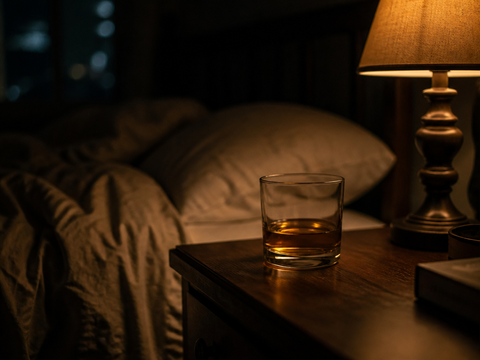
A drink before bed helps you sleep. Most people believe some version of this, and they are not crazy to. The glass of wine, the holiday whiskey, the beer that makes your eyelids heavy on the couch — it feels like a sedative because it is one. But if you have sleep apnea, or suspect you might, the nightcap is doing something more complicated to your airway than it is doing to your sense of drowsiness, and the two effects pull in opposite directions.
Here is the honest center of the problem. Alcohol genuinely makes you fall asleep faster. It also makes the sleep that follows worse, and it does specific, measurable damage to breathing in people prone to obstructed airways. The advice "a drink helps me sleep" is correct about the first ten minutes and wrong about the next six hours.
Does alcohol make sleep apnea worse?
Yes — alcohol consistently worsens obstructive sleep apnea, and the effect shows up even in people who don't have a diagnosed disorder. It does this mainly by relaxing the muscles that hold your upper airway open during sleep, so the airway is more likely to narrow or collapse, more often, for longer. The drowsiness you feel is real. The protection you imagine it offers your sleep is not.
That much is well-established. The size of the effect, and how much it depends on dose and timing, is where the data gets thinner than the confidence with which it's usually repeated.
Why the drink that relaxes you also relaxes your throat
Walk through what actually happens, in order.
You drink. Alcohol is a small molecule, absorbed quickly across the stomach and small intestine, and within roughly 30 to 60 minutes it's in your bloodstream and crossing into your brain. There it acts on GABA-A receptors, the brain's main inhibitory system. Enhancing GABA signaling is what benzodiazepines and many sleeping pills do too. The result is sedation: your cortex quiets, sleep onset comes faster, and the first sleep cycle is often heavier with slow-wave sleep than usual.
So far, this is the part the nightcap myth gets right.
But GABA-mediated relaxation isn't limited to the brain regions that produce drowsiness. The same depressant effect reaches the motor neurons controlling the upper airway dilator muscles — chief among them the genioglossus, the muscle of the tongue that, during normal sleep, fires rhythmically to keep the back of your throat open. Under alcohol, that muscle's tone drops further than it already does in sleep. The soft tissue of the pharynx loses some of the scaffolding holding it open.
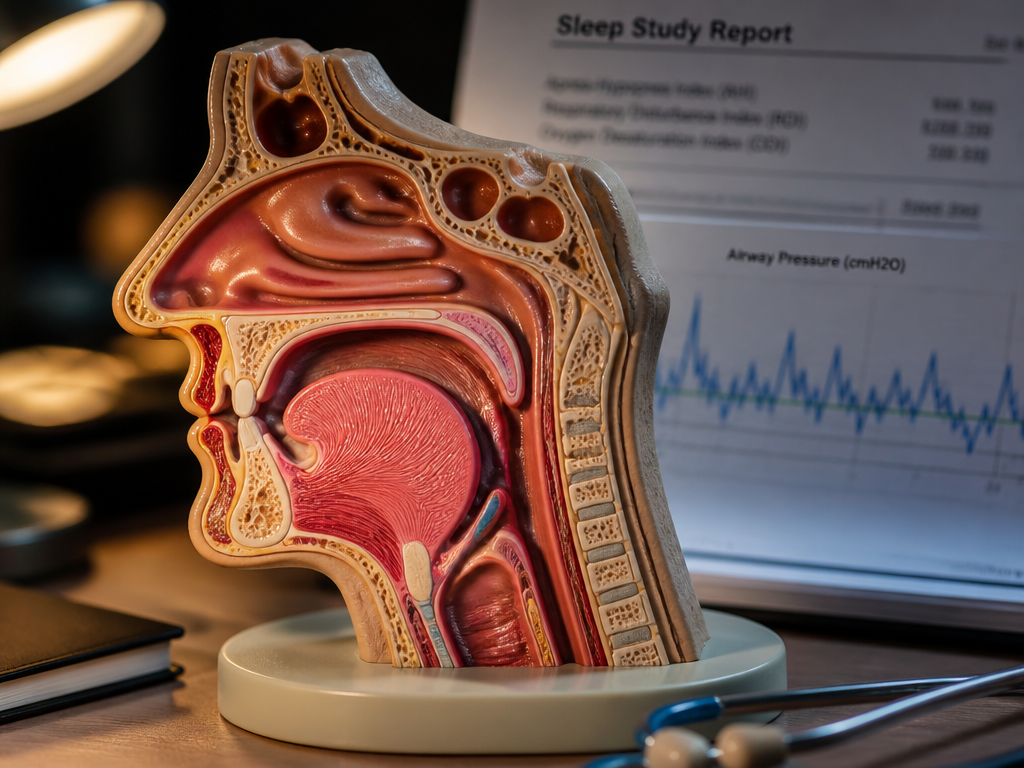
Now add the physics. The upper airway is a collapsible tube. When the muscles supporting it relax and you breathe in, the negative pressure can pull the walls inward. In someone with a naturally narrow or crowded airway — extra soft tissue, a recessed jaw, weight around the neck — that's the setup for obstruction. The airway narrows (a hypopnea) or closes entirely (an apnea). Oxygen drops. The brain, sensing it, triggers a brief arousal to reopen the airway, often with a gasp or snort the sleeper never remembers.
Then the second half of the night arrives, and the sedation reverses. As blood alcohol falls, the brain rebounds toward arousal. Sleep fragments. REM, suppressed early, comes back in a rush. This is why a few drinks can put you to sleep fast and still leave you awake at 3 a.m. feeling wrung out — and why, for an apnea-prone airway, the back half of the night can be the worst of it.
What the research actually measured
The mechanism above is solidly grounded. The clinical numbers are real but messier than headlines suggest.
The frequently cited early work is Issa and Sullivan (1982), published in the Journal of Neurology, Neurosurgery & Psychiatry, which gave alcohol to snorers and apnea patients and documented more frequent and longer obstructive events on drinking nights. It was a small study by modern standards, and it set the template that later work has mostly reinforced: alcohol increases the apnea-hypopnea index (AHI) — the count of breathing disruptions per hour that defines apnea severity — and lengthens individual events.
A 2018 meta-analysis by Simou, Britton, and Leonardi-Bee in Sleep Medicine pooled studies on alcohol and apnea risk and found that higher alcohol consumption was associated with roughly a 25% increase in the risk of sleep apnea. That's an association across populations, not proof that your specific Friday beer raises your AHI by a fixed amount — but it points the same direction as the lab work.
Where the data thins out: the precise dose-response curve. How much one drink versus three changes your AHI, how much body size and baseline airway anatomy modify it, and whether occasional drinking matters much for someone with mild disease — these are not nailed down with the precision people assume. The relationship is clearly real and clearly dose-related. The exact arithmetic for any one person is not something the literature can hand you.
One more honest caveat. Most controlled studies dose alcohol fairly close to bedtime, because that's the testable scenario. The common claim that alcohol "metabolizes out of your system in a few hours, so an early-evening drink is fine" is plausible but thinner than it sounds — clearance varies, and the airway effects of even modest residual alcohol haven't been mapped in detail.
Numbers worth keeping in your head
A useful anchor: the body clears alcohol at roughly one standard drink per hour, though this varies with sex, weight, and liver function. A standard drink is about 14 grams of pure alcohol — a 12 oz beer, 5 oz of wine, or 1.5 oz of spirits. Three drinks finished at 10 p.m. are, very roughly, still in your system past 1 a.m. — squarely inside your worst, most airway-vulnerable sleep.
| If you have... | What alcohol tends to do |
|---|---|
| No diagnosed apnea, but you snore | Adds airway resistance; can tip snoring toward measurable obstruction on heavy nights |
| Mild-to-moderate sleep apnea | Raises AHI and lengthens events; deepens oxygen dips |
| Apnea treated with CPAP | Doesn't disable the machine, but heavier dosing can outpace standard pressure settings |
An honest rule of thumb
If you have sleep apnea or snore heavily, treat the last drink like a deadline, not a quantity: finish drinking at least three to four hours before you lie down, and keep it to one or two standard drinks on a night you want to sleep well. This won't erase the effect — nothing short of abstaining does — but it lets most of the alcohol clear before you reach the fragile, REM-heavy back half of the night. If you're on CPAP, keep using it; the mask doesn't care that you had a glass of wine, and skipping it on drinking nights is exactly backward.
That's not a prohibition. It's a timing strategy, which is roughly the most the evidence honestly supports.
The myth: a nightcap helps you sleep. The truer version: a nightcap helps you fall asleep and then quietly works against your airway and your sleep for the rest of the night — and the more your breathing already struggles, the more it has to work with.