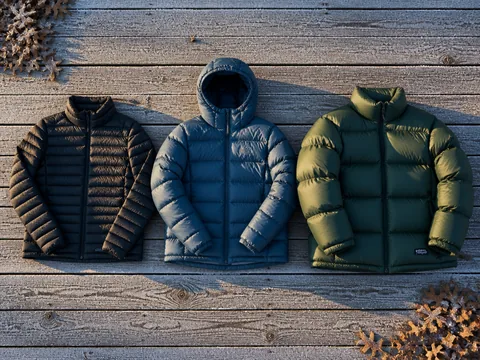
Every autumn someone at a trailhead tells me their new jacket is 900-fill, and they say it the way people quote horsepower. The idea behind it is common enough that whole product lines are priced on it: higher fill power, warmer jacket. I've owned enough down jackets to suspect that's only half true, so this fall I took three from my own closet, wore them on cold mornings and colder nights, and wrote down the numbers.
The short version: fill power tells you how efficient the down is, not how warm the jacket is. The warmest jacket in my test was the cheapest one, with the lowest fill power of the three, because it had the most down in it.
The myth: the bigger number is the warmer jacket
Fill power is a real measurement, and it means something. A one-ounce sample of down goes into a graduated cylinder under a light weighted disc, and the volume it lofts to, in cubic inches, is the number on the tag. An ounce of 850-fill down lofts to 850 cubic inches. An ounce of 650-fill lofts to 650. Ounce for ounce, the higher number traps more air, and trapped still air is what keeps you warm. That part is true.
The myth is the jump from the ounce to the garment. A jacket is not one ounce of down. It's however many grams the brand decided to put in, spread across however many baffles, behind whatever shell fabric. Smart shoppers repeat the fill-power line because it's the only insulation figure printed on most hang tags. The figure that actually decides warmth, fill weight, is often missing from the tag and sometimes missing from the website too.
The evidence: three jackets, two cold tests
All three jackets are hip-length, size medium, with sewn-through baffles. I wore each over the same merino base layer and thin fleece, with the same beanie and gloves.
- An 850-fill ultralight. 70 g of down according to the spec sheet, 250 g total. List price $300; I paid $180 in a March clearance.
- An 800-fill hooded jacket. 110 g of down, 360 g total. List $330; I paid $199 on a late-November sale.
- A 650-fill jacket from a big brand's entry line. 160 g of down, 520 g total. List $150; I paid $90 on an end-of-season markdown.
The porch test. On three still mornings between 26 and 28°F, I went out at first light with a 12 oz pour-over, sat in a camp chair and started a timer. I stopped it when I began to shiver or gave up and went inside, whichever came first. Same coffee, same mug, same chair, and I rotated the order so no jacket always got the warmest morning. I did three rounds per jacket over nine mornings, and the figures below are averages.
The sleep test. One night per jacket in a backyard tent, in a quilt rated to 30°F, with the jacket as my top layer. I kept a headlamp and notebook by my head and logged every time I woke up because I was cold. Wake-ups with another obvious cause (a raccoon, my own bladder) didn't count. Overnight lows were 29, 31 and 28°F.
This is one body, one metabolism and one backyard. The sleep results are a single night each. Read them as a direction, not a verdict.
| Jacket | Fill power | Fill weight | Total loft (cu in) | Porch minutes | Cold wake-ups | Paid |
|---|---|---|---|---|---|---|
| Ultralight | 850 | 70 g | ~2,100 | 38 | 3 | $180 |
| Hooded | 800 | 110 g | ~3,100 | 61 | 1 | $199 |
| Entry line | 650 | 160 g | ~3,670 | 64 | 1 | $90 |
The 850 lost clearly and on every measure. The 800 and the 650 finished within a few minutes of each other on the porch, which is inside the day-to-day noise of sitting outside in a chair. At night the 850 woke me three times, all between 3 and 5 a.m. The other two each woke me once, close to dawn.
The mechanism: loft is a multiplication
The third column explains the table. One ounce is about 28.35 grams, so 70 g of down is roughly 2.5 ounces. At 850 cubic inches per ounce, that's about 2,100 cubic inches of loft in the whole jacket. The hooded jacket's 110 g of 800-fill comes to about 3,100. The entry jacket's 160 g of 650-fill comes to about 3,670, the most of the three by a wide margin.
Spread that loft over roughly the same surface area and you get thickness, and thickness of still air is most of what insulation is. The ultralight was never going to win a sitting-still contest. It carries less than two-thirds the loft of the cheap jacket, and its sewn-through seams pinch down to nothing every few inches. Those seams are cold lines you can feel with your palm on a 27°F morning.

Why the hood closed the gap
The 800 had the smaller loft number but still ran almost even with the 650. The 650 has no hood. Even with a beanie, my neck and the back of my head were losing heat in the hoodless jacket that the 800's hood kept in. I can't separate the hood's effect from the down's with three jackets, but I'd bet on it. If you plan to sit still in a jacket, a hood is worth more than an extra 100 points of fill power.
Why the nights went the way they did
Core body temperature follows a daily rhythm and bottoms out in the small hours, usually a couple of hours before you'd normally wake. That's when a marginal layer stops being enough, and it's exactly when the 850 kept waking me. The coffee was a constant across the porch mornings, and it had nothing to do with the night results. What woke me was cold.
Where the 850 still earns its price
The ultralight did win one test I didn't set out to run. Stuffed into marked dry bags, it compressed to about a liter, the hooded jacket to about two, and the 650 to nearly three. Per gram carried, the 850 is the most efficient jacket I own. If it spends most of its life in a pack and comes out for ten-minute summit stops, that efficiency is the whole point, and it's what the extra money buys.
The honest takeaway for sale shoppers
The people who read this magazine tend to buy down in the sales, and sale pages are where the fill-power myth costs the most. Discounts are advertised as a percentage off, fill power is printed in bold, and fill weight is buried or left out.
This is the arithmetic I'd do before paying. Divide what you'd actually pay by the jacket's total loft in thousands of cubic inches:
- Ultralight: $180 ÷ 2.1 ≈ $86 per 1,000 cu in
- Hooded: $199 ÷ 3.1 ≈ $64 per 1,000 cu in
- Entry line: $90 ÷ 3.67 ≈ $25 per 1,000 cu in
If a spec sheet doesn't list fill weight, ask the brand. Several will tell you. If they won't, total jacket weight is a weak stand-in, because shell fabric, zips and the hood all count toward it.
If you only remember one line: multiply fill power by fill weight, and don't trust either number without the other.
On timing: the deepest markdowns I've paid have landed on last season's colorways in late winter and early spring, when the stock is thinnest in the common sizes. Mediums and larges go first. If you wear an odd size, you're the person those clearance racks are for.
Who this is for, and who it isn't
This is for anyone who stands or sits still in the cold: dawn coffee on the porch, kids' soccer sidelines, the campsite after dinner, or sleeping in the jacket to stretch a quilt's rating. For those uses, a heavier fill of mid-range down with a hood is warmer and cheaper than a premium ultralight. The 650 was the best value in this test, and the 800 hoodie was the best jacket.
This isn't for people who carry the jacket more than they wear it. That means climbers, thru-hikers and anyone counting grams, and for them the 850's weight-to-warmth ratio is a real advantage. It also isn't for anyone in a wet climate. Down loses loft when it's soaked, and nothing here tells you how any of these three handle rain.
What this didn't answer
I didn't test wet performance, including the water-resistant treated down several brands now sell. I didn't test durability: whether 650-fill down keeps its loft after five winters of being stuffed into a sack as well as 850 does. That's the real long-term argument for premium fill, and I can't settle it with one season. And I tested one body. People who run cold, or who sleep colder than I do, may see bigger gaps between the jackets.
If you want to go further, start with spec sheets that list fill weight in grams and favor the brands that publish it. For real warmth comparisons, look for heated-manikin testing under ASTM F1291, the standard that measures clothing insulation in clo. Few brands publish those results, but the ones that do have given you a better number than fill power. And for whether the fill-power figure on the tag is honest, look up independent down-testing labs and the verification behind certifications like the Responsible Down Standard. A tag that says 850 is only a claim until someone has put the down in a cylinder.


